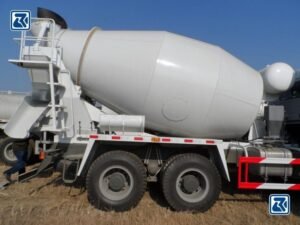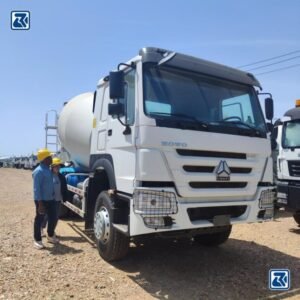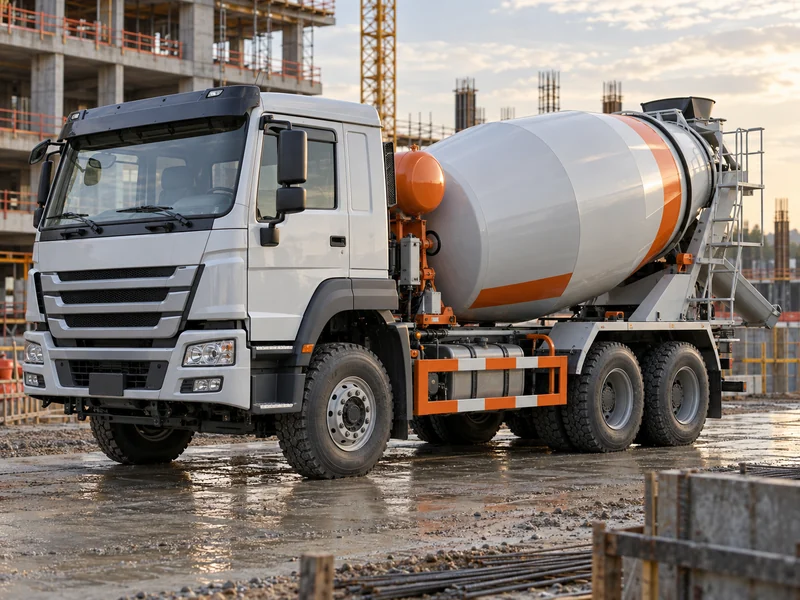
HOWO concrete mixer trucks in the spec sheets reviewed here run roughly 9.0 to 10.4 meters long, hold a nearly fixed width close to 2.49–2.5 meters, and stand about 3.6 to 4 meters tall. Drive configuration and drum size set the exact figures. A broader industry reference for concrete mixer trucks in general quotes a wider envelope, about 7 to 14 meters long, but that is a category range, not a HOWO measurement, so this article keeps the two apart. Published sheets for common 6×4 and 8×4 builds sit inside the HOWO envelope yet rarely match each other to the millimeter, because chassis length, wheelbase, and drum geometry change from build to build. Width barely moves across the range, so length, height, and axle layout are the figures that actually drive purchasing and site-access decisions. This article breaks those numbers down by configuration and by drum capacity, and flags which ones are stable and which shift with the specific build.
Overall dimensions of HOWO concrete mixer trucks
Across HOWO mixer trucks, the three overall figures behave very differently. Width holds steady, height climbs with drum size, and length swings the most from one configuration to the next. Manufacturer spec sheets put width consistently near 2,490–2,500 mm and height between about 3,600 and 3,980 mm. Length is the moving figure: it ranges from roughly 9,000 mm on a compact 6×4 to just over 10,000 mm on a heavier build. A widely circulated dimensions reference for concrete mixer trucks in general lists a broader typical envelope: 7–14 m length, 2,400–2,600 mm width, and 3,700–3,800 mm height. That envelope brackets the HOWO figures, but read it as a category range, not as any single HOWO model’s numbers.
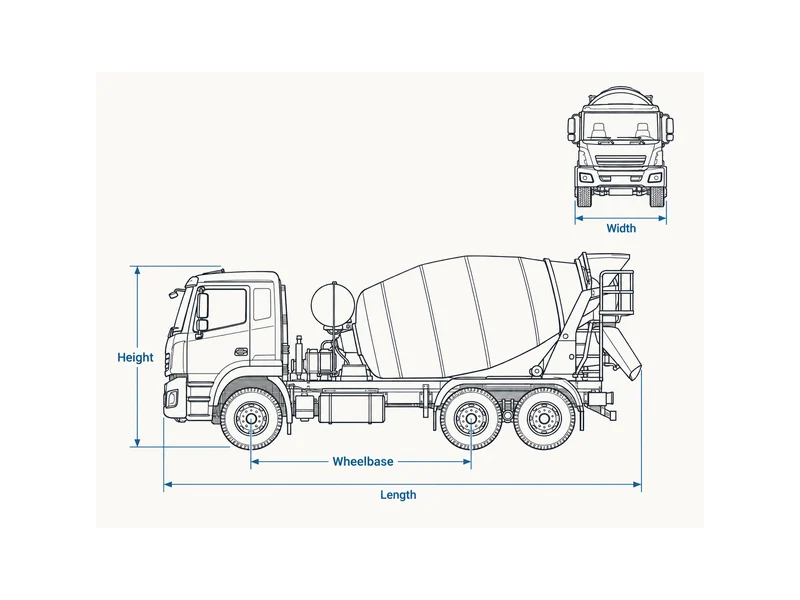
Two published 6×4 10 m³ builds show why no single figure is “the” dimension. One 6×4 mixer is listed at 9,000 × 2,490 × 3,600 mm. A higher-power build at a stricter emission standard is listed at about 10,380 × 2,496 × 3,980 mm, and a third 10 m³ unit sits between them near 9,025 × 2,496 × 3,950 mm. What drives those gaps is the chassis and drum specification behind the same nominal capacity. So the verification action is simple: read length and height off the exact build sheet for the chassis code and drum you are quoting, not off a category range. Across the sinotruk mixer truck range, that pattern holds regardless of the capacity label.
Dimensions by drive configuration: 4×2, 6×4, 8×4
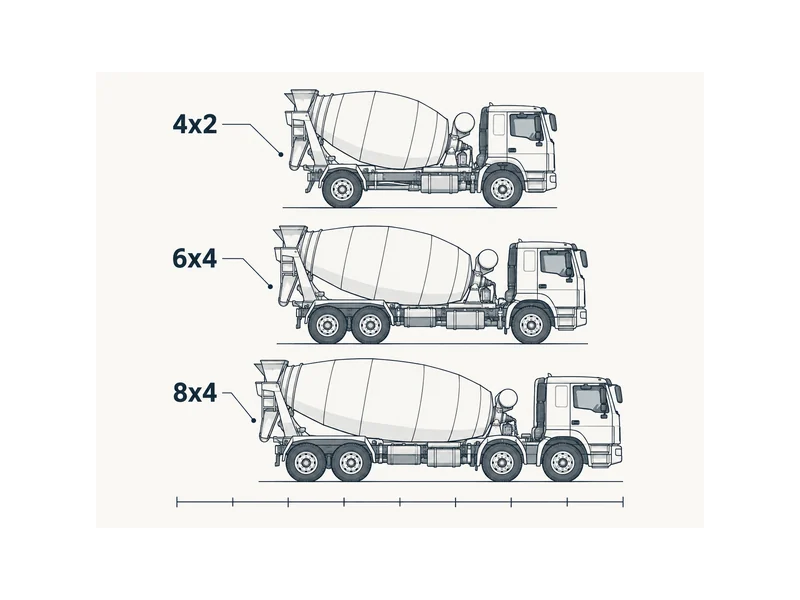
Start with drive configuration: axle count is tied to both the truck’s length and the drum size the chassis is built to support. A HOWO 4×2 concrete mixer truck runs a single rear axle. The sources reviewed this round did not publish a verifiable overall L × W × H or rated drum capacity for it, so confirm its figures against a specific build sheet. A HOWO 6X4 concrete mixer truck adds a second rear axle, and the 6×4 examples captured here were all 10 m³ builds. A HOWO 8X4 concrete mixer truck adds a second front axle for larger drums; the reviewed 8×4 was a 12 m³ build, with 13–14 m³ drums also listed by suppliers. The table below pairs each configuration with the drum capacity and example dimensions seen in these sources, and those figures still move with the specific build.
| Configuration | Drum capacity in sources reviewed | Example overall L × W × H (mm) | Notes |
|---|---|---|---|
| 4×2 | not published in the sources reviewed | not published as a confirmed L × W × H | Confirm capacity and size against the specific 4×2 build sheet |
| 6×4 | 10 m³ in the examples reviewed | ~9,000–10,380 × 2,490–2,500 × 3,600–3,980 | Spread across several published 10 m³ builds; other capacities may exist but were not captured here |
| 8×4 | 12 m³ in the example reviewed (13–14 m³ also offered) | ~10,040 × 2,496 × 3,850 | One published 12 m³ build; suppliers also list 13–14 m³ drums |
Reading down the table, the practical takeaway is that width stays close to constant while length grows with axle count. Because the sources reviewed published no single confirmed L × W × H for the 4×2, treat that row as an open item and confirm it against the specific 4×2 build. When you are still narrowing configuration against capacity, the model-by-model detail in how to choose the right HOWO concrete mixer truck model works through the same trade-off.
Drum capacity versus geometric volume
A mixer drum carries two different volume figures: rated capacity and geometric volume. Confusing them inflates both the load and the height you expect. Rated capacity is the volume of mixed concrete a drum is designed to carry. Geometric volume is the total interior volume of the drum shell, which is larger. One published 10 m³ HOWO drum, for example, is listed with a geometric volume of about 16.5 m³. The gap exists because the drum needs unfilled space to turn and fold the mix while it rotates, so rated capacity lands well below the shell’s geometric volume.
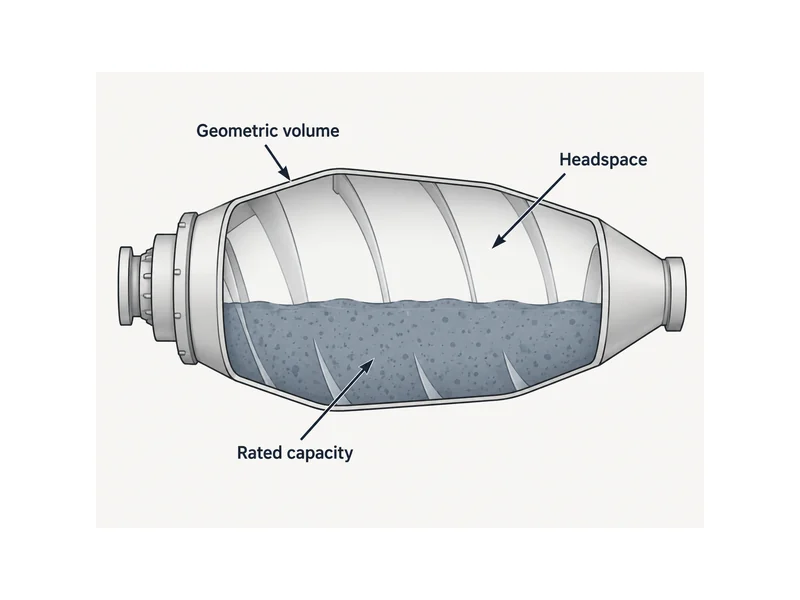
For dimensions, the point is that a larger drum generally adds height and can affect rear overhang, without the rated capacity number showing it directly. How much it adds depends on the specific chassis and drum, and these sources reveal it only through their differing published heights. Suppliers also list more than one drum size against similar configurations, which is part of why two trucks with the same drive configuration can show different heights. The verification action is to check the rated capacity, the geometric volume, and the drum’s outer height together on the build sheet; that keeps a bigger rated number from reading as a proportionally taller truck.
Curb weight, GVW, and payload
Read the label before the value: HOWO mixer weight comes in three figures that are easy to conflate, and published listings define them inconsistently. For one 6×4 10 m³ build, a spec sheet lists a vehicle (curb) weight of about 14.5 tons alongside a rated load near 10.37 tons. A different 10 m³ listing states a payload of 20 tons. Those payload figures do not contradict the trucks so much as their labels: “rated load” and “payload” use different baselines, so do not copy either without knowing which baseline applies.
Gross vehicle weight is the figure usually cited for axle loading and road limits, but here the sources are thinner and less consistent, so it stays conditional. A general concrete mixer truck reference puts loaded GVW in a typical 25–40 ton band; that is a category range, not a HOWO-specific rating. At least one supplier’s stated GVW for a 6×4 build looked low enough to be a sub-component figure instead of the whole-vehicle rating, so this article does not carry it. Note too that GVW and per-axle ratings are separate figures and are not interchangeable. The reliable move is to confirm curb weight, GVW, and the axle ratings together from the build sheet. Read against local rules, those three decide whether a given loaded drum is workable on your route.
Wheelbase, axles, and the truck’s footprint
Wheelbase and axle layout describe the truck’s real-world footprint and turning behavior more fully than the overall length figure alone. On the 10 m³ 6×4 examples reviewed, the wheelbase is commonly given as 3,800 + 1,350 mm: the front-to-rear-bogie span plus the spacing between the two rear axles. Axle ratings follow a recurring pattern: a front axle around 9,000 kg with rear axles near 2 × 16,000 kg. Those ratings indicate how much load the chassis is configured to support, alongside the drum size. Whether a given loaded weight is permitted on a route is a separate check against certification and local limits.
Adding a front axle to reach an 8×4 lengthens the front section and spreads the load, which is why the largest drums sit on four-axle trucks. Tire choice rides along with this: 12.00R20 and 315/80R22.5 both appear across builds, and tire size can influence overall height. When a truck has to work a confined pour site, check wheelbase and the number of axles, not headline length. They drive the turning circle and how the truck places weight over each axle.
Matching mixer dimensions to your site and transport
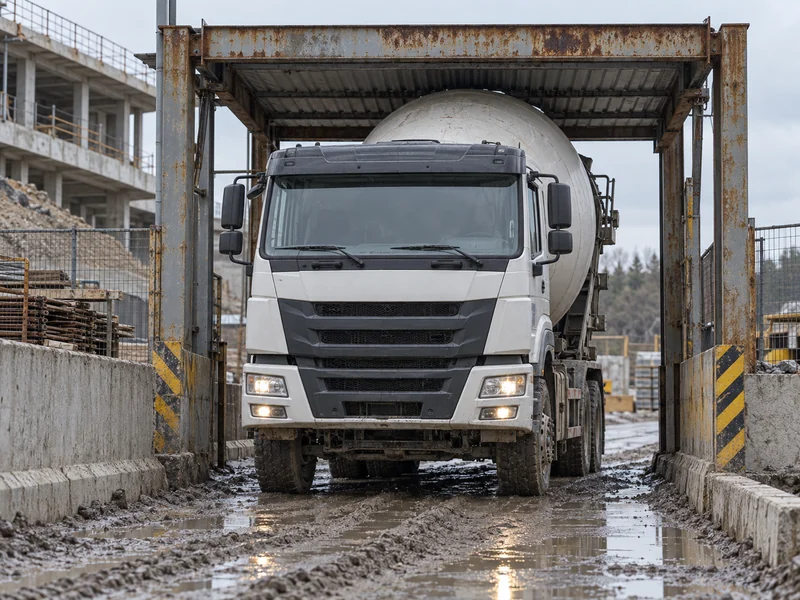
Sizing a mixer works as a sequence of exclusions: rule out what will not fit or clear, then compare what remains on capacity. Height is usually the first constraint. A mixer near 3.9–4.0 m tall has to clear gates, canopies, and any overhead structure on the delivery route, and that clearance does not change with how much concrete is loaded. Width is the least likely to cause trouble, since it stays close to 2.5 m across the range. Length and wheelbase are what decide whether the truck can turn and reverse into a tight pour position.
Axle count and weight then bear on route feasibility. A loaded 8×4 carries more concrete but puts more total weight on the road. Local axle-load and gross-weight rules vary by jurisdiction, so they may matter even where the biggest drum physically fits. Those limits are set locally, and the sources reviewed here did not document them. Treat road and bridge limits as a separate check with the authority for your route, not as a fixed figure you can read off a spec sheet. In practice the order runs: confirm overhead clearance and site access first, then narrow drive configuration and axle count, and only then optimize drum capacity.
Conclusion
The most useful way to read HOWO concrete mixer truck dimensions is as a short exclusion order, not as a single spec. Lock the overhead-clearance and site-access limit first, then settle drive configuration and axle count, and pick drum capacity last. Width is effectively constant near 2.5 m, height climbs with drum size toward roughly 4 m, and length stretches from about 9 m on a compact 6×4 toward 10 m and beyond on an 8×4. Every one of those figures shifts with the specific chassis and drum, so the number to trust is the one on the build sheet for the exact configuration you are quoting. Once clearance and axle limits are fixed, the choice between a 6×4 and an 8×4 rests on how much rated drum capacity your pours need, set against the weight limits your route allows.
FAQ
How long, wide, and tall is a HOWO 10 m³ concrete mixer truck?
In the spec sheets reviewed, a HOWO 10 m³ mixer is a 6×4 build, listed in roughly the 9,000–10,380 mm length, 2,490–2,500 mm width, and 3,600–3,980 mm height range. The spread exists because the same 10 m³ rating is fitted to different chassis and drum specifications, so confirm the exact length and height on the build sheet for the chassis code you are quoting.
How much does a HOWO concrete mixer truck weigh?
Curb weight for one 6×4 10 m³ build is published around 14.5 tons, while loaded gross vehicle weight for concrete mixer trucks generally falls in a typical 25–40 ton band that is not HOWO-specific. Because “rated load” and “payload” figures in supplier listings use different baselines, verify curb weight, GVW, and axle ratings together instead of trusting a single payload number.
What is the difference between a HOWO mixer’s drum capacity and its geometric volume?
Rated drum capacity is the volume of mixed concrete the drum is designed to carry; geometric volume is the drum shell’s total interior volume, which is larger. One published 10 m³ HOWO drum lists a geometric volume near 16.5 m³, the gap being the unfilled space the drum needs to turn and fold the mix while it rotates.
How tall is a HOWO concrete mixer truck?
Published HOWO mixer heights fall between about 3,600 mm and just under 3,980 mm, rising with drum size. Height is set by the truck and drum configuration, not by the load, so it is the clearance figure to check against gates and overhead structures before delivery.
Do HOWO 6×4 and 8×4 mixer trucks have different dimensions?
Yes. The 8×4 adds a front axle, which lengthens the front section and supports larger drums. In the sources reviewed, the 8×4 was a 12 m³ build (with 13–14 m³ drums also offered), while the 6×4 examples were 10 m³ builds. Other capacities may exist but were not confirmed in these sources. Width stays close to 2.5 m on both, so the practical differences are length, drum size, and how axle count spreads weight for route checks.
Further Reading
- Concrete mixer truck dimensions guide — a general, non-manufacturer overview of concrete mixer truck dimensions. Used here only to frame the typical category envelope (length, width, height, wheelbase, and drum-capacity ranges) that brackets the HOWO figures; read it as a category range, not as HOWO model numbers. Not a standards or industry-authority source.
- HOWO 10 m³ concrete mixer truck spec sheet (machinery-trucks.com) — a supplier product spec sheet, cited only as the origin of the 6×4 10 m³ example dimensions, wheelbase, and weight figures above. It is a commercial supplier listing, not an independent authority; confirm against the exact chassis code before quoting.