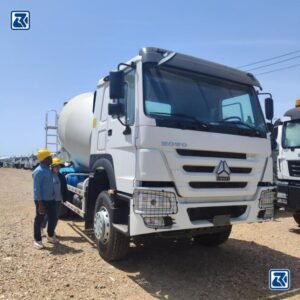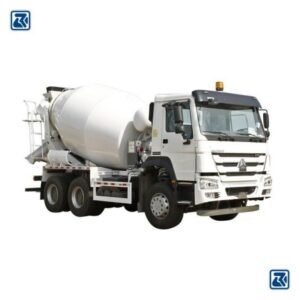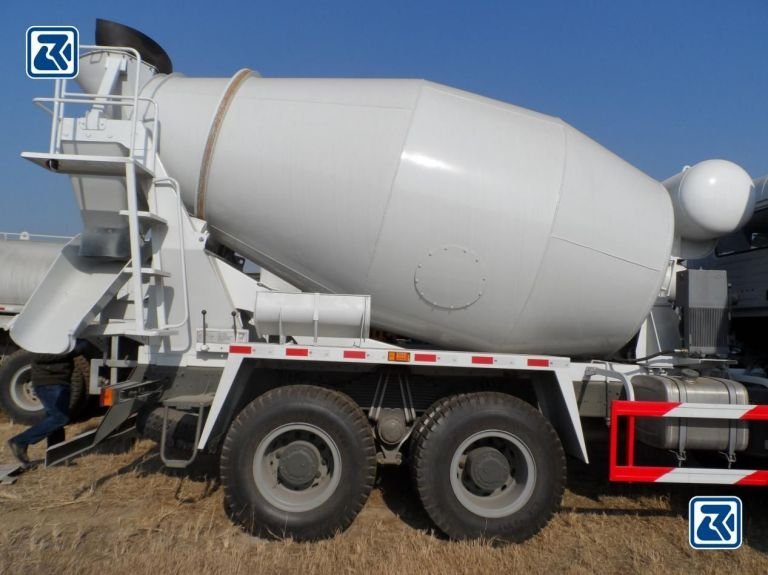
A HOWO concrete mixer truck works by turning a drum that keeps fresh concrete moving from the batch plant to the pour, then reversing that same drum to push the load out on site. The drum, a hydraulic drive, the diesel engine, and an operator control interface act as one system so the mix stays uniform and workable in transit instead of segregating or setting early. Built by HOWO Special Truck Ltd. alongside the rest of the HOWO trucks range, these units are aimed at construction, logistics, and infrastructure work where concrete has to arrive ready to place. The sections below explain what each part does, how the drum and hydraulics move the concrete, and how loading, discharge, and maintenance decide whether the concrete is still usable when it reaches the forms.
HOWO Concrete Mixer Trucks
A HOWO concrete mixer truck is a chassis-mounted transit mixer that carries and continuously agitates ready-mix concrete so it does not segregate or stiffen before placement. The platform pairs a multi-axle chassis with a rotating drum sized for the load, and the exact configuration depends on the model and local axle limits, since the weight of a full drum drives both traction and handling.
The HOWO concrete mixer truck range comes in several drum sizes so operators can match the truck to the job, from small pours to large infrastructure deliveries. Larger drums move more concrete per trip but add weight and turning radius, so the practical choice depends on site access, batch size, and axle limits, not capacity alone.
Key Components of HOWO Concrete Mixer Trucks
Four systems do the real work: the mixing drum, the hydraulic drive, the engine, and the control interface. Each one has a distinct job, and a fault in any of them shows up as poor mixing, slow discharge, or lost time on site.
Mixing Drum
Uniformity depends on the mixing drum, which folds the concrete on every turn with internal spiral blades. Its cylindrical or double-cone shell is lined with abrasion-resistant material to survive constant contact with aggregate, and the length-to-diameter ratio is set to give enough mixing surface without adding dead weight.
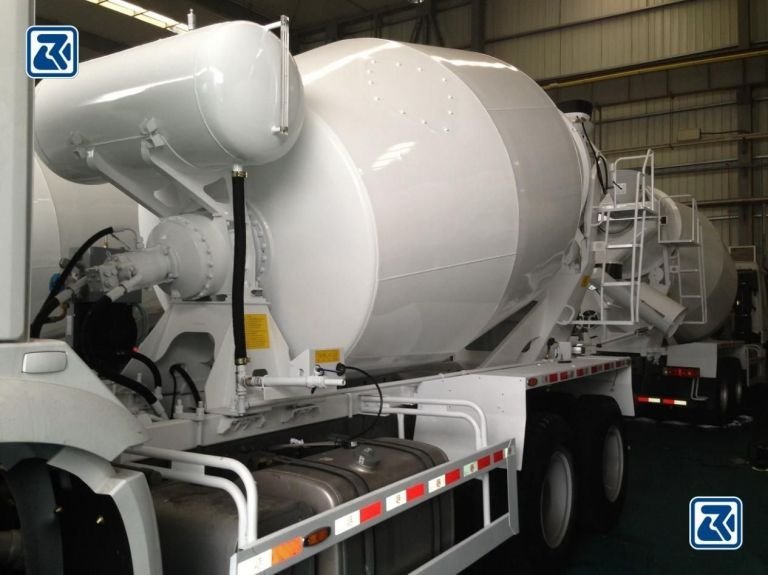
Hydraulic System
Variable drum speed comes from the hydraulic system, which converts engine power into controlled rotation through a pump, a hydraulic motor, and a gearbox. Because it meters flow to the motor, the operator can vary drum speed and direction smoothly, which is what makes precise agitation and controlled discharge possible.
Engine
Power for both the truck and the drum starts at the engine, normally a diesel unit chosen for torque under sustained load. It has to pull a fully charged drum up site grades and keep the drum turning while the truck is stationary during a pour.
Control System
One operator runs charging, agitation, and discharge from the control interface, which sets drum speed and direction along with auxiliary functions. Tying engine, hydraulic flow, and discharge together is what lets discharge be paced to the crew placing the concrete.
How the Mixing Drum Works
The drum mixes by turning at different speeds for different tasks, and it discharges by reversing direction. According to ASTM C94 practice and industry references such as Pavement Interactive (a program of the FHWA, state DOTs, and the University of Washington), the drum turns at roughly 12 to 18 rpm to charge and mix. In transit it slows to about 2 to 6 rpm to agitate the load, which keeps the mix from segregating without adding the slump loss that constant fast mixing would cause.
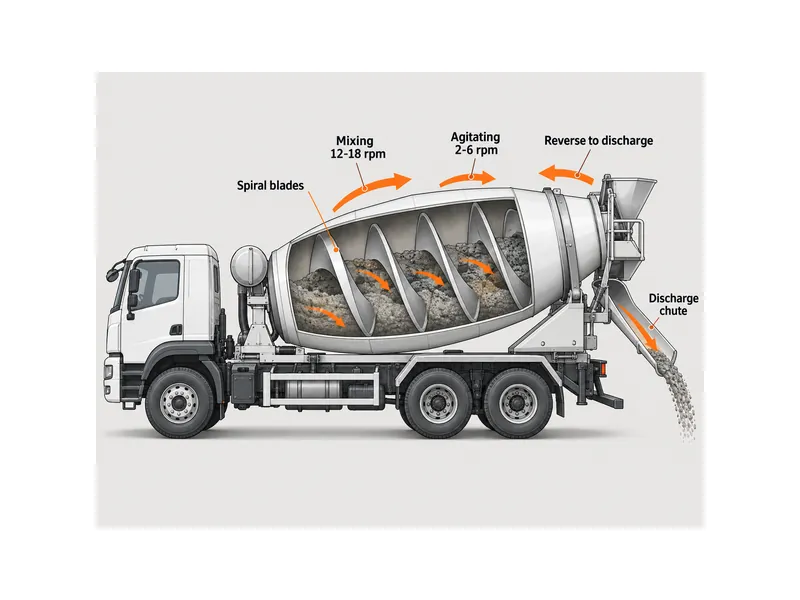
The drum’s internal geometry is what turns rotation into mixing. Spiral blades welded inside pull material inward and fold it over as the drum turns one way; when the operator reverses rotation, those same blades act like a screw and drive the concrete up toward the discharge chute. That reversal, not a separate pump, is how the truck unloads.
Direction and revolution count affect quality as much as speed. Steady low-speed agitation prevents segregation and keeps water from separating out, while the total number of turns is tracked because over-mixing stiffens the batch: industry practice under ASTM C94 commonly limits the drum to about 300 revolutions between the time water is added and discharge. Past that point the concrete has usually taken too much energy and lost workability.
Hydraulic System Functionality
The hydraulic system exists to give the drum controlled, variable rotation under heavy load, which a direct mechanical link cannot do as smoothly. It transmits engine power as pressurized fluid to a hydraulic motor, and by regulating that flow it sets the drum’s speed and direction on demand. This is the same compact, high-force power transmission principle that lets a relatively small circuit move a drum weighing several tonnes when full.
Beyond turning the drum, the circuit also handles related functions such as discharge control and, on some builds, auxiliary equipment. Sealed hydraulic components run efficiently and last well when the fluid stays clean, which is why contamination and leaks are the failures worth watching.
Loading and Unloading Processes
Loading and unloading are timed so the concrete is placed while it is still workable, not simply moved from plant to site. The clock starts when water meets cement, so both ends of the trip are scheduled around that window and not around the truck’s availability.
Loading begins at the batching plant, where aggregates, sand, cement, and water are proportioned to the mix design and fed into the drum while it turns at charging speed. Getting the volume and proportions right at this stage is what sets the final strength and slump; the truck can adjust consistency later only within limits.
Unloading is the loading sequence in reverse, with positioning and pacing added. The truck is stabilized near the pour, the drum reverses to drive concrete down the chute, and the operator controls flow so the crew can place it evenly. If the mix has stiffened in transit, water may be added on site only when the slump is below target and the mix design’s water content has not been exceeded; per NRMCA guidance following ASTM C94, any such addition should be followed by at least about 30 revolutions at mixing speed so the water is fully blended before discharge.
Delivery timing is the variable that most often decides quality. The usable window is commonly described as roughly 90 minutes or about 300 drum revolutions after water is added, but it is set by the mix design and site conditions: hot weather shortens it and set-retarding admixtures extend it, so the job specification, not a fixed clock, decides when the load must be placed. Because of that window, crews plan discharge order before the trucks arrive and watch for early stiffening.
Maintenance for Optimizing Performance
Maintenance on a mixer truck is aimed at two failure paths: hardened concrete inside the drum and contaminated or leaking hydraulics. Both are cheaper to prevent than to repair, and both build up gradually, so the routine matters more than any single big service.

Cleaning the drum is the daily non-negotiable. Rinsing out residual slurry after each load, and washing the drum, charging port, and discharge area at the end of the day, stops cement from curing into hard buildup that reduces capacity and unbalances the drum. The step-by-step routine for cleaning the mixing drum covers how thoroughly to wash and when.
Hydraulic care means keeping the fluid clean and catching leaks early. Inspecting hoses and fittings for chafing and seepage, and checking fluid level and condition, addresses the contamination that drives most hydraulic failures. Instead of fixing the drum and hydraulics to an arbitrary hour count, follow the interval in the manufacturer’s service schedule and let running hours and fluid condition trigger fluid and filter changes. Pairing that with the broader regular maintenance checks on filters, belts, and fluids keeps small issues from becoming downtime.
Conclusion
The core thing to take away is that a HOWO concrete mixer truck does not mix concrete continuously so much as keep it moving: fast rotation charges and blends the batch, slow rotation agitates it in transit to fight segregation, and reversing the drum discharges it. Understanding that difference explains why drum speed, revolution count, and delivery time all matter more than raw drum size. The point most often misread is that a drum turning on the road means the concrete is being mixed the whole way; in transit it is only being agitated, and the usable window still runs from the moment water was added, not from arrival. For any specific truck, the drum drive, hydraulic condition, and maintenance intervals are worth confirming against that model’s service documentation instead of a generic rule of thumb.
FAQ
When does the clock start on concrete in a HOWO mixer truck?
The clock starts when water is first added at the batch plant, not when the truck arrives on site. From there the usable window is commonly described as roughly 90 minutes or about 300 drum revolutions, but the real limit is set by the mix design and conditions: hot weather shortens it and set-retarding admixtures extend it, so the job specification decides when the concrete must be placed.
What speed does the drum turn at?
Drum speed changes with the task. Charging and mixing run at roughly 12 to 18 rpm, while agitation in transit drops to about 2 to 6 rpm to limit slump loss, and for discharge the drum reverses direction so the internal blades push the concrete toward the chute, per ASTM C94 practice.
How is concrete discharged from the truck?
Discharge works by reversing the drum. Turning the drum the opposite way makes the internal spiral blades act as a screw that drives the mix up and out through the chute, and the operator controls flow rate by drum speed so the crew can place the concrete at a steady pace.
How often should the hydraulic system be serviced?
Service intervals should follow the manufacturer’s schedule, not a fixed hour count. Inspect hoses and fittings for leaks and chafing, monitor fluid level and cleanliness, and let running hours and fluid condition trigger filter and fluid changes, since contamination and undetected leaks cause most hydraulic failures on mixer trucks.
Further Reading
- PCC Truck Mixer — Pavement Interactive — Reference program of the FHWA, state DOTs, and the University of Washington (T2). Supports the drum mixing versus agitating speeds, revolution limits, and ASTM C94 / AASHTO M 157 references used above.
- Frequently Asked Questions on Concrete Materials — NRMCA — National Ready Mixed Concrete Association (T2). Supports the on-site water-addition rule and the requirement to re-mix at least about 30 revolutions before discharge.