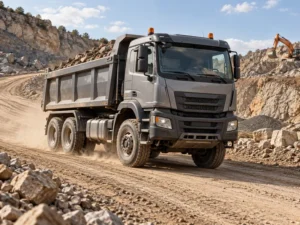
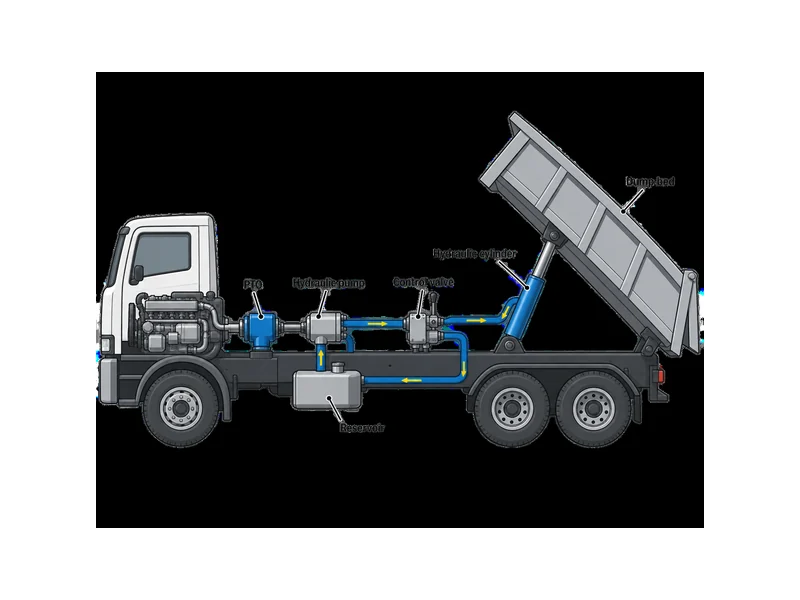
The hydraulic system on a HOWO dump truck has one core job: raise the loaded bed far enough that gravity empties it, then bring it back down under control. In the common power-take-off arrangement, it borrows power from the engine, converts that power into fluid pressure, and uses the pressure to push a cylinder that tilts the bed. Exact parts and layout vary by model, body, and PTO/hydraulic build, so confirm your own configuration against its manual. The power chain itself — engine to pump to valve to cylinder — is what separates a quick roadside diagnosis from an expensive guess.
For a fleet buyer or maintenance lead spec’ing or servicing a HOWO dump truck, the practical value is knowing where each part sits in that chain and what its failure looks like. A slow bed, a bed that stalls halfway, or oil weeping from a fitting are not random events; each points to a specific link. This article walks the chain in order, compares the two cylinder layouts you will actually choose between, and sets out the faults and maintenance habits that keep the system predictable.
One boundary up front: this covers only the tipping hydraulics that lift and lower the body. Steering assist, brake circuits, and any auxiliary hydraulics are separate systems with their own pumps and standards, and they are not addressed here.
What the HOWO dump truck hydraulic system actually controls
The tipping hydraulic system controls the body-lift function and nothing else on the truck. Its job begins when the operator asks for a lift and ends when the bed is back down and the power take-off is disengaged. Keeping that scope clear matters, because a symptom like a slow bed belongs to this circuit, while weak steering belongs elsewhere and should not be diagnosed against tipping components.
Within that scope, the tipping hydraulics form a circuit that moves oil from a reservoir to the cylinder and back. The reservoir stores and cools the fluid, the pump raises its pressure, a valve decides where it goes, and the cylinder turns that pressure into the lifting stroke. Because the oil passes through every part in turn, contamination or wear in one component can affect the others, so the parts are best understood as a set.
The lift is powered by the engine, not a separate motor. A power take-off taps rotation from the transmission or engine and drives the pump only while the operator engages it. That means the hydraulic system draws power on demand instead of continuously. On most builds the design is efficient, and it makes the first check on any no-lift complaint simple: confirm the power take-off is actually engaging.
Core components: PTO, pump, valve, cylinder, reservoir
Five components carry the load: PTO, pump, control valve, cylinder, and reservoir. Each one constrains the others, so sizing or servicing a part in isolation tends to move the problem instead of solving it. Read them as a set:
- Power take-off (PTO): transfers engine or transmission rotation to the pump on demand; if it slips or fails to engage, no oil is pressurized and the bed will not move.
- Hydraulic pump: converts that rotation into flow and pressure. Gear pumps are common on tipping duty for their simplicity, but the pump type and displacement determine how fast the bed rises and how much it resists a heavy load.
- Control valve: directs pressurized oil to raise, hold, or lower the bed, and sets a pressure ceiling through a relief function so the circuit cannot over-pressurize.
- Hydraulic cylinder: turns fluid pressure into the mechanical stroke that tilts the body. Its stroke and closed length have to match the frame and body length.
- Reservoir, filter, and lines: store, clean, and carry the oil. The reservoir also sheds heat, and the filter is the main defense against the contamination that damages the pump and cylinder seals.
The variable that ties them together is flow matched to pressure. A pump that delivers strong flow into a valve or cylinder sized for less will build heat and pressure it was never meant to see. An undersized pump lifts slowly no matter how healthy the cylinder is. So when any component is replaced, confirm its rating against the rest of the circuit and the truck’s original specification before fitting a part just because it bolts on.
How the system raises and lowers the dump bed
The bed rises through a fixed sequence, and knowing the order is what makes faults readable. The operator engages the power take-off, the pump draws oil from the reservoir, and pressure builds as that oil meets the resistance of the loaded body. The control valve routes the pressurized oil into the cylinder, the cylinder extends, and the bed tilts up from its rear hinge until the load slides out by gravity.
On a telescopic cylinder the stroke happens in stages, not in one motion. Pressurized oil pushes the largest section first, then each smaller nested section in turn, which is how a compact closed length can still reach a high tipping angle. That staged action is normal, but it also explains why a telescopic cylinder can extend unevenly when a stage is worn or air is trapped in the circuit.
Lowering is controlled release, not a second power stroke. When the operator selects lower, the valve opens a return path and the weight of the bed pushes the oil back to the reservoir. The cylinder then retracts in stages and the bed settles. The cue here is smoothness: a bed that drops in jerks or refuses to seat fully points at the valve, trapped air, or a staging problem — not the pump, which does no work on the way down.
Telescopic vs. scissor (underbody) hoist cylinders
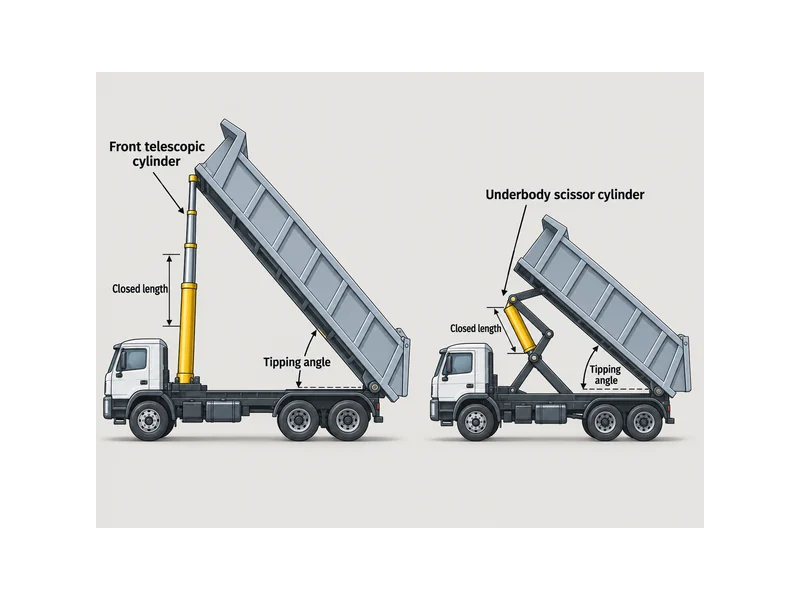
Which cylinder layout suits a truck turns on body length, payload, and how the load tends to shift. Two arrangements dominate tipping duty, and the right one follows those variables, not the model badge.
A front-mounted telescopic cylinder pushes from behind the cab and suits long bodies and front-heavy loads. Because it acts at the front of the body, it can raise a long bed to a steep angle with a compact closed length. That is why it is common on longer tipper bodies. The trade-off is that a tall, multi-stage cylinder is more exposed to side loads if the truck tips on uneven ground, so the verification point is checking for even extension and watching for any lateral play.
An underbody or scissor arrangement mounts lower and lifts through a linkage beneath the body. Keeping the cylinder shorter and lower manages side loads better on uneven sites, which is why this layout tends to suit shorter, heavier bodies. Its trade-off is a lower maximum tipping angle for a given package. So the choice follows body length and site conditions: a long body and steep dump favor the front telescopic route, while a shorter body on rough ground often favors the underbody one. Either way, verify the fit by matching the cylinder’s stroke, closed length, and rated capacity to the specific body and duty, not to the truck model alone.
Common hydraulic faults and what they signal
Most tipping-hydraulic faults announce themselves through the lift behavior, and reading that behavior narrows the cause fast. Before replacing anything, work the symptom back along the power chain. The common patterns map cleanly onto specific links:
- Bed will not move at all: start at the power take-off and its engagement, then the fluid level and the pump, because no pressure is reaching the cylinder.
- Bed lifts slowly or weakly: points toward low fluid, a worn pump losing output, a partially open relief path, or oil that is too thin from overheating.
- Bed stalls or sticks in the raised position: usually a valve or return-path fault, or a mis-staged telescopic cylinder that has not extended cleanly.
- Cylinder chatters or the bed shudders on the way up: commonly air trapped in the circuit or uneven stage movement, which calls for bleeding and a stage inspection.
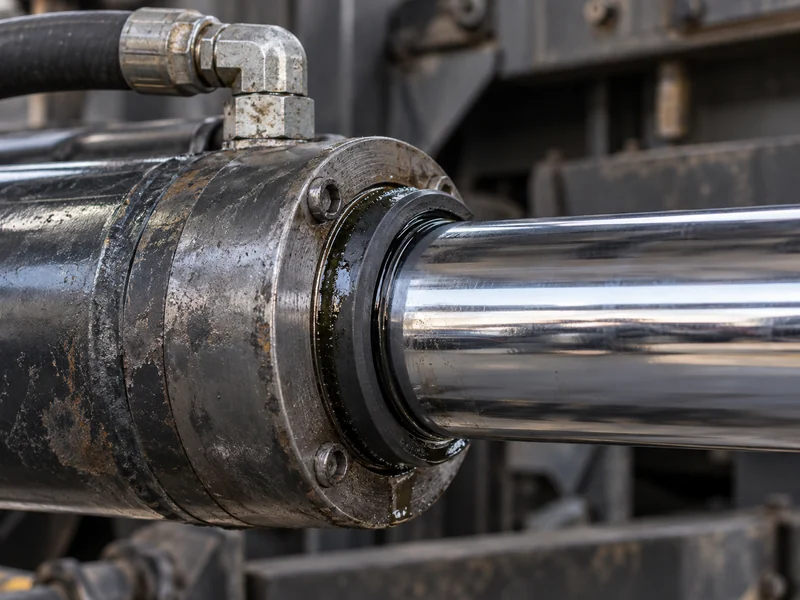
- Oil leaks at a fitting or rod: a seal, hose, or fitting issue that will worsen; trace it to its source, since topping up only hides it.
The unifying variable behind several of these is fluid condition. Air, contamination, or overheated oil can produce slow lifts, chatter, and jerky lowering at the same time. So confirming clean fluid at the correct level is the cheapest first check before condemning a pump or cylinder. Where a symptom persists after the fluid checks out, the fault has moved to a mechanical part, and the inspection should follow the chain in the order above.
Maintenance that keeps the system working
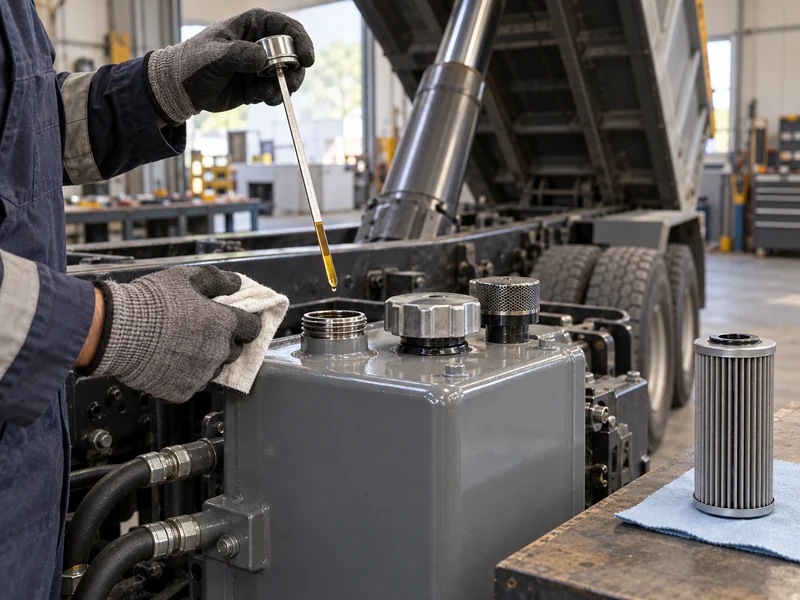
Maintenance for the tipping hydraulics is mostly about protecting the fluid and catching wear before it strands the truck. Because the oil passes through every part of the circuit, keeping it clean and at the right level and temperature does more for reliability than any single component upgrade. A practical routine covers a few recurring checks:
- Fluid level and condition: check regularly and top up with the oil type the truck’s manual specifies; discolored, milky, or contaminated fluid signals a change is due.
- Filters and breather: replace filters on schedule so contamination cannot circulate into the pump and cylinder seals.
- Hoses, fittings, and seals: inspect for weeping, chafing, and soft spots, and trace any leak to its source, since topping off only defers the repair.
- Cylinder and rod: watch for scoring, uneven extension, and lateral play, all of which point to seal wear or side-load damage.
- Grease points and linkage: keep pivot and linkage points lubricated so the mechanical side of the hoist does not load the hydraulics unevenly.
Service intervals should track duty, not a fixed calendar number. Frequent high-cycle tipping, heavy loads, dusty sites, and high ambient heat all shorten the safe interval between fluid and filter changes. The reliable guide is the truck’s own manual read together with the actual condition of the oil, not a single figure carried over from lighter service. One habit pays off: log what each check finds, so a gradual loss of lift speed or a slowly growing leak shows up as a trend instead of a breakdown.
Conclusion
The most useful thing to carry away is that a HOWO dump truck hydraulic system is a single power chain, and every symptom belongs to a link in it. Engine power becomes pump flow, flow becomes directed pressure at the valve, and pressure becomes the staged cylinder stroke that tips the bed; lowering is controlled release of that same oil. Read a fault against that order and the diagnosis usually falls out — no-lift starts at the power take-off, slow-lift points at fluid and pump, and chatter or a stuck bed points at air, valve, or cylinder staging.
The point most often misread is that the pump does the work in both directions. It does not: the bed comes down on its own weight through the valve, so lowering faults live in the valve and staging, not the pump. Match the cylinder layout to the body and site, not the model name; keep the fluid clean and correctly filled; and let the truck’s manual and the oil’s condition — not a fixed number — set the service interval. Those three habits keep the tipping circuit predictable through hard duty.
FAQ
Why is a HOWO dump bed lifting slowly or not at all?
Slow or no lift almost always traces to fluid or to the pump side of the circuit, so start there before touching the cylinder. A bed that will not move at all usually means the power take-off is not engaging or no oil is being pressurized; a bed that lifts slowly points to low fluid, a worn pump, a partly open relief path, or oil thinned by overheating. Confirm fluid level and condition first, then check power-take-off engagement and the pump against the layout in your truck’s manual.
How does the PTO drive the hydraulic pump on a HOWO dump truck?
The power take-off transfers rotation from the transmission or engine to the hydraulic pump, and it does so only while the operator engages it. When engaged, it spins the pump, which draws oil from the reservoir and raises its pressure so the control valve can send it to the cylinder; disengage it and the pump stops driving the lift. Because PTO type and mounting vary by build, confirm the engagement method and pump pairing against your truck’s PTO and hydraulic manual before diagnosing a no-lift fault.
Telescopic or scissor hoist cylinder — which suits a heavy tipper?
The choice depends on body length and site conditions, not on the truck model. A front-mounted telescopic cylinder raises long, front-heavy bodies to a steep angle with a compact closed length; an underbody or scissor layout stays shorter and lower and manages side loads better on uneven ground, at the cost of a lower maximum tipping angle. Match the cylinder’s stroke, closed length, and rated capacity to the specific body and duty.
What hydraulic oil and change interval does the PTO pump need?
Use the oil type the truck’s manual specifies, and set the change interval by duty and oil condition, not a fixed figure. Frequent high-cycle tipping, heavy loads, dust, and high heat all shorten the safe interval, so let the manufacturer’s manual and the actual state of the fluid guide it. Discolored, milky, or contaminated oil means a change is due regardless of the hours on it.
Why does the tipper cylinder chatter or stick in the raised position?
Chatter on the way up is commonly trapped air or uneven stage movement, while a bed that sticks up usually points at the valve, the return path, or a mis-staged telescopic cylinder. Bleed the circuit and check for even stage extension first, since air in the lines can cause both. If the bed still refuses to seat or hold after fluid and air are ruled out, the fault sits in the valve or cylinder staging, not the pump.
Further Reading
- Yamada Sharyo — What is a Dump Hoist? (structure guide) — Manufacturer technical explainer. Supports the article’s mechanism section on how the lift arm, cylinder, and linkage form the hoist; note it describes hoist makers’ general assemblies, not a HOWO-specific configuration.
- Oxmaint — Hydraulic System Maintenance for Dump Trucks, Lifts, and PTOs — Fleet-maintenance reference. Supports the maintenance section’s point that service intervals track duty and fluid condition; treat its specific interval figures as general fleet guidance to verify against the truck’s own manual.
Related Articles
- HOWO 4X2 Dump Truck — A light-duty 4×2 tipper option for lighter loads and urban or short-haul construction work.
- HOWO 4X4 Dump Truck — An all-wheel-drive model built for rugged, off-road sites where traction matters.
- HOWO 6X4 Dump Truck — A 371 hp 6×4 workhorse for short-distance bulk material haulage.
- HOWO 6X6 Dump Truck — An off-road 6×6 for construction and mining on tough terrain.
- HOWO 8X4 Dump Truck — A high-capacity 8×4 with a front lifting tipping bucket for large-scale transport.