On a HOWO dump truck, “gear ratio” almost never means a single number. It means two: the ratios inside the gearbox and the fixed ratio in the rear drive axle, and each does a different job. Buyers who ask what gear ratio a sinotruk HOWO dump truck runs are usually after one practical answer — whether a given truck will pull loaded on grade, hold a workable road speed, and stay economical on the empty return leg. This guide separates the two numbers, explains what the common values mean, and shows how to read them off a spec sheet before you commit to a configuration.
What Gear Ratio Means on a HOWO Dump Truck
Two separate places on a dump truck carry a gear ratio, so the single phrase hides two numbers. The gearbox multiplies engine torque through a set of selectable ratios, from a deep first gear for moving off under load to a near 1:1 top gear for cruising. The rear axle ratio — also called the drive-axle or final-drive ratio — applies one fixed reduction between the driveshaft and the wheels. Read that number like this: a 5.45 axle ratio means the driveshaft turns 5.45 times for one full turn of the wheels.
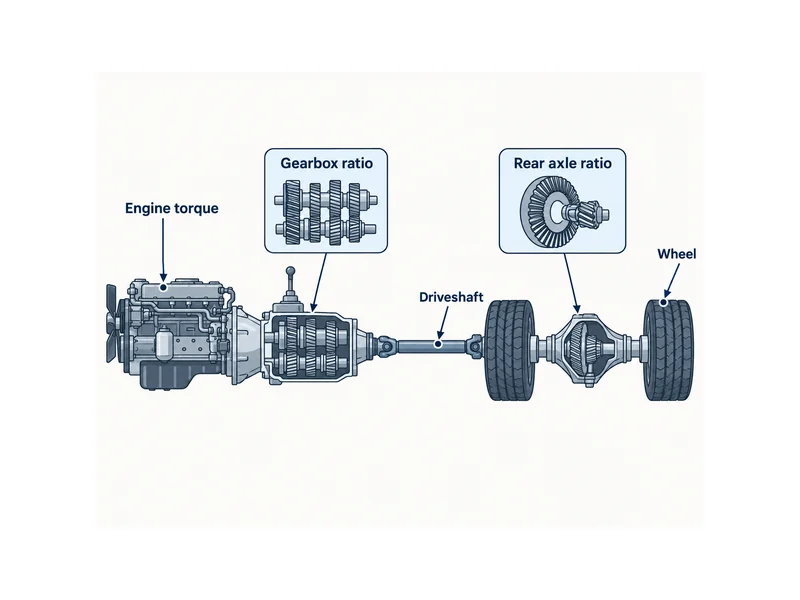
The two figures are frequently confused because both get quoted as “gear ratio,” yet they are specified independently and change independently. You can order the same gearbox behind different axle ratios, or the same axle behind different gearboxes, and the truck’s character shifts each time. Keeping them apart is the first step to reading any HOWO spec correctly, because the axle ratio is the number that most directly sets loaded pulling power and cruising engine speed.
Where you actually find these numbers is the build or spec sheet, listed as the transmission model plus a separate axle ratio. When a listing gives only one “gear ratio,” it is almost always the rear axle ratio, and the gearbox is identified by its model code instead of a headline number. Reading both lines together — not one in isolation — is what lets you predict how the truck will behave loaded.
How Gear Ratio Shapes a Loaded HOWO’s Torque, Speed, and Fuel Use
Pulling power and economy sit on opposite ends of the axle-ratio trade-off. A numerically higher ratio such as 5.45 turns the wheels fewer times per driveshaft revolution, so the truck makes more torque at the wheel for climbing grades and moving heavy payloads. That torque has a cost in engine speed: at any given road speed the engine spins faster and uses more fuel. A lower ratio does the opposite — the engine loafs at highway speed and saves fuel, while grade-climbing muscle and start-ability from a stop under load drop off.
The torque-versus-economy relationship holds across heavy-truck practice and is not specific to any one brand. Industry spec guidance from Work Truck Online notes that medium- and heavy-duty drive-axle ratios span roughly 2.69:1 to 7.17:1, with a dozen or more options between the extremes. Loaded dump-truck duty typically sits toward the higher, torque-biased end of that band. So ratio choice follows the terrain and the load, not a “bigger is better” instinct — match it to the work and both halves of the trade-off stay in balance.
The trade-off is easier to hold in mind as a short comparison than as prose:
| Rear axle ratio | Wheel torque / grade | Cruising engine speed | Fuel use | Best-suited duty |
|---|---|---|---|---|
| Higher (e.g. around 5.45) | More; strong on grade and start-ability | Higher at a given road speed | Higher | Loaded off-road, quarry and site, steep grades |
| Lower (e.g. around 4.4) | Less pulling power | Lower at a given road speed | Lower | Longer, flatter hauls where economy leads |
Two variables change this picture and should be checked alongside the ratio. Tire size shifts effective gearing: a taller tire raises road speed and softens the ratio’s effect, while a shorter tire sharpens it. Transmission type matters too — an automated or torque-converter-equipped box can sometimes make a slightly lower numerical axle ratio workable, since it handles launch multiplication differently than a straight manual.
HOWO Gearbox Ratios: Inside the HW-Series 10-Speed Spread
The clearest way to read a HOWO gearbox is through a specific documented model. The HW19710 — a Sinotruk 10-forward, 2-reverse manual rated around 1,900 Nm input torque — steps from a deep first gear near 14.284:1 down to a 1.0:1 top gear, per Sinotruk gearbox specification listings. Many HOWO dump trucks are offered with a 10- or 12-speed manual, and some builds add an automated (AMT) option, but the exact box depends on the configuration. Treat the HW19710 figures as one documented example, not a series-wide constant. That wide first-to-top span is what lets a loaded tipper crawl away on a soft haul road and still reach a useful road speed once it is up to weight.
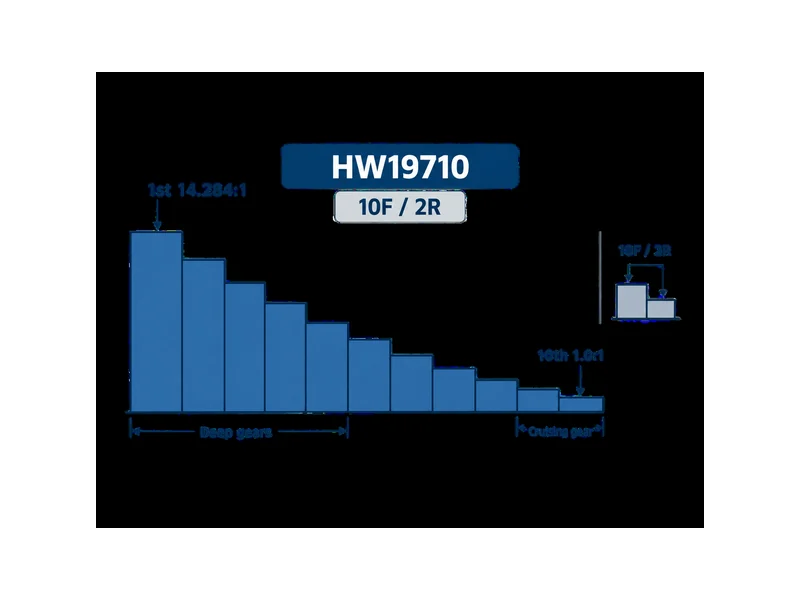
Read the gearbox spread as the truck’s flexibility, not its final drive. The deep lower gears exist for start-ability and low-speed grade work, the tall upper gears for economy once rolling, and the two reverse gears give a loaded truck a controllable back-up on site. The same HW19710 also appears on other models, such as the HOWO 6X4 tractor truck. The gearbox alone still cannot tell you how a specific dump truck will behave until you pair it with the axle ratio.
Some HOWO builds use a different gearbox than the HW19710, and gear counts and ratio spans vary between boxes. Confirm the exact gearbox model on the build sheet instead of assuming a 10-speed HW box. The number of gears and the first-to-top ratio span are what determine the flexibility you are buying, so read them from the model’s own specification, not from a comparable truck.
HOWO Rear Axle Ratios: What 4.4, 5.26, and 5.45 Tell You
Rear axle ratios on HOWO dump trucks vary by model and intended duty, so the figure only means something once you tie it to a specific configuration. A ratio around 5.45 appears on some 6×4 tipper builds and biases the truck toward torque for loaded, off-highway work. Other configurations are quoted nearer 4.4 for more speed-and-economy-oriented duty, or around 5.26 on certain multi-axle builds. Treat these as configuration-dependent values to confirm on the spec sheet, not fixed figures that fit every truck in the range.
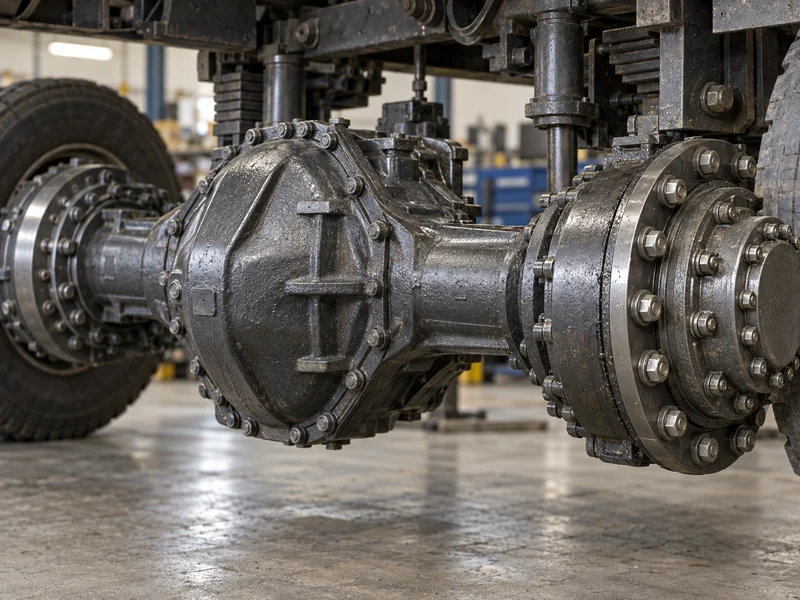
Many heavy HOWO tippers use a double-reduction (hub-reduction) drive axle, which splits the final reduction between the central differential and a second set of gears at the wheel hubs. Confirm the axle type for the specific build, because not every configuration uses it. Where it is fitted, that design carries high torque without oversizing the central gears and adds ground clearance, both useful on rough sites. It also puts a premium on axle upkeep — differential oil level and correct differential-lock use — for service life. When you compare two HOWO axle ratios, compare them on the same model, because axle type and tire size have to be held constant for the numbers to mean anything.
Matching Gear Ratio to Terrain and Haul Route
Pick the axle ratio from your worst repeated grade and your typical loaded speed, not from a spec that simply looks impressive. Trucks that spend most of their time climbing out of quarries, pits, or construction sites with full payloads reward a higher numerical ratio, which keeps engine speed in its torque band on grade and protects start-ability from a stop on a slope. Trucks that run longer, flatter hauls between sites benefit from a lower ratio that drops cruising rpm and saves fuel across the year.
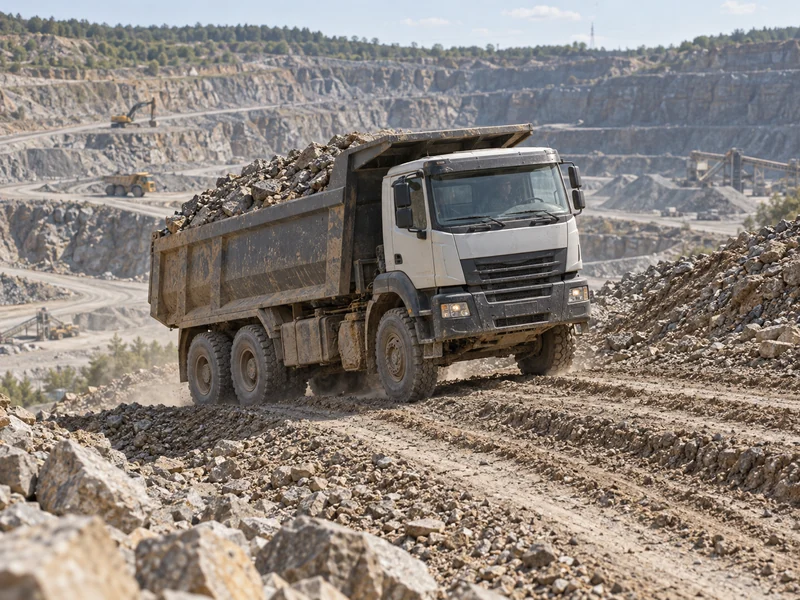
Two related factors decide most of that choice: start-ability and grade-ability. Start-ability is whether the truck can pull away fully loaded from a stop on the steepest grade it regularly faces. Grade-ability is whether it can hold a workable speed up that grade without lugging the engine down out of its torque band. Both improve with a higher numerical axle ratio, which is why site and quarry trucks are geared higher than highway-biased ones. The time a truck actually spends on severe grades, not its headline top speed, is what should anchor the ratio you specify.
Load and axle count feed the same decision. A heavier gross weight or a steeper grade pushes the choice higher, while a mostly-highway profile pulls it lower; heavier multi-axle builds such as 8×4 tippers lean on axle ratio to keep that payload moving on site. Before you finalize a configuration, confirm three things together on the build sheet: the gearbox model and its gear count, the rear axle ratio, and the tire size. Change any one of them and the other two behave differently, so they only make sense read as a set.
Reading a HOWO Gear Ratio With Confidence
Here is the judgment to walk away with: a HOWO’s “gear ratio” is really a gearbox spread plus a fixed axle ratio. The axle ratio is the number that tells you whether the truck is built to pull or to cruise. Higher axle numbers buy torque and grade-ability at the cost of speed and fuel; lower numbers do the reverse; the gearbox spread sets how much flexibility you have in between. The place this gets misread most is treating a single quoted “gear ratio” as the whole story, when it is the axle ratio — held against the same model, tire size, and gearbox — that actually predicts loaded behavior. If you are matching a truck to a route, tell your supplier the grade and loaded speed you run, and verify the axle ratio, gearbox model, and tire size together as one specification, not three loose numbers.
FAQ
What is the difference between the gearbox ratio and the rear axle ratio on a HOWO?
The gearbox ratio is a set of selectable ratios that multiply engine torque, while the rear axle ratio is one fixed reduction between the driveshaft and the wheels. Both get quoted as “gear ratio,” but they are specified separately, and the axle ratio most directly sets loaded pulling power and cruising engine speed.
How many gears does a HOWO dump truck have?
Many HOWO dump trucks use a 10- or 12-speed manual gearbox, and some builds add an automated (AMT) option; the exact count depends on the configuration. The HW19710, for example, is a documented 10-forward, 2-reverse box. Confirm the gearbox model on the build sheet, because configurations differ from one build to another.
Does a higher rear axle ratio use more fuel?
A higher numerical axle ratio generally raises fuel use at road speed, because the engine turns faster for any given speed. That same ratio delivers more torque for climbing grades and moving heavy payloads, so the added consumption is the trade-off for pulling power on demanding, loaded routes.
Is a 5.45 rear axle ratio better than 4.4 for hauling on steep grades?
Neither ratio is automatically better; it depends on the duty. A 5.45 ratio favors torque and start-ability for steep, loaded grade work, while a 4.4 ratio favors cruising speed and fuel economy on flatter routes. Compare the two only on the same model, tire size, and gross weight, because a ratio pulled off one configuration will not predict behavior on another. Match the number to your worst repeated grade and typical load instead of assuming one figure wins outright.
Further Reading
- Selection of Rear Axle Speed Ratio for Dump Truck — Xinda Motor (driveline component maker, technical explainer). Supports the torque-versus-speed-and-fuel trade-off and the rear-axle-ratio selection logic above; its worked example uses non-HOWO figures, so read the numbers as a method illustration, not HOWO spec values.
- A Comprehensive Guide to Selecting the Right Axle Ratio for Your Semi Truck — Bobtail (industry blog). Backs the fuel-economy-versus-torque trade-off and the application-based approach to choosing a ratio; oriented to on-highway semis, so its ranges skew lower than loaded dump-truck duty.