HOWO dump truck price for export runs from roughly USD 19,500 to USD 60,000, depending on axle configuration, condition tier and price scope. Two offers become comparable only when both state the same Incoterm, body build and condition. Most of that spread comes from scope and condition, and only a smaller part from the model. At the low end sits an older build, a lighter specification, a chassis without a fitted body, or a bulk-order unit price. Freight, insurance, duty, clearance and inland delivery are added on top of all of them.
Why HOWO Dump Truck Price Quotes Differ So Widely
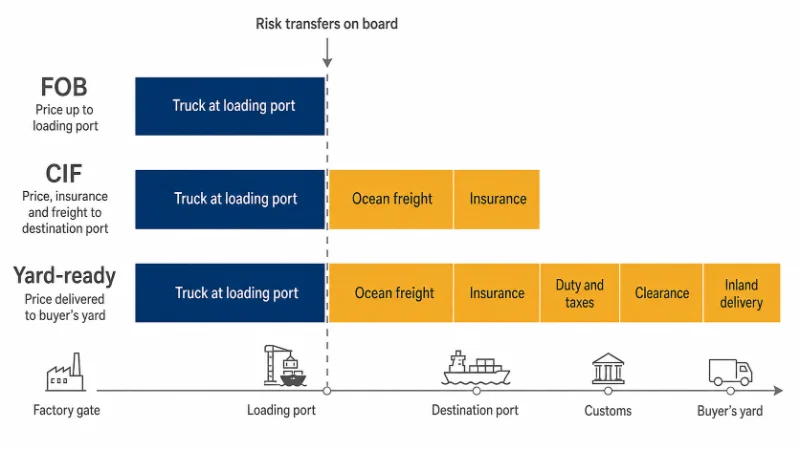
A HOWO dump truck price quote can describe three different cost bases: FOB at the Chinese loading port, CIF at your destination port, or yard-ready after clearance and inland delivery. The gap between those three is often wider than the gap between two models.
Incoterms® 2020 are the ICC rules that set the delivery point, risk transfer and cost split in a sale contract. Under FOB, the seller places the truck on board the vessel you nominate at a named port of shipment. Risk passes to you at that moment, and the seller handles export clearance. Everything after loading is yours.
FOB assumes sea or inland waterway carriage. Where a unit is dismantled and containerised rather than rolled or lifted onto the vessel as a complete truck, a container-handoff term such as FCA usually fits the delivery better, so settle the Incoterm against how the truck actually ships.
Before comparing two figures, settle the five things that move a quote more than the badge on the door:
- Price basis: FOB, CIF or yard-ready, against a named port.
- Condition tier: new, refurbished, or sold as-is.
- Build content: chassis with a PTO provision only, or chassis with body, hoist cylinder and subframe fitted.
- Order scope: a single-unit price, or a figure contingent on a minimum order quantity.
- Destination specification: emission stage, drive side, and any conformity certification the market requires.
Of the five, price basis decides whether the other four are even comparable. Accepting a specification sheet without them restated in writing usually ends the same way: a deposit paid against one definition of the truck, an invoice raised against another. The correction is procedural. Before we quote, we align price basis, axle configuration and body build on a single line, so two offers can be set side by side.
| Term you will see in quotes | What it actually refers to | What to ask for instead |
|---|---|---|
| “Price” | FOB, CIF or yard-ready, unmarked | The figure restated as FOB [named port], with freight and duty quoted separately |
| “10-wheeler / 12-wheeler” | Wheel count, not drive layout | The axle configuration (6×4, 8×4, 6×6) and the number of driven axles |
| “50-ton load capacity” | Often a gross or overload figure | Rated payload and GVW from the chassis plate, plus your route’s legal axle limits |
| “371HP” | An engine output figure, frequently used as a model name | The engine model and certified emission specification |
| “Used” versus “refurbished” | Two different scopes of work at similar prices | A component-level record of what was repaired, replaced or only cleaned |
| “Euro II / Euro III” | The certified build specification | The emission stage your destination accepts on import |
Price by Axle Configuration and What Sets the Payload Limit
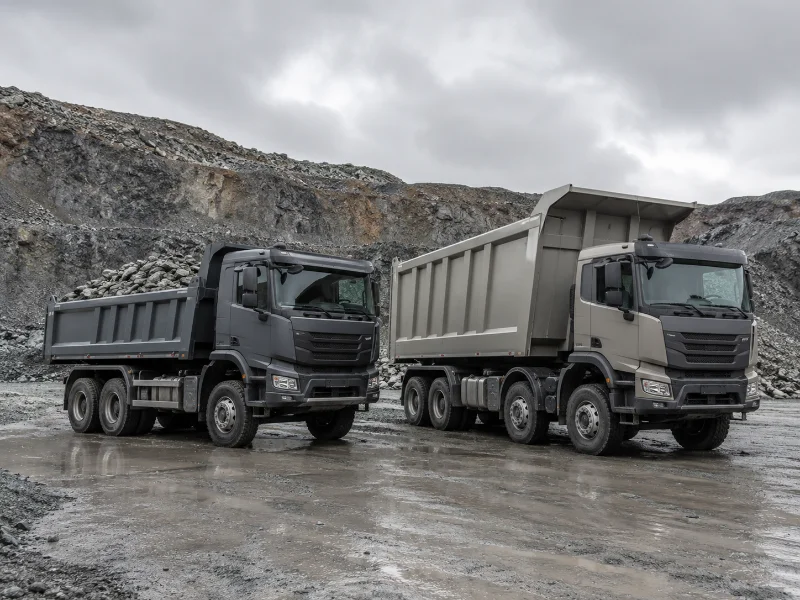
Axle configuration produces the widest single band in a HOWO quote; the choice that fits follows your material density and your route’s legal axle limits. It changes the chassis, suspension, tire count and the load the truck can legally carry, none of which a wheel-count label in a listing reveals.
| Configuration | Indicative export reference (USD, FOB) | Typical work | What governs the payload limit | What moves price inside the band |
|---|---|---|---|---|
| 6×4 (10-wheeler) | 19,500–40,000 | Road base, sand, gravel, municipal haulage, short cycles | Rear axle rating and destination axle-load law | Engine output, body steel and floor plate, cab grade, emission stage |
| 8×4 (12-wheeler) | 40,000–55,000 | Highway earthwork, quarry supply, long loaded cycles | Front axle group rating and route bridge limits | Body build and hoist spec, suspension package, emission stage |
| 6×6 all-wheel drive | 47,000–60,000 | Mine haul roads, soft ground, sustained gradients | Traction and gradeability before axle rating | Transfer case and driven front axle, tire spec, cooling package |
Scope note: these are published export reference ranges for complete units at FOB scope, updated August 2026. The band is a reference, not a quotation. Freight, duty and clearance are excluded. Reconfirm against the specific build, order quantity, Incoterm and quotation validity date before committing a budget.
Body volume and payload are two different quantities. The arithmetic between them is short: load mass equals body volume multiplied by the material’s bulk density. Crushed stone runs roughly 1.4–1.6 t/m³ loose, so a 20 m³ body filled level carries about 28–32 t of stone. Topsoil, at roughly 1.1–1.4 t/m³, puts the same body at about 22–28 t. These are planning ranges, not design values, because bulk density shifts with particle size, moisture, grading and compaction. Put your own numbers into the same product: body volume times your material’s tested bulk density gives the mass a full load asks the axles to carry.
The calculated material mass is not a permissible load. What you may legally carry is the lower of two figures. One is the vehicle’s rated payload capacity from the build sheet; the other is the axle or GVW limit applying on your route. On U.S. Interstate highways, for example, federal rules cap gross weight at 80,000 lb, a single axle at 20,000 lb and a tandem axle at 34,000 lb, and the U.S. Federal Highway Administration’s bridge formula can make a load illegal on axle spacing alone even below 80,000 lb. Read the calculation as a sizing check on the body, then confirm the entitlement to fill it from the chassis plate and the axle-load law on your own route.
A larger body is not a larger payload. Size the body for the densest material you haul routinely. On lighter material you fill to the top; on denser material you fill to a marked line. Copying body volume from a competitor’s spec sheet, before checking density and axle rating, usually produces a truck that is compliant empty and overloaded on every dense load. The fix is a smaller body or a marked fill line.
Engine Output and Emission Stage: Where the Premium Pays
Engine output on export HOWO dump trucks commonly falls in the region of 370–430 HP, though the figure available to you depends on model, engine family and destination specification. The premium at the top of that band returns value on sustained gradients and long loaded cycles.
Horsepower is an output figure and a poor proxy for engine identity. Older HOWO configurations commonly used WD615-family engines at around 371 HP, while current TX and N ranges carry newer powertrains that vary by model and market. Ask for the engine model and the certified emission specification rather than treating the horsepower badge as a model name. A 371 HP label on its own tells you very little.
If your haul is short, flat and limited by loader output, a 371–380 HP build moves the same tonnage per shift. The extra output buys headroom against a constraint you do not have. That judgement costs us the sale on the larger unit, and it is still the right one to state.
Emission stage should be checked against two things at once: the truck’s certified specification, and the fuel quality and entry rules in your destination market. Export HOWO builds appear across Euro II to Euro V and the equivalent China stages. The stage is a build decision taken at order time. After-treatment hardware at higher stages is sensitive to diesel sulphur content. A higher-stage truck can carry an operating dependency the purchase price never shows. Where local sulphur limits or parts coverage are uncertain, confirm both before paying the premium. Where your market sets a minimum stage on import, that premium is a cost of entry. Both situations can apply together, and the resolution depends on which constraint binds first.
New, Refurbished and Used: What Each Condition Tier Buys
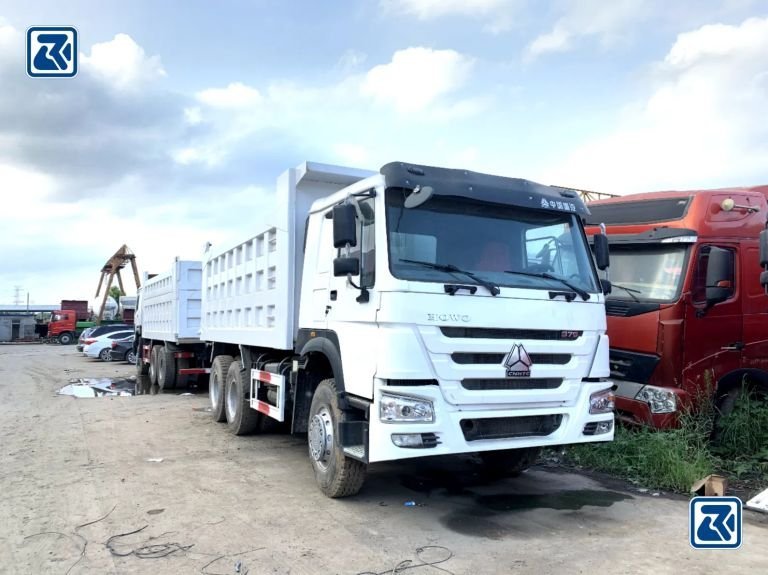
Condition tier changes what a HOWO dump truck quote includes more than model year does, because two units built in the same year can differ by a full engine overhaul.
| Tier | What the quote usually covers | Evidence to demand before paying | Suits you when | Main risk |
|---|---|---|---|---|
| New | Complete unit to your spec, stated warranty terms, single build year | Build sheet, chassis and engine numbers, emission-stage declaration | Fleet standardisation matters, or entry rules block older units | Longest lead time, highest cash outlay |
| Refurbished | Inspection, corrective repair, functional test, export preparation | Before, during and after photographs; component-level record of what was repaired, replaced or retained | Capacity is needed quickly and a shorter service life is acceptable | Depth of work varies widely at similar prices |
| Used, as-is | The vehicle in its present state | Cold-start and dashboard video, tipping and brake test, documents matched to the chassis number | You have your own workshop and can absorb early repairs | Repairs and downtime can exceed the purchase saving |
Fresh paint is presentation, not readiness. The offer worth trusting names the components it touched, and supports each statement with vehicle-specific photographs and identification numbers. We verify chassis and engine numbers against the documents and the repair record before a refurbished unit ships. The buyer is then auditing a record.
Landed Cost and the Entry Rules That Decide Which Tier You Can Buy
Landed cost adds shipping, import and delivery charges on top of whichever FOB figure you were quoted. In several markets an entry rule then decides which condition tier is open to you at all, regardless of the headline price. The charges arrive in five waves, and knowing when each one lands is what keeps a budget intact:
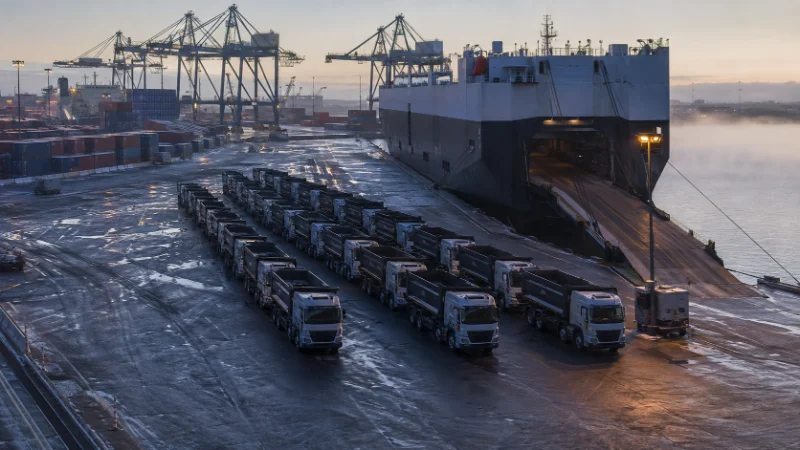
- At the loading port: the truck and body price, export documentation, and loading on board.
- In transit: ocean freight and marine insurance.
- On arrival: discharge and terminal handling, storage if clearance runs long, and pre-shipment or conformity inspection where the destination requires it.
- At customs: import duty and taxes, broker fees, and bank charges on the payment itself.
- Before the first shift: registration and homologation, inland delivery, any local body modification, and the initial spare-parts order.
The last two waves are where budgets break. On used HOWO trucks they absorb the saving that attracted the buyer. Duty and tax are the one wave no supplier can size for you, because the rate follows your tariff classification and your own customs authority sets it.
Where a destination bars used units above a set age, every quote below the price of a compliant unit falls out of scope. The apparent discount is a truck that cannot be registered. The entry rule, not the market, sets the floor under your usable price. At minimum, check the age basis and the drive-side rule. You should also confirm the emission stage accepted on import, and whether a pre-shipment inspection certificate is required.
Kenya is a working example of how strict this gate can be. The Kenya Bureau of Standards publishes the inspection code for imported road vehicles, KS 1515:2000, the Kenya Standard Code of Practice for Inspection of Road Vehicles, together with periodic import notices that set an age limit, a registration-date basis and a drive-side rule for used units. The exact cutoff year, how age is counted, and whether it runs from first registration or year of build can change between notices, so read the current figure off the notice rather than assuming last year’s rule still applies. Action: confirm the year of first registration on the export documents, not the year of build, before paying a deposit.
A special-purpose route may exist for units that fall outside the standard age or drive-side limits. KEBS also publishes guidance on special-purpose vehicle imports, which can allow entry subject to waiver conditions such as proof of customisation and a record of serviceability. Whether a tipper is classified as a special-purpose vehicle, and what the current waiver conditions and maximum age are, is a determination for the standards body, not something you can assume from the truck type. Action: confirm the classification and any waiver in writing before the unit ships, and treat the answer as a gate on the order.
Rules of this kind are national, and governments revise them at short notice. Run the same three checks with your own standards body before shortlisting on price: how age is counted, which drive side is admitted, and which emission stage clears customs.
Locking the Two Variables That Set Your HOWO Dump Truck Price
Two variables in a HOWO dump truck price settle before the others: the price basis you compare against, and the axle configuration your material density and route limits allow. Engine output, cab grade and body steel stay open while you are still specifying the order. All three become fixed physical decisions once the unit is built. Treat any published band as a planning reference at FOB scope, and expect freight, duty and clearance to move your real figure well outside it.
On dusty haul roads with frequent loaded tipping, hoist cylinder seals and body subframe welds are usually the first items to need re-inspection. The maintenance reserve you set depends on your route surface as much as on the truck.
If your body volume is already fixed by a tender and your material is dense, the tested density figure and your destination axle-load limit decide the configuration before any price does. Send us those two numbers with your destination port, and we will compare the HOWO truck configurations that fit before putting a figure against them.
FAQ
Can the emission stage be changed after the truck is built?
No. The certified stage follows the engine and after-treatment hardware fitted at the factory, so changing it later means changing hardware. Fix the stage before the build slot is booked.
How long is an export quotation valid?
Validity is supplier-specific and tracks steel prices, freight rates and exchange rates. Ask for the exact expiry date in writing, and re-confirm freight close to the booking date.
Can I buy the chassis and have the body built locally?
Yes, and it is common where local body builders are cheaper or a specific body shape is required. Price the chassis and the body as separate lines, and confirm that the chassis order includes the PTO and hoist provision.
Is a right-hand-drive unit more expensive than left-hand drive?
Steering position is usually a build option, so it affects lead time and available stock more than price. Where your destination restricts one drive side on import, it becomes a compliance condition.
What spare parts should ship with the first truck?
Ask for an initial package built around the engine, transmission, axle and hydraulic configuration supplied, then set quantities from expected running hours and how easily HOWO dump truck spare parts reach your workshop. Filters and hydraulic seals run short first.
Does a higher horsepower rating raise resale value?
Not reliably. Resale in most export markets tracks condition, hours and parts availability more closely than the horsepower badge.
Further Reading
- Incoterms® 2020 — International Chamber of Commerce — ICC (industry body). The authority behind the FOB/CIF/yard-ready distinction this article uses to decide whether two quotes are even comparable.
- Bridge Formula Weights — U.S. Federal Highway Administration — FHWA / U.S. DOT (government). The federal gross-weight, single-axle and tandem-axle limits that cap the legal payload behind any dump-body sizing decision on U.S. routes.