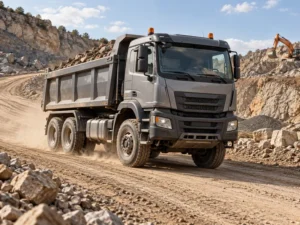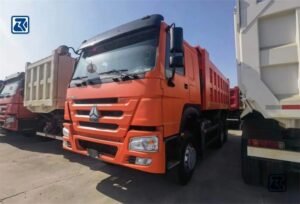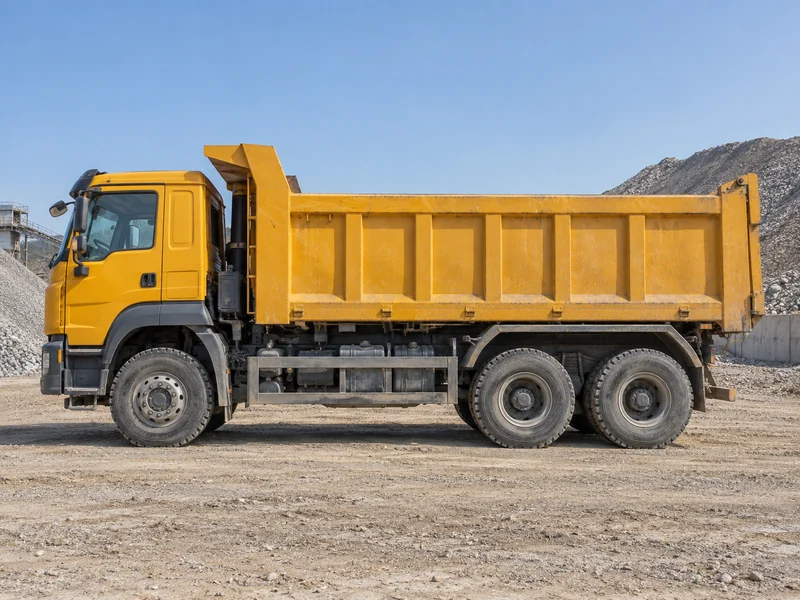
A HOWO dump truck’s dimensions are not a single number: they change with the chassis configuration, and each configuration carries a different overall length, width, height, wheelbase and cargo body size. Buyers usually search for one “size” figure, but a road-legal width, a jobsite gate clearance and a cargo body’s internal volume are three separate measurements that rarely move together. This guide reads the dimensions of a HOWO dump truck by configuration — 4×2, 6×4, 8×4 and off-road builds — so you can match the truck to the roads it runs on and the material it carries. Figures below are typical published ranges; confirm the exact numbers for any specific model against its spec drawing before you commit.
Reading a HOWO Dump Truck’s Three Dimension Layers
Three dimension layers answer three different questions, and mixing them is the most common spec error in this category. Overall dimensions (length x width x height of the whole vehicle) decide whether the truck fits the road and the site. Cargo body external dimensions decide the truck’s silhouette when the body is fitted and how tall it stands when tipping. Cargo body internal dimensions decide how much material actually fits. A quoted “5.6 m box” is an internal or external body length, not the truck’s overall length, and a quoted 2.5 m width usually describes the whole vehicle, not the body’s inner width.
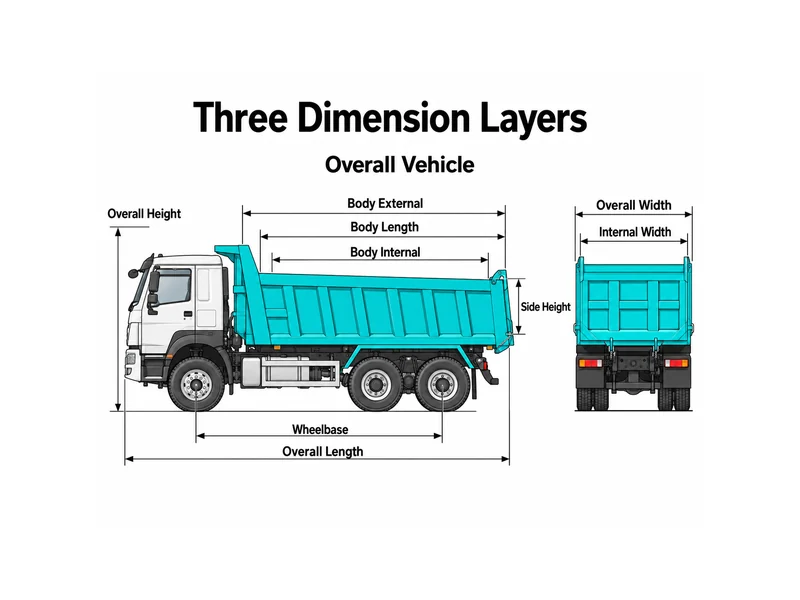
Overall height also depends on whether the body is down or raised. HOWO tipper bodies lift to a tipping angle of roughly 45 degrees, so the same truck stands much taller at full tip than it does parked. That raised height, not the travelling height, is what has to clear canopies, conveyors, gantries and overhead lines at the discharge point. The full-tip figure is model-specific: it shifts with body length, hinge point, hydraulic geometry, chassis height and load state. Read it from the model’s tipping envelope or spec drawing, and check it where the truck actually dumps.
Overall Dimensions by Chassis Configuration
Overall size scales with axle count, so the fastest way to narrow dimensions is to fix the configuration first. Lighter 4×2 builds are the shortest and are meant for tight, on-road work, and 6×4 is the mainstream haulage build. An 8×4 adds length and a longer wheelbase for volume, while off-road 6×6 trades some road manners for clearance. The table gives typical published ranges to compare like for like, with a manufacturer example where a specific figure is useful. Treat ranges as starting points and read the exact drawing for the model you shortlist.
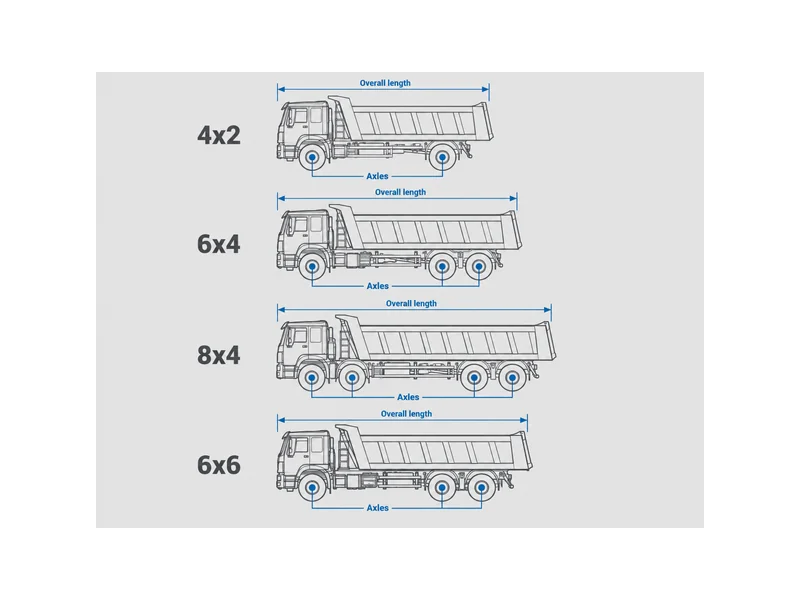
| Configuration | Overall L x W x H (typical) | Wheelbase (typical) | Common body length | Body volume (typical) | Payload band |
|---|---|---|---|---|---|
| 4×2 (light) | shortest overall length; single drive axle; ~2.5 m wide (confirm L and H per model) | shorter, single-drive | smaller (confirm per model) | smaller | lower band (confirm per model) |
| 6×4 (standard) | ~7.5-8.5 m long, ~2.5 m wide, ~3.0-3.5 m high (unloaded) | ~3.8-4.2 m | ~5.6-6.2 m | ~12-20 m3 | ~20-30 t |
| 8×4 (high volume) | longer and taller than 6×4; one OEM model lists 9,800 x 2,550 x 3,450 mm (single-model example) | ~5.2-5.8 m (one model: 3,200 + 1,350 mm) | ~6.8-7.6 m | ~20 m3 and up (one model: 22 m3) | ~30-40 t |
| 6×6 (off-road) | shorter body, higher clearance | rugged setup | shorter | smaller | terrain-limited |
4×2 and lighter builds
Tight sites, not tonnage, are where a 4×2 earns its place. Keeping overall length down, its shorter chassis and single drive axle make it easier to place in urban plots and yards, at the cost of body volume and payload. When manoeuvring room is the deciding constraint, the compact footprint of a HOWO 4X2 dump truck or a light-duty 10 ton HOWO dump truck is usually the reason to choose it. Confirm the rated payload for the specific model, and verify the turning radius against your tightest gate, not just the length.
6×4 — the standard haulage build
Fleets settle on the 6×4 as the volume-versus-access compromise, so its numbers are the reference point for the whole category. Overall length commonly runs about 7.5 to 8.5 m and width holds near 2.5 m. Unloaded height sits around 3.0 to 3.5 m, on a wheelbase of roughly 3.8 to 4.2 m. A widely quoted 6×4 cargo body measures about 5,600 x 2,300 x 1,500 mm, with floor and side plates often around 8 mm and 6 mm. If your material is dense and the roads are normal, the dimensions of a HOWO 6X4 dump truck are the baseline to compare everything else against.
8×4 and off-road builds
Load and axle count drive the 8×4: a second steer axle lets it carry a longer, higher-volume body, so this is the configuration to read when volume sets the spec. For a single-model reference, one Sinotruk-published 8×4 lists overall dimensions of about 9,800 x 2,550 x 3,450 mm, a 22 m3 body and a 3,200 + 1,350 mm wheelbase — one model, not a whole-range figure. Across the configuration, bodies of roughly 6.8 to 7.6 m are common, and payloads move into the 30 to 40 t region where local axle-load law allows. For rough ground, a heavy HOWO 8X4 dump truck or a high-clearance HOWO 6X6 dump truck trades body length for ground clearance and approach angle, so read those two figures alongside the box size.
Cargo Body Size and Loading Volume
Body volume in cubic metres, not overall length, tells you how much loose material a run carries. Common HOWO tipper bodies are offered around 12, 16 and 20 m3; one 8×4 model lists 22 m3, and heightened or heavy off-road bodies can exceed 30 m3. Internal width is usually near 2.3 m and side height often falls in the 1.5 to 1.8 m range. That is why two trucks with the same footprint can differ sharply in capacity once the side panels change height.
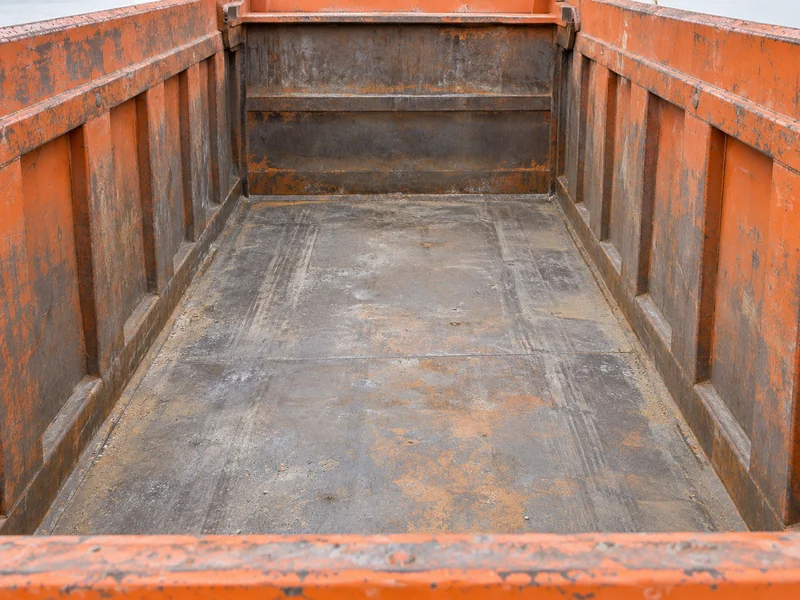
Struck volume and heaped volume are different numbers, and quoted capacity often means the heaped figure. Struck volume is the material level with the top rails; heaped volume assumes a mounded load at the material’s natural angle of repose. For dense, free-flowing material you will hit the weight limit before the struck line, so the heaped rating overstates what you can legally haul. Read whether a m3 figure is struck or heaped before you size the fleet against it.
Turning Body Volume into Payload
Payload is set by material density and the legal weight limit, so cubic metres alone never tell you the tonnage. A 20 m3 body carries very different weights of sand, wet aggregate, crushed rock or topsoil, because each has a different bulk density. With light material the body fills before the axles are loaded; with heavy material the axles load before the body fills. Published payload bands of roughly 20 to 30 t for 6×4 and 30 to 40 t for 8×4 assume the gross vehicle weight and axle limits in the operating market, not an unlimited load.
Overloading a correctly sized body is a real risk when buyers spec by volume and load by weight. If the material is dense, the practical move is to run the body part-full and stay under the GVW, and to confirm the axle-load rules that apply where the truck runs. The variable is density, the impact is legal and structural load, and the verification action is a simple check. Target tonnage divided by material density gives the working volume you actually need, which is often smaller than the catalogue body.
Fitting Dimensions to Roads and Jobsites
Overall width and height, not body volume, decide whether the truck is road-legal and can reach the work. HOWO dump trucks generally hold an overall width near 2.5 m, which keeps them within common highway width limits in many markets. Overall height, raised tipping height, turning radius and ground clearance are the figures that fail a site when you ignore them. Ground clearance often sits around 300 to 400 mm and turning radius around 8 to 9 m on standard builds. Both shift with configuration and tyres, so treat them as items to confirm, not fixed values.
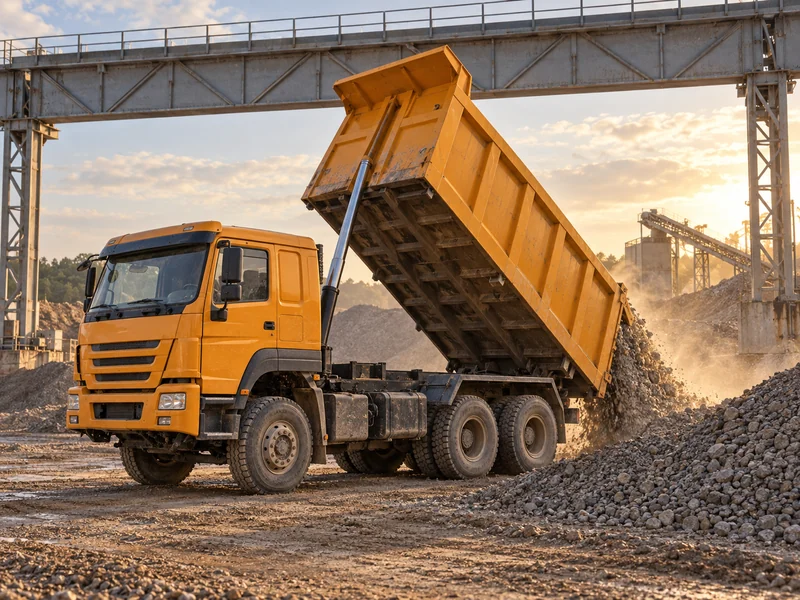
Match the constraint to the number before comparing capacity. If gates and lanes are tight, the overall length and turning radius rule out longer 8×4 builds regardless of their volume advantage. If the discharge point sits under structures, the raised tipping height decides the truck, not the travelling height. If the haul crosses broken ground, ground clearance and approach angle matter more than an extra cubic metre. Confirm each governing dimension against the actual route and discharge point, because a truck that fits the spec sheet can still fail the last hundred metres of the job. This article covers physical dimensions and does not cover pricing, emissions class or homologation, which follow their own rules by market.
Conclusion
Size a HOWO dump truck by fixing constraints in order, not by chasing the largest body. Start with the hard limits the route and site impose — road-legal width, travelling and raised height, turning radius and ground clearance — because those exclude whole configurations before volume ever enters the decision. Then choose the configuration, 4×2, 6×4, 8×4 or 6×6, that survives those limits, and only then compare cargo body volume and internal dimensions against the tonnage your densest material actually produces. The number that most often gets missed is the internal body size versus the loader or pallet feeding it, and the raised tipping height at the discharge point. Confirm both against the model’s spec drawing before you order, and the delivered truck will fit the work rather than the brochure.
FAQ
What are the dimensions of a HOWO dump truck?
Overall dimensions depend on the configuration. A mainstream 6×4 is the category reference point, lighter 4×2 builds are shorter, and 8×4 builds are the longest and highest-volume. Because bodies and wheelbases vary within each configuration, use the comparison table above for typical ranges and read the exact spec drawing for the specific model you shortlist.
How many cubic meters is a HOWO dump truck body?
Common HOWO tipper bodies are offered around 12, 16 and 20 m3, with one 8×4 model listing 22 m3 and heightened off-road bodies exceeding 30 m3. Check whether a quoted figure is struck or heaped volume, because heaped capacity assumes a mounded load and overstates what dense material can legally carry.
How wide is a HOWO dump truck?
Overall width generally sits near 2.5 m, which keeps most HOWO dump trucks within common highway width limits, while the internal body width is usually closer to 2.3 m. The two are different measurements: the 2.5 m figure governs road legality, and the narrower inner width governs how material and loading equipment fit.
What is the difference between the dump body internal size and the truck’s overall dimensions?
Overall dimensions describe the whole vehicle for road and site fit, while internal body size describes the loading space for capacity. A 5,600 mm figure is usually a body length, not the truck’s overall length, and internal width runs narrower than overall width. Size road access from the overall dimensions and size capacity from the internal body dimensions and volume.
Is a HOWO 8×4 larger than a 6×4?
Yes. An 8×4 is longer and higher-volume than a 6×4, with a longer wheelbase and cargo bodies commonly near 6.8 to 7.6 m. It carries more material but needs more room to manoeuvre, so a 6×4 often wins on tight sites even though the 8×4 wins on volume.
Further Reading
- HOWO 8×4 dump truck manufacturer specification — Manufacturer (OEM) product spec. Supports the specific 8×4 dimensional example (overall size, body volume, wheelbase); read as a single-model figure, not a whole-range value.
- Dump truck dimensions and sizes guide — General industry guide (not a standards or OEM source). Supports the by-type dimension and payload ranges used to frame the 6×4/8×4 comparison; treat as typical ranges, not exact specs.