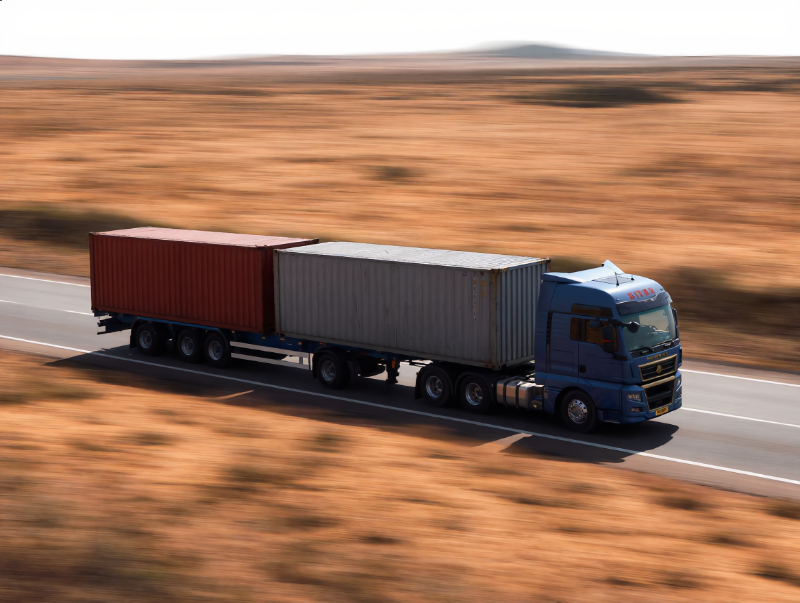
The SITRAK C7H is Sinotruk’s premium heavy tractor line, built on MAN TG platform technology. Export builds differ by engine family, gearbox, cab and emission level. Two trucks quoted under one model name can carry different drivelines and different parts baskets, and at the destination port they can meet different plating rules.
Three questions decide a C7H order: what the model name spans, which variables carry the decision, and which papers prove that the delivered truck matches the quote. Semi-trailer matching and fifth-wheel position sit outside that scope, and that review comes once the tractor spec is fixed.
What the SITRAK C7H Model Name Covers Across Build Years and Markets
One model name, the SITRAK C7H, spans a whole tractor family; the driveline that actually arrives depends on the model code. Sinotruk places SITRAK trucks above HOWO, and the cab, chassis and driveline content trace back to a licensed European heavy-truck platform.
Diesel builds cluster around the MC11 and MC13 engine families. Export listings also show gas builds, and engines from outside the MC series. Treat those as market-specific, and confirm the engine code from the engine plate and the conformity certificate. A listing page is not evidence. Drive layouts run from 4×2 and 6×2 up to the common 6×4, and off-highway C7H-M variants extend to 6×6 and 8×8.
The model code is what binds a quote to a driveline. Public listings for 6×4 C7H tractors carry codes that begin ZZ4256, and the suffix encodes the driveline, the cab and the emission build. We pin down that code, along with the engine, gearbox and axle part numbers behind it, before we quote. One model name can point to drivelines with entirely different service parts.
Why Horsepower Ranks Low Among C7H Specification Variables
Rated horsepower ranks below gross combination mass, sustained gradient and axle ratio in any C7H decision. Rated output is a ceiling, and what reaches the wheels on a given grade is another number entirely. Buyers who sort quotes by horsepower end up comparing trucks built for different work.
Axle ratio is what turns engine output into usable pull. A ratio set for flat highway running holds top gear well on level ground, then hunts on a long climb. A ratio set for gradients settles on hills, but it runs at higher engine speed across the flat, and fuel burn per kilometre goes up.
Pick a ratio on the assumption of highway duty, skip the check on gross combination mass and sustained gradient, and the truck hunts gears for the rest of its life. Fuel climbs, and the clutch and driveline wear early. The fix is a driveline change, and it costs far more than the review would have. We match the stated route profile against the axle ratio and the gearbox ratio spread on every C7H enquiry, and we settle both before the order reaches the factory.
C7H Powertrain Families and the Route Profiles They Match
Three powertrain groups cover the C7H: 11-litre diesel, 13-litre diesel and gas. The right group follows load, gradient and the fuel supply along the corridor.
| Engine family | Class | Common pairings | Best-fit route profile | Verify before order |
|---|---|---|---|---|
| MC11 | 11-litre diesel | Automated manual, or 16-speed manual | Regional distribution, moderate gradients, weight-sensitive loads | Whether the payload gain offsets lower reserve torque on climbs |
| MC13 | 13-litre diesel | Automated manual, hydraulic retarder | Long-haul highway, container haulage, sustained gradients | Retarder rating against descent length and brake duty |
| Gas builds | CNG or LNG | Gas tank package, automated or manual gearbox | Fixed corridors with reliable gas refuelling | Refuelling coverage and tank capacity against stage length |
| Market-specific engines | Varies by build | Local gearbox options | Markets that put parts access first | Engine code, emission level, and whether local parts channels match |
Torque at low engine speed decides whether a rig holds a gear on a climb. Peak power does not. Torque curves also differ between builds inside one engine family, so two trucks with the same rated output can behave differently on the same hill. Published fuel figures come from bench test runs, and a loaded export corridor rarely reproduces them, so they read as a comparison, not as a budget.
In hot, dusty corridors, the air intake, charge-air cooler and radiator are the first parts that need a second look after the first service. We check the cooling and filter package against the heat and dust at the destination, and we specify it on the order. Retrofitting the same package after delivery costs more and takes the truck off the road.
Specification Fields to Pin Down Before a Quotation Is Binding
Six fields decide whether a C7H quote describes a truck you can plate, and a document or a plate proves each one.
| Field | Why it changes the decision | Proven by |
|---|---|---|
| Model code | Binds the quote to one driveline and cab build | Order document, conformity certificate |
| Engine code and serial | Sets the parts basket, service interval and emission hardware | Engine plate, conformity certificate |
| Gearbox model and ratio spread | Decides whether the truck holds gear on the worst grade | Gearbox plate, spec sheet |
| Axle model and final drive ratio | Turns engine output into pull at the wheels | Axle plate, spec sheet |
| Emission level | Decides whether the truck can be plated at the destination | Emission certificate, conformity certificate |
| Drive layout | Sets traction, unladen mass and tyre wear | VIN plate, physical inspection |
Listings quote values for all six fields, and those values disagree across sources for one model name. The same spread runs through published SITRAK truck price ranges, which is why a quote only means something once the six fields are fixed. We check each field against the truck’s own papers before we issue the proforma, and we treat listing values as a guide and nothing more.
Drive Layout, Cab and Emission Level: The Variables That Move Landed Cost
Drive layout, cab and emission level swing landed cost and fleet uptime more than the sticker price does. Route data settles all three; preference should not.
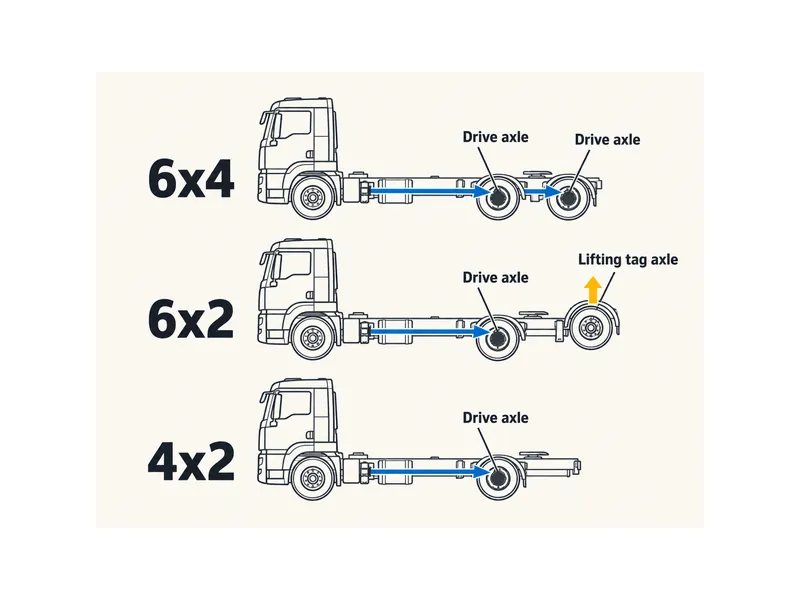
Layout follows surface and load. A 6×4 drives both rear axles under a full container load, which is why it rules long-haul export orders. A 6×2 lifts its tag axle when empty, which cuts unladen mass and tyre wear on paved roads, and it gives up traction the moment a yard turns loose or wet. A SITRAK 4×2 tractor truck suits lighter regional work, where the load never approaches what a 6×4 is built for. The C7H-M in 6×6 and 8×8 is off-highway equipment on a different chassis and suspension.
Cab choice is where the platform’s European lineage shows, and where buyers overspend most often. A high-roof sleeper earns its cost on multi-day cross-border runs, because standing height, a bunk and storage help keep an experienced driver with the fleet. On a shuttle between a port and an inland depot, that same cab adds unladen mass and frontal area for a benefit nobody uses, and a day cab carries the load for less. Where the destination demands cab-strength approval, ask whether the cab on offer meets UN Regulation No. 29 (ECE R29), the UNECE standard that sets the cab crush tests for occupant survival space, and ask to see the certificate instead of trusting the claim.
Emission level is the one variable on this list that nobody can fix after the truck lands. A build made to one Euro level cannot be re-certified to another at the destination. Under the EU heavy-duty emission framework (Regulation 595/2009), Euro VI has capped engine NOx at 0.4 g/kWh since 2013, well below the 2.0 g/kWh allowed under Euro V, and each step is a different exhaust-hardware build that no destination workshop can dial in. Send a low-level build into a market that plates only a higher level, and the truck clears customs, then stops at the licensing counter. Re-export, not repair, becomes the remedy. We read the emission level off the conformity certificate and check it against the destination rule before shipment, because that paper decides whether the truck gets plates.
Documents and Plates That Prove a C7H Specification Before Shipment
A C7H order is proven by its documents and by the plates on the truck itself. Which papers carry the most weight depends on the destination’s plating and emission regime, and each step below leaves a record an inspector can hold against the truck.
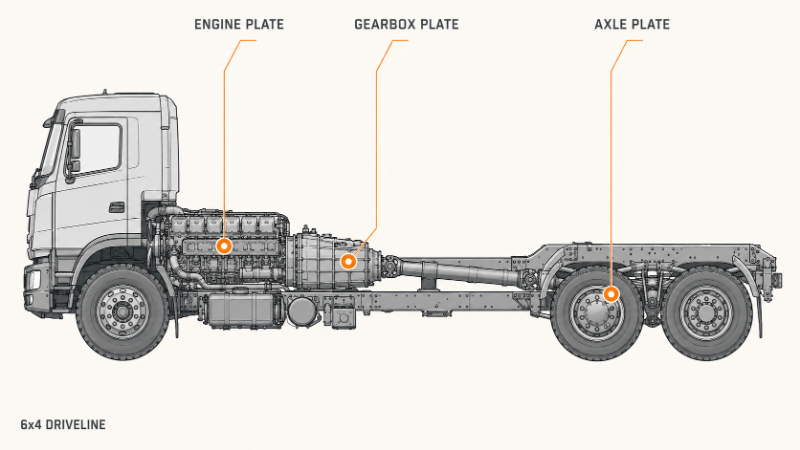
- Confirm the model code, then write down the engine, gearbox and axle part numbers it implies.
- Match the VIN on the chassis to the VIN on the invoice and on both compliance certificates.
- Photograph the engine, gearbox and axle plates. Check the engine code and serial, the gearbox model, and the axle model and final drive ratio against the quote.
- Ask for the emission certificate in the destination language, and check the level against the rule now in force.
- Where the destination demands cab-strength approval, ask whether the cab holds ECE R29, and ask for the certificate.
- Book a third-party pre-shipment inspection covering driveline part numbers, cab build and paint. Then order one minor part through the intended channel and time the delivery.
Plate photographs are the cheapest evidence in this sequence, and the most often skipped. An engine code that sits one suffix character off the quote points to a different emission build and a different parts basket, and in some markets it points to a different plating outcome as well. We time these checks to the shipping schedule, so a mismatch surfaces before loading, while the fix stays a second inspection instead of a return.
Next Steps for a C7H Specification Review
By the time a C7H order is ready to place, the decision has narrowed to three things: the route the truck will run, the driveline that matches it, and the papers that prove what was delivered. Horsepower and cab trim sit downstream of all three.
The errors that surface after delivery are rarely exotic. An axle ratio matched to a corridor nobody measured. An emission level assumed and never certified. An engine code one character off the quote. Each of these is visible on paper, or on a plate, before the truck ships. We check the model code, the ratio spread and the emission certificate on every order, and we match the build to the destination rule before the proforma goes out. Tyre spec, retarder sizing and parts stocking still depend on route data that only the operator holds.
Before you ask for a quote, prepare three inputs. First, the corridor profile: distance, worst sustained gradient, and how much of the route is unpaved. Second, the gross combination mass you intend to run. Third, the plating and emission rule at the destination. Send those to us with the C7H variant you have in mind, or with any other SINOTRUK Tractor build you are weighing against it. We will compare the available builds and return a spec review that lists the documents each build needs.
FAQ
Is the SITRAK C7H the same truck as a HOWO tractor?
SITRAK and HOWO are separate Sinotruk lines, with different cabs, chassis and driveline sourcing. SITRAK sits higher in the range and carries European-licensed platform content, while HOWO favours simple mechanics and wide parts supply. Road surface, fuel quality and service-network depth decide which line fits. Where the answer points to HOWO, the next step is choosing a HOWO tractor truck model against the same route data.
Does the SITRAK C7H use European-licensed engines?
The C7H runs Sinotruk MC-family engines, built on technology licensed from MAN. They are not badged as the licensor’s own units, and the parts basket is Sinotruk’s. Some export builds carry engines from outside the MC family altogether, so read the engine code off the plate before you assume either way.
Which engine is in a 540 hp SITRAK C7H?
Published 540 hp C7H listings name 13-litre engines from the MC13 family. The suffix after MC13 varies across listings for trucks that look identical, and that gap tracks build year and emission hardware, with no single canonical engine behind the number. Take the full code from the engine plate, never from a listing page.
Can a 6×2 SITRAK C7H be converted to 6×4 later?
Not as a practical retrofit. A 6×2 carries a lifting tag axle that no torque passes through, while a 6×4 carries a second drive axle, its own driveshaft and a different suspension. Swapping one for the other is a full rebuild, well beyond an option box, so drive layout has to be right on the order.
Is the SITRAK C7H sold in Euro V or Euro VI?
Both, depending on the build. The factory sets the emission level, and both the conformity and emission certificates record it. No build can be re-certified upward once it ships. Read the level off those two papers, and match it to the destination rule before you sign.
Which documents are needed to import a SITRAK C7H tractor truck?
A C7H import file usually holds five papers, and each one comes from a different source. The seller issues the commercial invoice. The maker issues the conformity certificate and the emission certificate. The yard supplies the VIN plate photograph, and the inspection body supplies the pre-shipment report. Some destinations also want a certificate of origin, a cab-strength approval or a homologation certificate, so confirm the list with the plating authority before shipment.
Further Reading
- DieselNet EU Heavy-Duty Engine Emission Standards — technical standards database (T2). Sets out the Euro III to VI NOx and PM limits and their in-force dates, which underpin the emission-level check that decides whether a C7H build can be plated at the destination.
- UN Regulation No. 29: Commercial Vehicle Cab Occupant Protection — UNECE regulation reference (T2). Defines the cab crush tests behind the cab-strength approval some markets require before plating.
- TransportPolicy.net EU Heavy-Duty Emissions — industry policy reference (T2). Confirms the Euro V and Euro VI approval dates and limits used to match a build to a destination emission rule.