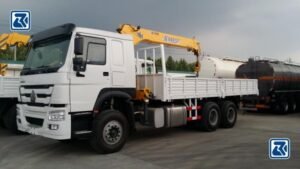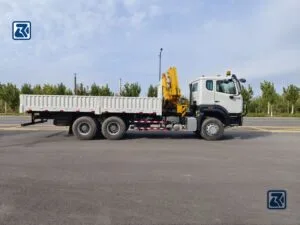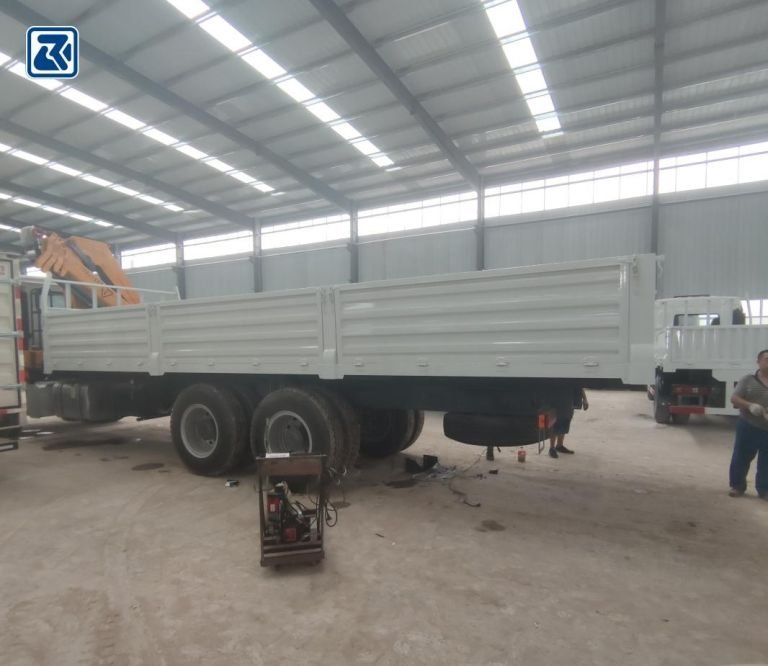
Safe operation of a HOWO truck crane depends far more on setup, load-chart discipline, and operator competence than on the machine itself. A well-maintained crane still tips or drops a load when the ground is soft, the outriggers are short-set, or the lift exceeds the rated capacity for that radius. This guide walks through the full working sequence an operator runs on a HOWO truck-mounted crane, from the pre-shift inspection to shutdown. It also flags the U.S. safety limits that govern each stage. It does not cover model-specific specifications or any modification of the machine; both of those belong to the manufacturer’s manual for your unit.
Pre-Operation Inspection: What to Check
A pre-operation inspection decides whether the crane is fit to work that day, so it comes before the engine and the PTO ever engage. The goal is to catch a worn rope, a leaking cylinder, or a missing pin while the machine is still parked. Work through the crane in a consistent order so nothing gets skipped under time pressure.
- Structure and wire rope: check the boom, jib, and steel cables for cracks, corrosion, kinks, bird-caging, or flattened strands. Confirm the rope is spooling cleanly without knots.
- Hook and latch: look for deformation, cracks, or wear on the hook, and verify the safety latch closes and holds.
- Hydraulic system: inspect lines, hoses, and cylinders for leaks, chafing, or bulging. Confirm fluid levels sit within the manufacturer’s range.
- Safety devices and fasteners: confirm that the emergency stop and any load indicator or overload protection your machine is equipped with respond as described in its manual. Check that no bolts or pins are loose or missing.
- Documents: keep the inspection log and maintenance records current and on hand.
A defect in the load path, whether in the rope, hook, boom, or a safety device, takes the crane out of service until it is repaired. It is not something to note for later. Recurring hydraulic seepage in particular is worth tracing to its source, not topping off each morning.
Setting Up on Stable Ground with Outriggers
Where and how you set up determines the crane’s stability envelope before a single load leaves the ground. The rated capacities on a load chart apply only to the specific outrigger configuration and level condition printed on the chart you are lifting by. Many machines publish separate, reduced charts for partially extended outriggers, so the setup has to match the chart in force or that chart no longer applies. Position the truck so the intended lift stays within the crane’s rated working area, and level the frame to the tolerance the manual gives.
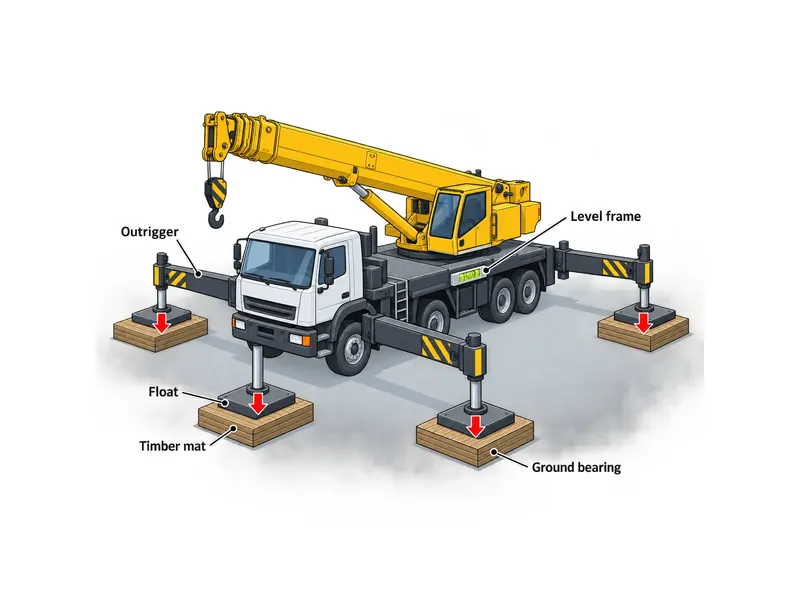
Ground bearing is the variable operators most often underestimate. Soft, backfilled, or recently disturbed soil can settle under outrigger pressure even when the surface looks solid. That is why crews use timber mats or pads to spread the load on anything less than firm, compacted ground. Check the footing under each outrigger float, not only the surface the tires sit on, because the floats carry most of the reaction during a lift. Watch for buried voids, trench backfill, or a crowned surface that would tilt the machine. Deploy the outriggers to the configuration the load chart and manual call for, and use a partial-extension setup only when a corresponding chart permits it. Setting up well also underpins the efficiency of operations across a shift, because a stable, level base cuts the repositioning that eats into productive lifting time.
Reading the Load Chart Before You Lift
The load chart is the single document that tells you whether a planned lift is safe, so read it before rigging. Rated capacity is not a single number: it changes with boom length, boom radius, and boom angle. Each cell of the chart gives the capacity for one specific configuration. Find the row and column that match your actual boom length and load radius, then treat the value there as the ceiling for that lift, including the weight of the hook block, rigging, and any jib.
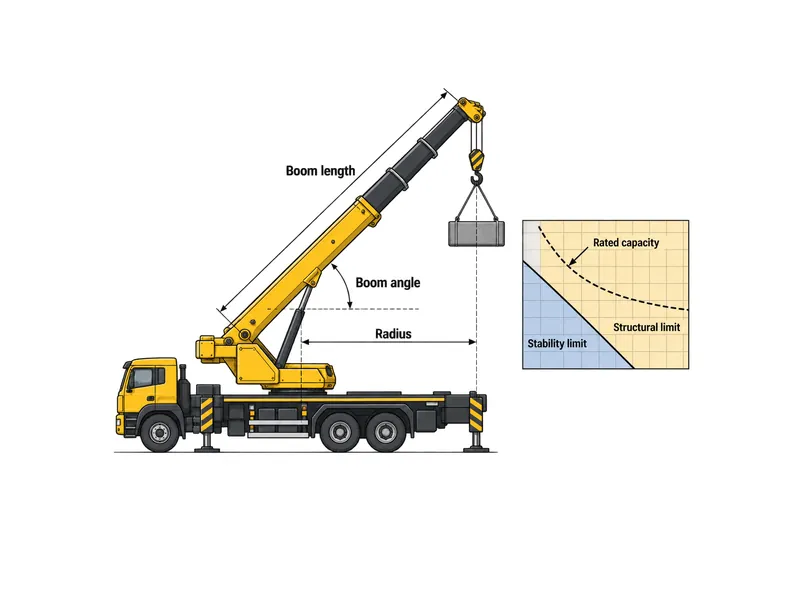
Two limits sit inside every chart. Capacities above a bold dividing line are limited by the crane’s structural strength; those below it are limited by stability, meaning the tipping point. Boom angle correlates cleanly with radius only when the boom is straight, so on longer configurations verify the lifting capacity against the radius you can actually measure. Where a single line cannot carry the load, the chart specifies reeving with more parts of line to share it. Read the chart at the largest radius the load will reach during the lift, not only at its starting point. A load that swings out or is set down farther from the crane can move past capacity mid-lift. Capacity falls off sharply as the load moves away from the crane’s center. On many jobs the working radius of a HOWO truck-mounted crane is the deciding variable in whether a lift is feasible at a given setup.
Controls and Safe Load Handling
The controls on a truck crane exist to move the load smoothly and predictably, so the operator’s aim is steady, deliberate motion. Identify and function-test the controls, load indication, and protection devices your specific crane is equipped with before the shift, using its operating manual. Where a load indicator or overload protection is fitted, treat it as a backup that catches an error, not as permission to work up to the limit.
Once the setup and chart check out, the handling itself follows a short discipline:
- Rig the load with slings, straps, or chains rated for the weight, and inspect them for wear before every use.
- Balance the load so it will not shift or rotate as it leaves the ground.
- Lift smoothly, avoiding sudden starts, stops, or swings that shock-load the rope and boom.
- Change swing direction slowly and pull straight; do not rock the boom.
- Use a tag line to steady the load’s rotation and keep ground crew out of its path; a suspended load left to spin free is a frequent cause of near-misses during placement.
- Keep clear communication with a designated signal person throughout, by standard hand signals or radio.
Lifts over the front of the cab deserve special caution. On many truck cranes the front is the most restricted zone on the chart, so confirm the rated capacity for that quadrant before committing. Do not assume the side or rear figures apply.
Power Line Clearance and Site Hazards
Contact with overhead power lines is the hazard that most often turns a routine lift fatal, so clearance is planned before the crane sets up. NIOSH has long identified crane contact with energized lines as the most common cause of fatalities in mobile crane operations. Its investigations also found that full compliance with the applicable clearance rules would have prevented the incidents it studied. Treat every overhead line as energized unless the utility has de-energized and visibly grounded it.
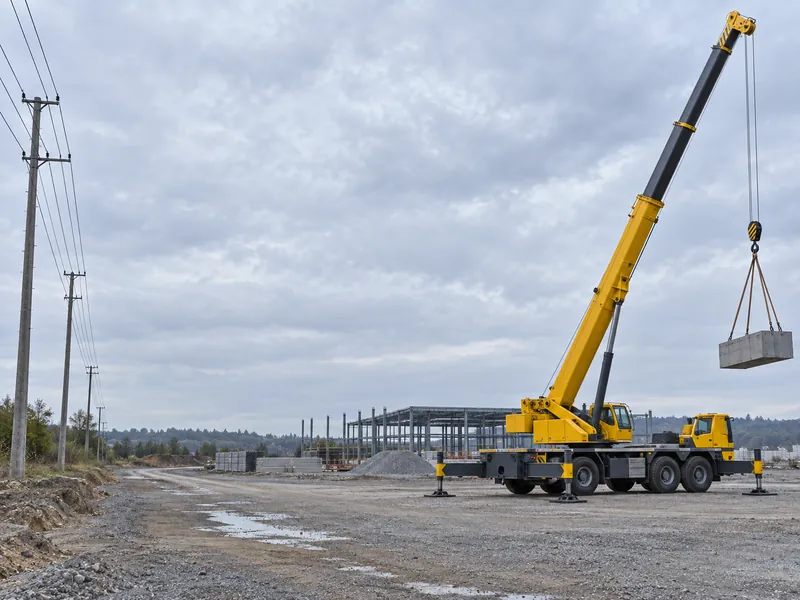
Under OSHA 29 CFR 1926.1408, crane work near energized lines must maintain a minimum clearance that increases with voltage:
| Line voltage (kV, AC) | Minimum clearance |
|---|---|
| Up to 50 | 10 ft |
| Over 50 to 200 | 15 ft |
| Over 200 to 350 | 20 ft |
| Over 350 to 500 | 25 ft |
| Over 500 to 750 | 35 ft |
| Over 750 to 1,000 | 45 ft |
Where the exact voltage is unknown, the standard’s default is a minimum of 20 feet until the utility or a qualified engineer confirms otherwise. Beyond power lines, the recurring site hazards are unstable ground, overloading, and poor visibility. Each is managed by the same habits: verify the setup, respect the chart, and keep non-essential personnel out of the swing radius and out from under the load.
Operator Certification, Shutdown, and Maintenance
In the United States, operating a truck crane on a construction site is a regulated activity, not just a skill. OSHA 29 CFR 1926.1427 requires construction crane operators to be certified or licensed through an accredited path, with certification valid for up to five years. Equipment with a manufacturer-rated capacity of 2,000 pounds or less is exempt from that section. Certification covers load-chart use, rigging, and hazard recognition, so training is the real backstop against overload and tip-over.
Shutdown protects both the crane and the next shift, so it follows a fixed order. Lower the load fully to the ground, retract and stow the boom to its rest position, secure the hook, retract and lock the outriggers, and disengage the PTO. Then run a brief post-operation check of the rope, hook, and hydraulic system, and log any wear or leak for repair before the crane is used again. Between shifts, routine maintenance keeps the machine on its capacity ratings: lubricate moving parts to the manufacturer’s spec, and test the overload and emergency-stop systems on a regular schedule. Because so much of a truck crane’s reliability rides on its hydraulics, a disciplined routine for maintaining the HOWO crane hydraulic system does more for uptime than any single component upgrade.
Conclusion
Operating a HOWO truck crane safely rests on getting three things right before the hook ever takes weight. First is a stable, level setup on adequate ground, with the outriggers deployed to the configuration the load chart calls for. Second is a load-chart check for the exact boom length and radius of the lift. Third is confirmed clearance from any overhead power lines. Those are also the three points where a rushed operator does the most damage, so they are the confirmations worth slowing down for on every lift. When a lift falls outside the machine’s manual, such as an unusual ground condition, a marginal chart reading, or a certification gap, stop and verify the limits against that crane’s load chart, the applicable regulations, and a qualified person before proceeding.
FAQ
Do crane operators need certification to run a truck crane?
Yes, for construction work in the United States. OSHA 29 CFR 1926.1427 requires construction crane operators to be certified or licensed through an accredited path, valid for up to five years, with an exemption for equipment rated at 2,000 pounds or less. Certification confirms the operator can read a load chart, rig correctly, and recognize hazards.
How far must a HOWO truck crane stay from overhead power lines?
At least 10 feet for lines up to 50 kV, with the required clearance increasing at higher voltages under OSHA 29 CFR 1926.1408. When the line voltage is unknown, keep a minimum of 20 feet until the utility or a qualified engineer confirms it is safe to work closer. Treat every line as energized unless it has been de-energized and grounded.
Why does the outrigger setup have to match the load chart?
Because each rated capacity applies only to a specific outrigger configuration and a level machine. A partial-extension setup narrows the crane’s stability envelope, and many machines require a separate reduced-capacity chart for it or bar the lift entirely. Deploy the outriggers to the configuration the chart calls for, on firm ground or on mats where the ground is soft, so the actual setup matches the numbers you are lifting by.
How do you know if a lift is within the crane’s capacity?
Match the actual boom length and load radius to the load chart and read the rated capacity for that exact configuration, then subtract the weight of the hook block, rigging, and jib. Capacity drops as the radius grows and as the boom lowers, so a load that is safe close-in can be over capacity at reach.
Further Reading
- OSHA 29 CFR 1926.1427 — Operator training, certification, and evaluation — U.S. federal standard (T1/T2). Supports the certification and five-year validity requirement for construction crane operators.
- OSHA 29 CFR 1926.1408 — Power line safety (equipment operations) — U.S. federal standard (T1/T2). Source of the minimum clearance distances by voltage used in the power-line section.
- NIOSH — Preventing Electrocutions from Contact Between Cranes and Power Lines (85-111) — U.S. government/NIOSH (T1). Supports the judgment that power-line contact is the leading cause of fatal mobile-crane incidents.