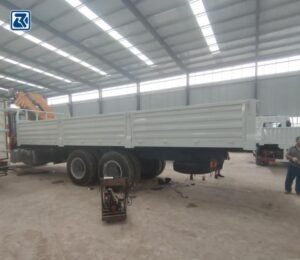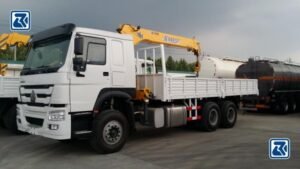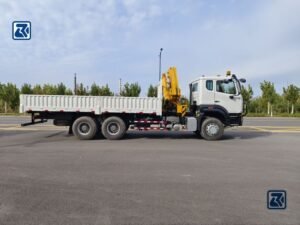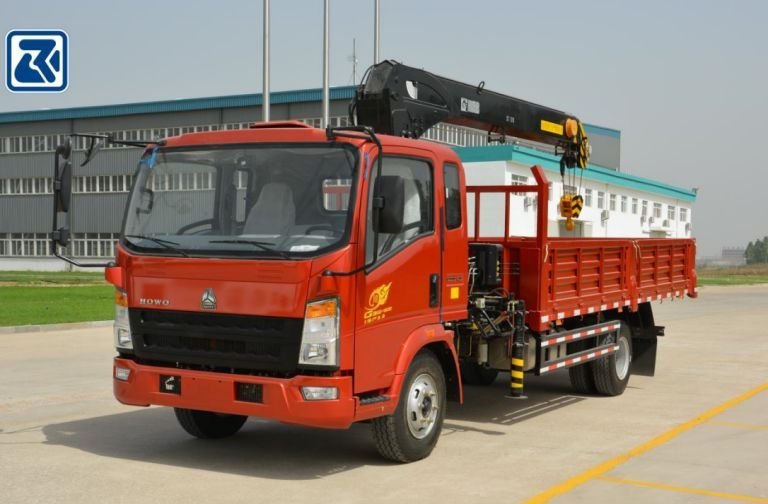
HOWO truck-mounted cranes typically lift from about 2 tons up to 20 tons or more, with 8-, 10-, 12-, and 16-ton units among the most common on working sites. That headline tonnage is a rated maximum measured at a short, defined working radius and boom setup, not a fixed weight the crane can pick up anywhere in its range. The number that matters on site is what the crane can lift at your actual radius and boom length once the hook and rigging are subtracted. That figure is almost always lower than the model’s name.
The sections below explain how rated capacity is defined for HOWO truck cranes, which variables move it up or down, and how to read the load chart that ties them together. This guide does not cover fixed tower cranes or all-terrain mobile cranes, which are rated on a different basis.
HOWO Truck Cranes and What “Rated Capacity” Means
Rated capacity is the manufacturer-rated maximum load a truck crane can lift under a specific set of conditions, not a single fixed weight. Each HOWO crane pairs a truck chassis with a boom mounted on a slewing turntable, and the rating always assumes a stated working radius, boom length, boom angle, and outrigger configuration. Change any one of those, and the safe load changes with it.
Two rating limits sit behind every capacity figure. One is stability, the point at which the load would start to tip the crane, and the other is structural strength, the point at which the boom or components would be overstressed. The published capacity at any position is the lower of the two. A crane close to its base is usually limited by structure, while the same crane at long radius is limited by tipping.
Truck cranes also come in two common boom styles that affect how capacity behaves. Straight (telescopic) booms extend for height and reach and are simpler to rate across a range, while articulated (knuckle) booms fold for tight spaces and trade some outright reach for maneuverability. Neither style changes the core rule: the rated tonnage is an anchor point, and the working figure depends on how the crane is set up for the lift.
Factors That Change a HOWO Crane’s Lifting Capacity
Working radius is the single largest reason a crane cannot lift its rated tonnage everywhere. Radius is the horizontal distance from the crane’s slew center to the hook, and capacity falls sharply as that distance grows because the load’s leverage against the machine increases. A crane may be rated at its full tonnage only within a few meters of the base and carry a fraction of that at the far end of its reach. This inverse relationship is why the working radius of HOWO truck-mounted cranes is planned together with capacity, not treated as an afterthought.
Boom length and boom angle work together to set that radius. Extending the boom lengthens the load path and lowers capacity, while raising the boom angle pulls the load back toward the machine and recovers capacity. A shorter, steeper boom is the configuration that lets a crane approach its rated maximum; a long, low boom is where capacity drops off fastest.
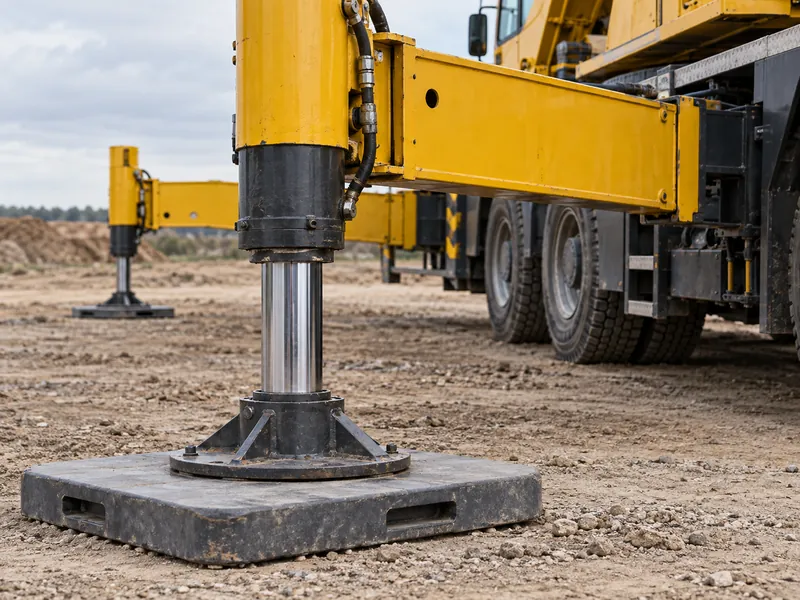
Outrigger deployment and counterweight set the stability baseline before the lift even starts. Fully extended outriggers widen the support footprint and open up the higher end of the load chart, while partial or single-side deployment can cut available capacity substantially. Counterweight balances the load’s overturning moment, so the chart used must match the counterweight actually fitted.
Ground conditions and load control decide whether the rated figure holds in practice. Soft, uneven, or unconfirmed ground reduces effective capacity because the outriggers can settle and shift the crane out of level, and dynamic effects such as wind, load swing, and side loading all erode the margin. The following variables should be confirmed before any lift:
- Working radius and boom length for the planned pick
- Boom angle and the matching load-chart column
- Outrigger extension and counterweight configuration
- Ground bearing under each outrigger pad
- Wind and any risk of the load swinging or being side-loaded
How to Read a HOWO Truck Crane Load Chart
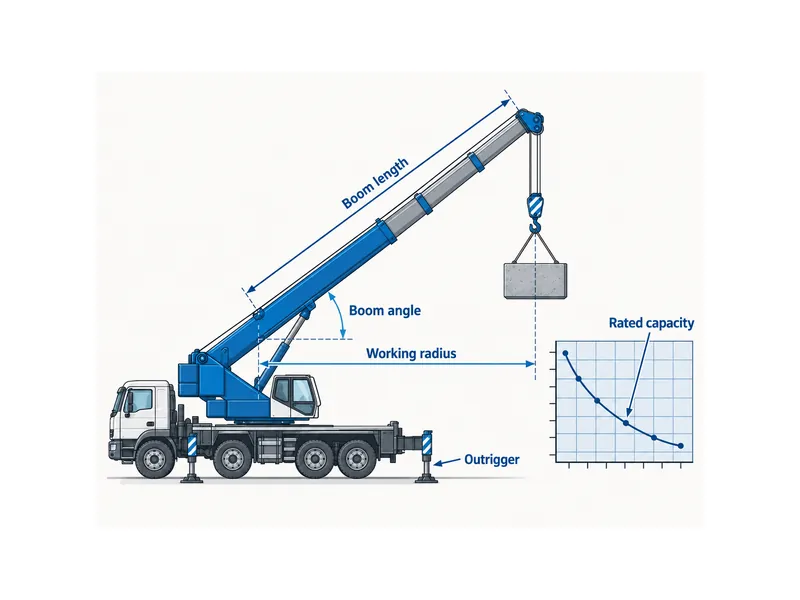
The load chart is the tool that converts a rated tonnage into the weight the crane can actually lift for your lift. On a typical chart the left column lists working radius, the top row lists boom length, and each cell where they meet gives the gross capacity for that combination, often with the boom angle shown in parentheses. Reading down and across to your planned radius and boom length is how you find the real limit; the model name alone will not tell you.
Gross capacity is never the number you rig to, because attachments have to be deducted. The working relationship is simple: gross capacity minus the weight of the hook block, slings, spreader bars, and any other rigging equals the net load you can safely lift. Skipping this deduction is one of the most common ways an operator ends up over capacity while believing the chart said otherwise.
Rated-capacity information is also a compliance requirement, not just good practice. Under OSHA 29 CFR 1926.1417, a crane must not be operated in excess of its rated capacity, and the load chart, operating instructions, and manual must stay readily available in the cab for the operator. The rated-capacity data itself, per 29 CFR 1926.1433, has to cover the manufacturer’s approved radii, boom angles, boom lengths, and configurations. It also has to give separate ratings for outrigger and counterweight setups. Reading the chart that matches your exact configuration is therefore both the safe and the required way to plan a pick.
Lifting Capacity Across HOWO Crane Models
HOWO truck cranes span roughly 2 to 20 tons and above, and matching the model to the job means matching capacity at your working radius, not just the headline tonnage. The tonnage tiers below reflect where each range commonly fits; treat them as starting points to verify against the load chart, since the same crane delivers less as the radius grows.
| Rated tonnage | Common use | What to verify |
|---|---|---|
| 8 tons | Light construction, small equipment and material handling in tight urban sites | Whether the load stays within reach at the short radius the rating assumes |
| 10 tons | Logistics yards and small-to-medium construction, wall and panel material handling | Capacity at the mid-range radius most handling actually uses |
| 12 tons | Factory equipment install and larger construction materials in medium projects | Boom length and angle needed to keep the pick within the chart |
| 16 tons | Heavier industrial and larger structural components such as roof trusses | Outrigger and ground setup, since the higher tiers demand a wider, firmer base |
Choosing among these tiers is a capacity-and-reach decision, not tonnage alone. If most of your lifts sit at a long radius, a higher-rated model keeps the net figure comfortable, while short, heavy picks close to the base can be handled by a smaller crane. That trade-off is the heart of choosing the right crane model: compare each candidate’s load chart at the radius your lifts actually use, not its headline tonnage.
Staying Within Rated Capacity on Site
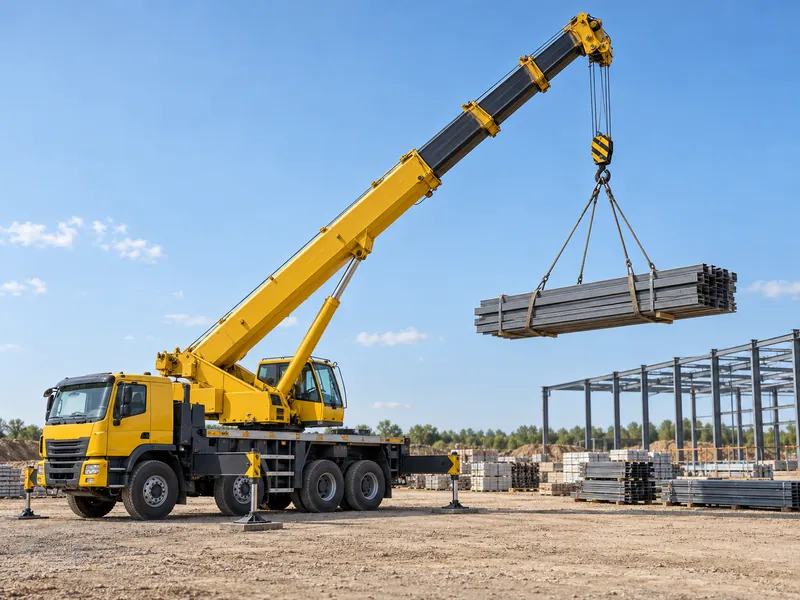
Staying within rated capacity starts with calculating the actual load and reading it against the correct chart, before the boom moves. Operators need to know the weight of the load and its rigging, confirm the radius and boom configuration, and check that the outriggers and counterweight match the chart in use. Overloading is what drives instability and tipping, so the rated limit is treated as a hard ceiling, not a target.
Operator training and certification are what keep those checks reliable instead of assumed. A trained operator understands load calculation, signal commands, the effect of dynamic factors, and the emergency response if a lift goes wrong. That skill set is why the ability to correctly operate a HOWO truck crane is inseparable from its stated capacity. Daily pre-lift inspection of the load-bearing components belongs in the same routine.
Maintenance That Keeps Rated Capacity Reliable
Regular maintenance is what keeps a crane able to reach its rated capacity safely over time. Wire ropes, hooks, and the hydraulic system carry the load directly, so inspecting them on a set schedule and replacing worn or damaged parts before failure is the baseline for reliable lifting. A crane that is nominally rated for a tonnage but running on degraded components no longer has the margin the chart assumes.
Matching maintenance to rated capacity is the practical point. Inspection of the lifting components on a set interval, prompt replacement of worn parts, and operator attention to early wear signs keep a crane’s real capacity in line with what its load chart promises.
Conclusion
A HOWO truck crane does not carry one fixed lifting capacity; it works across a curve of capacities that the load chart maps out. The model name marks the maximum under ideal, short-radius, fully-supported conditions. The number that governs a real pick is the net capacity at your radius, boom length, and outrigger setup, after rigging is deducted. The concept most often misread is exactly that gap: a “12-ton” crane is not a crane that lifts 12 tons anywhere. Read the chart that matches your configuration, confirm the ground and rigging, and the rated tonnage becomes a reliable planning figure instead of a guess.
FAQ
What is the lifting capacity of HOWO truck cranes?
HOWO truck cranes typically range from about 2 tons up to 20 tons or more, depending on the model and configuration. The rated tonnage applies at a specific short radius and boom setup, so the weight you can lift at a longer radius or higher boom extension is lower and should be read from the load chart.
Does a 12-ton HOWO crane really lift 12 tons at any radius?
No, a 12-ton rating is the maximum at a defined short radius and boom configuration, not across the whole working range. As the load moves out or the boom extends, capacity drops, so the safe load at your actual radius comes from the load chart, not the model name.
What is the difference between gross and net crane capacity?
Gross capacity is the figure listed in the load chart for a given radius and boom length, while net capacity is what remains after subtracting the hook block, slings, and other rigging. You rig to the net figure, because that is the actual load the crane can lift safely in that configuration.
How do I choose the right HOWO crane capacity for a job?
Match capacity to the load weight at your working radius, not just the heaviest pick. Confirm the radius and reach your lifts require, add the rigging weight, and select a model whose load chart still shows headroom at that position, not just a name that exceeds the load.
Further Reading
- OSHA 29 CFR 1926.1417 — Operation — U.S. federal regulation. States that cranes must not be operated beyond rated capacity and that the load chart must remain available in the cab, supporting the rated-capacity limits discussed above.
- OSHA 29 CFR 1926.1433 — Design, construction and testing — U.S. federal regulation. Defines what rated-capacity information must cover, including radii, boom angles, lengths, and separate outrigger and counterweight ratings.
- ASME B30.5 — Mobile and Locomotive Cranes — industry safety standard. Covers load-rating charts, stability, inspection, and operation for mobile and truck-mounted cranes.