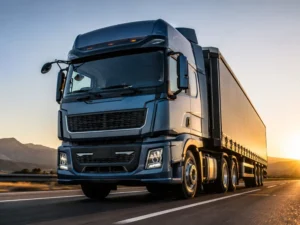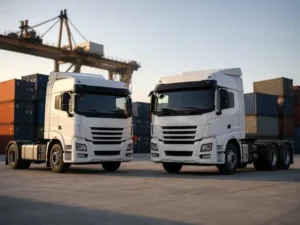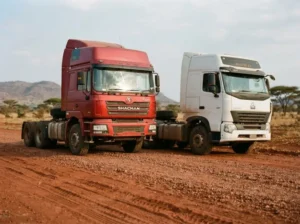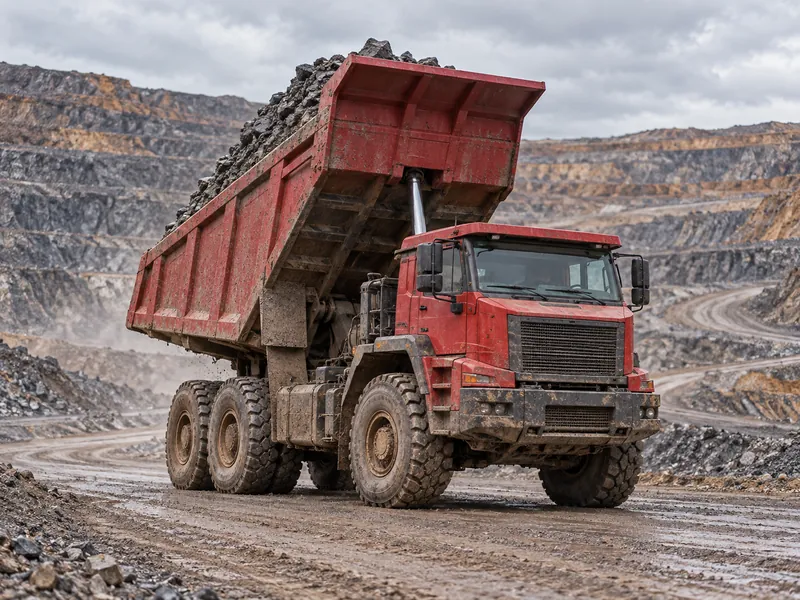
Shacman dump trucks suit heavy-duty mining when the job is scoped correctly: short-to-medium hauls, small-to-mid-size mines, quarries, and maintained haul roads where a rugged on-highway tipper belongs. They are not a drop-in replacement for ultra-class off-highway trucks moving hundreds of tons per pass on long open-pit benches. The deciding factors are your haul-road quality, grade, cycle distance, and payload per load, and this article maps each one to the right Shacman configuration. If you already know your site profile, you can request a Shacman dump truck quote to compare drive layouts and bodies.
Which Mining Conditions Match a Shacman Dump Truck
Haul-road quality, grade, haul distance, and payload per cycle decide the match, not the Shacman name by itself. A truck that is ideal for a maintained quarry ramp can be the wrong tool on a soft, seasonal bench, so the first decision is which class of hauler your site actually needs.
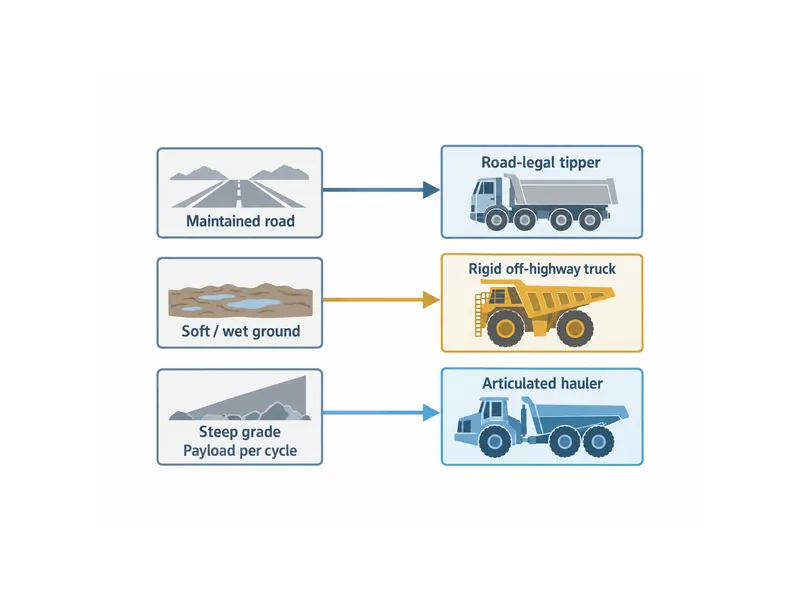
Road-legal Shacman tippers such as the X3000 and X5000 are built for the roughly 20–45 ton payload class on firm, maintained haul roads. That envelope covers quarries, aggregate yards, and small-to-medium mines. For long open-pit benches that move hundreds of tons per pass, the fleet standard is a dedicated off-highway rigid truck; Shacman addresses that duty with its heavier off-highway mining series, not a road-legal tipper. Articulated haulers, commonly placed in the 25–60 ton class, take over where haul roads are soft, wet, or steeply graded and a rigid truck loses traction. Within that road-legal range, comparing payload, body build, and drive layout against your haul profile is how you settle which Shacman dump truck model is best.
Haul distance and cycle count decide how hard that class choice bites. For short cycles under roughly two kilometers on rough ground, an articulated hauler often wins because it climbs and turns without a prepared road. On longer, well-graded routes, a rigid or road-legal tipper returns better cycle times and lower cost per ton. Count your loads per shift and round-trip distance before fixing on a Shacman tipper, since a truck that is efficient on a graded quarry loop can lose that edge on a long, rutted bench.
Match the drive layout to the load and terrain before committing to a truck. A 6×4 layout suits medium loads on firmer ground, while an 8×4 spreads a heavier payload across more axles for stability on rough surfaces. Verify the loaded gradeability against your steepest ramp, and confirm the haul road can carry a rigid truck year-round. On soft or seasonal roads, an articulated hauler is often the safer match.
Where Shacman Dump Trucks Fit in Heavy-Duty Mining
Within maintained-road, matched-load, and in-spec-grade conditions, a Shacman tipper’s fitness narrows to three checkpoints: drivetrain pulling power, frame fatigue resistance, and axle stability under off-center loads. Inspect those three before the badge, since each is what wears or fails first under sustained overload.
Performance and Off-Road Capabilities
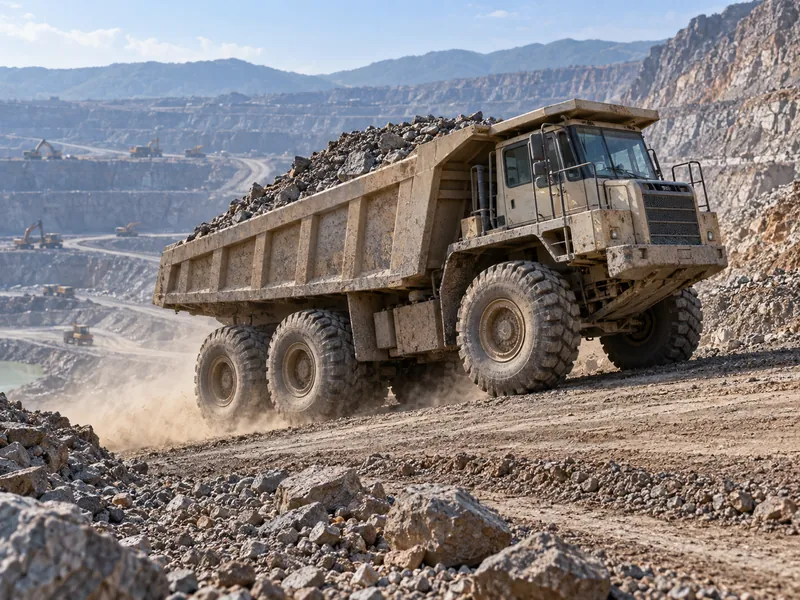
Traction and ground clearance decide whether a loaded truck keeps moving or digs in on unpaved mine terrain. A 6×4 or 8×4 drive layout keeps power to the ground on uneven or muddy surfaces, while large deep-tread tires resist punctures and hold grip on loose material. High ground clearance lets a loaded truck clear rutted haul roads without grounding the frame. How much grade a truck can actually pull is a matter of its rated gradient capability, which shifts with payload and haul-road surface and is never a single headline figure.
Efficiency and Cost Savings
Operating cost on a mine site is driven more by cycle time and uptime than by headline fuel numbers. Large fuel tanks cut refueling stops on remote benches, and engine braking reduces service-brake wear on repeated downgrades, which shortens maintenance stops. The larger cost lever is uptime, and the reliability of Shacman dump trucks under repeated heavy cycles matters more to cost per ton than any single fuel-savings claim. Treat vendor efficiency percentages as figures to verify on your own haul profile, not as transferable numbers.
Key Features and Benefits
Four components carry the load on a mining tipper, and each maps to a specific duty:
- High-torque diesel engine (Cummins or a comparable heavy-duty unit) paired with a Fast Gear gearbox — sustains pulling power for loaded ramps and rough starts.
- Double-layer high-strength frame — resists fatigue under repeated overload; some mining variants use a 10mm+10mm girder per the manufacturer’s specification.
- Mining-grade drive axle — holds stability under heavy, off-center loads on uneven ground.
- Engine compression and exhaust braking — controls speed on long downgrades and reduces service-brake wear.
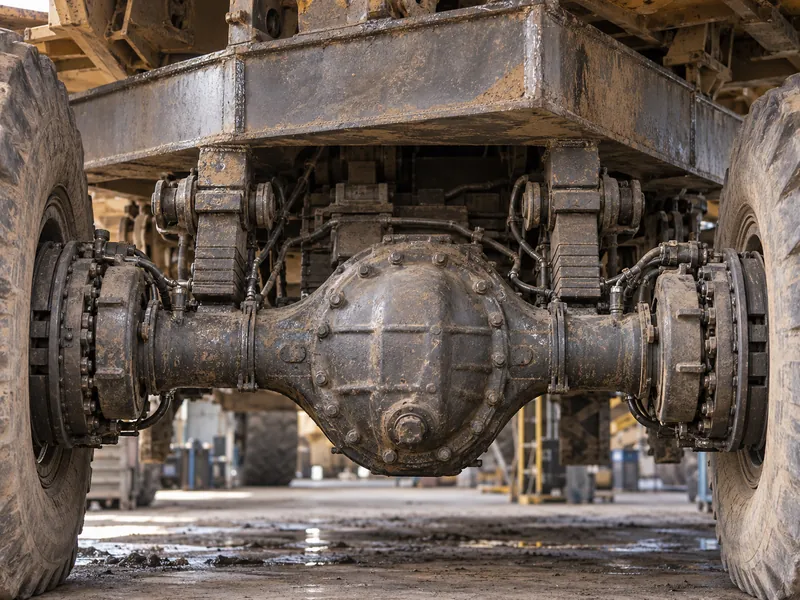
On a used or hard-worked mining truck, those four components are the first parts to inspect, because they wear fastest under overload.
Safety and Smart Features
On a mine haul, the largest safety risks are visibility and downhill control, not raw engine output. For U.S. surface mines, NIOSH reports an average of about 13 workers killed each year by being run over or pinned by mobile mining equipment. Blind spots behind large trucks are the specific hazard: in NIOSH’s review of surface-mine blind-area fatalities, roughly 38% involved trucks and about two-thirds happened while the machine was backing.
Reversing aids and braking systems address exactly those two risks. A multi-camera reverse-imaging system reduces the blind zones that cause backing collisions, while engine and exhaust braking keeps a loaded truck controllable on long descents where service brakes alone would overheat. If your site requires operator protection, confirm the specific cab is certified to ISO 3471 for rollover protection (ROPS) and ISO 3449 for falling-object protection (FOPS), since that certification is model-specific and not automatic on every configuration.
Haul-road design carries as much of the safety load as the truck itself. Adequate road width, berms, and traffic control are what keep a loaded truck inside its margins on a mine bench. Match the truck’s size and turning envelope to the road you actually have, not to the road on the datasheet.
Cold- and hot-climate operation depends on the ordered package, not on the base truck. Sealing, dust protection, and optional heating support low-temperature starts and dusty benches. Confirm the rated operating range and climate package on the datasheet for your site conditions before committing.
Specifications of Shacman Mining Dump Trucks
Read mining specifications as a match to your load and haul profile, not as a ranking. The figures below are manufacturer-stated examples and should be confirmed against the current datasheet for your configuration.
The Shacman STL380, an off-highway 6×4 mining model, illustrates the heavy end of the range. Its manufacturer-stated figures include a curb weight near 29,000 kg and a rated gradeability of 40% or more. The body measures 5,800 × 3,200 × 1,800 mm with a 16 mm floor and 12 mm sides, on a 450 L aluminum fuel tank and 14.00-25 tires. Engine options are heavy-duty diesels rated for sustained loaded pulls; match the specific engine to your duty cycle rather than to a headline power figure.
At the road-legal end, a model such as the X5000 6×4 is quoted by the manufacturer around 520 hp with a payload near 31 tons. Its gross mass runs near 50,000 kg, on an 8 mm wear-resistant steel body and 12.00R24 tires. The gap between the two illustrates the earlier point: pick the class by your tonnage and haul-road bearing capacity first, then compare specifications within that class.
Conclusion
Choose a Shacman dump truck for mining when your haul roads are maintained, your cycles are short-to-medium, and your payload sits in the on-highway tipper class; step up to a dedicated off-highway rigid or an articulated hauler once tonnage, distance, or soft ground push past that envelope. The order of checks is what protects the decision: fix the hauler class to the haul-road surface, then set the drive layout to the load, then verify loaded gradeability against your steepest ramp. To match a configuration to your mine’s grade, haul distance, and payload, contact our expert team for a spec review against your site profile.
FAQ
What is the typical payload capacity of a Shacman mining dump truck?
Road-legal Shacman tippers typically carry about 20–45 tons, while heavier off-highway mining variants go higher by model. Payload depends on the drive layout and body build, so match it to your load per cycle; a single headline number rarely fits every configuration.
What type of engine do Shacman mining dump trucks use?
Shacman mining dump trucks run high-torque heavy-duty diesel engines offered in several power ratings. Higher torque helps loaded pulls on grade, so size the rating to your steepest ramp and heaviest payload rather than the biggest number on the sheet.
How fuel-efficient are Shacman mining dump trucks?
Fuel use varies with load, grade, haul distance, and driving style, so a single efficiency figure rarely transfers between sites. Large fuel tanks and engine braking reduce refuel stops and downhill wear, but confirm real consumption on your own haul cycle before budgeting.
How do Shacman mining dump trucks handle extreme temperatures?
Shacman offers cold- and hot-climate packages with sealing and optional heating for low-temperature starts. Confirm the rated operating range and climate package on the datasheet for your site; the base build does not automatically cover extreme conditions.
Can Shacman mining dump trucks be customized for a specific mine?
Shacman dump trucks can be configured for body type, drive layout, tires, and cold- or high-altitude packages. Specify your haul-road condition and load profile so the configuration matches the duty, and a generic mining spec will not fit every site.
Further Reading
- OSHA — Understanding Powered Haulage Safety in Surface Mining — Safety training resource. Supports the powered-haulage and blind-spot risk context for mine haul trucks.
- NIOSH Mining — Proximity and Blind-Area Warning Research — U.S. government (NIOSH). Source for the surface-mine blind-area and backing-fatality figures cited above.
- MSHA — Safety Program for Surface Mobile Equipment — U.S. government (MSHA). Federal safety-program resource for mobile equipment at surface mines, relevant to the haul-road safety context.