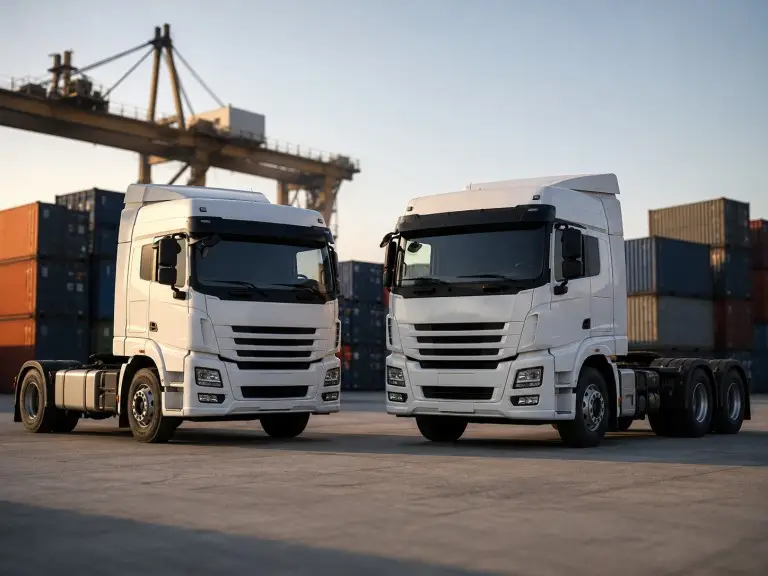
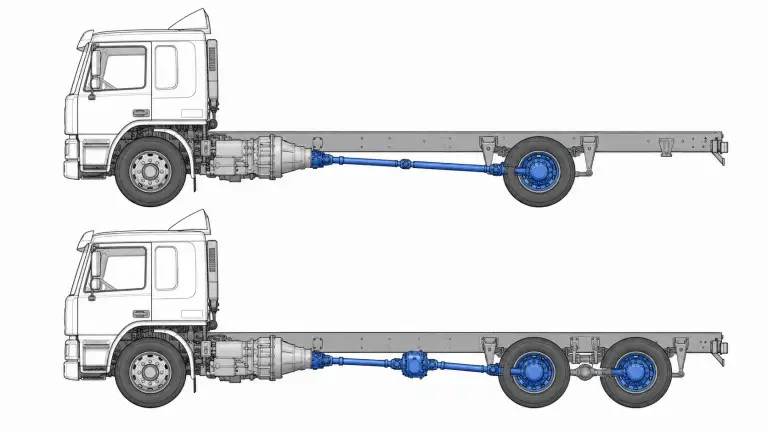
Shacman tractor trucks use two primary axle configurations: 4×2 and 6×4. The difference between them determines payload ceiling, fuel burn, traction limits, and long-term operating cost. The first number counts total wheel positions. The second counts how many receive engine power. A Shacman 4×2 runs on two axles with only the rear axle driven. A Shacman 6×4 adds a second rear drive axle, putting power to four wheels across a tandem setup.
This distinction matters more than horsepower or cab series when spec’ing a Shacman tractor for export. The drive layout sets the hard ceiling on gross combination weight. It dictates which terrains the truck can handle safely and shapes every maintenance invoice across the truck’s service life, from MAN-technology rear axle overhauls to FAST transmission servicing. Getting this choice wrong is expensive to reverse.
This article does not cover 6×2 or 6×6 configurations, which serve different use cases. It does not replace route-specific engineering validation. GCW limits, axle load regulations, and trailer pairing must be confirmed against local standards for each destination country.
| Choose 4×2 if… | Choose 6×4 if… |
|---|---|
| Paved highway routes dominate your operation | Routes include gravel, mud, or construction site access |
| Container and general cargo at moderate GCW | Mining, heavy haulage, or rough-road freight |
| Fuel economy and tire cost are top priorities | Traction and load distribution are top priorities |
| Destination enforces strict total vehicle weight limits | Axle-load distribution matters for legal compliance |
| Lighter payload over long distances | High GCW and variable terrain conditions |
Why a 6×4 Is Not Always the Better Spec
Shacman 6×4 tractors dominate export orders for construction, mining, and regional haulage because those applications demand traction and load distribution. But that pattern creates a persistent misconception: that 6×4 is universally safer and more capable. Specifying a 6×4 where a 4×2 would suffice wastes money in two direct ways.
First, a 6×4 tractor carries additional chassis and drivetrain weight. The second drive axle, extra differential, propeller shaft components, and additional tire positions all add mass. The exact weight difference varies by series, frame specification, fuel tank size, and cab variant. It should be confirmed from the selected chassis specification sheet rather than assumed as a fixed number. On routes governed by strict total vehicle weight limits, every kilogram of unnecessary truck weight is cargo revenue lost.
Second, maintenance cost rises with drivetrain complexity. A 6×4 doubles the rear differential oil changes, adds universal joints, and increases tire positions to manage. For fleets running predictable highway routes, those costs accumulate without delivering any traction benefit.
The 6×4 earns its place when routes include unpaved sections, steep grades, or frequent heavy rain — conditions where two driven axles prevent wheel slip and maintain momentum. When we spec Shacman tractors for buyers in regions with seasonal road degradation, we default to 6×4 unless the buyer can confirm year-round paved access at both pickup and delivery points. The choice is not about which layout is “better.” It is about matching drive configuration to actual operating conditions.
Decision Variables for Choosing Between Shacman 4×2 and 6×4
Shacman tractor buyers should evaluate five variables before locking in a drive configuration. Each variable points toward one layout or the other. When variables conflict, the dominant operating condition takes priority.
Gross combination weight. Shacman 4×2 tractor GCW varies by platform, engine, axle rating, frame specification, fifth-wheel setup, and market homologation. Certain F3000 4×2 models are listed with GCW ratings up to 50 tonnes, but the real legal operating weight still depends on local axle-load limits and trailer pairing. Shacman 6×4 platforms support higher GCW. F3000 6×4 configurations are listed in ranges from 70 to 90 tonnes depending on axle and engine specification. For consistent heavy haulage, rough roads, or high-GCW operation, a 6×4 should be evaluated first.
| Item | Shacman 4×2 Example | Shacman 6×4 Example |
|---|---|---|
| Example platform | F3000 | F3000 |
| Example GCW (listed) | Up to 50 tonnes* | 70–90 tonnes* |
| Typical advantage | Lower curb weight, lower fuel consumption | Stronger traction, heavier-duty hauling capacity |
| Common application | Paved highway, container logistics | Construction, mining, rough roads, heavy haulage |
Example configurations; actual GCW depends on engine, axle, frame, fifth-wheel setup, and market homologation.
- Road surface and terrain:Paved national highways and port-to-depot corridors favor 4×2. Routes that include gravel access roads, construction site entries, steep mountain passes, or seasonal mud conditions require the traction redundancy of a 6×4. We assess this variable by asking buyers to describe their worst-case road segment, not their average one. The truck must survive the worst stretch on every trip.
- Trip distance and fuel budget:Long-haul operations on flat corridors benefit from the lower fuel consumption of 4×2 due to reduced curb weight and less drivetrain friction. Shorter haul cycles with frequent loading at rough sites favor 6×4, where traction and durability matter more than per-kilometer fuel cost. The exact fuel difference depends on route gradient, load weight, tire specification, and driving behavior. We verify this against the buyer’s specific route data rather than quoting a universal percentage. For detailed consumption figures by series, see our guide on fuel efficiency of Shacman tractor trucks.
- Axle-load regulations at destination:Some countries enforce per-axle weight limits that make a 6×4’s weight distribution advantage essential for legal compliance under heavy loads. Others impose total vehicle weight limits where a lighter 4×2 maximizes legal cargo capacity. Before finalizing a tractor configuration, buyers should verify local requirements for GCW, per-axle load limits, emission level (Euro II / III / V / VI), steering position (LHD/RHD), braking system compatibility, trailer kingpin and fifth-wheel height, tire specification (such as 315/80R22.5 or 12.00R20), and roadworthiness certification.
- Resale and fleet standardization:In markets where 6×4 dominates the used truck pool, resale value for 4×2 units can be lower — even when the 4×2 was the operationally correct choice. Buyers running mixed fleets should also consider parts commonality and mechanic familiarity.
Which Shacman Series Offer 4×2 and 6×4
Shacman tractor series available for export include F3000, H3000, X3000, X5000, and X6000, with drive layout options varying by region and configuration.
| Series | 4×2 Available | 6×4 Available | Primary Positioning |
|---|---|---|---|
| F3000 | ✓ | ✓ | Cost-effective workhorse for mining, construction, and regional haulage |
| H3000 | ✓ | ✓ | Mid-range balance of comfort and value |
| X3000 | ✓ | ✓ | High-end export tractor with broadest HP range (430–550 HP) |
| X5000 | — | ✓ | Premium long-haul with advanced cab design |
| X6000 | ✓ | Confirm availability | Flagship series; availability depends on market and emission standard |
Series selection depends on duty level, cab requirements, and budget. These factors are covered in our Shacman F3000 vs X3000 comparison and Shacman tractor pricing guide. The drive layout is confirmed first because it determines chassis length, weight distribution, and compatible trailer types. We configure each series to order — engine options, transmission type, cab variant, fuel tank capacity, and fifth-wheel position are all adjustable.
The Shacman 4×2-vs-6×4 Cost Trap
Shacman 4×2 and 6×4 tractors carry different total cost profiles, and the most common configuration regret we encounter is a decision based on purchase price alone.
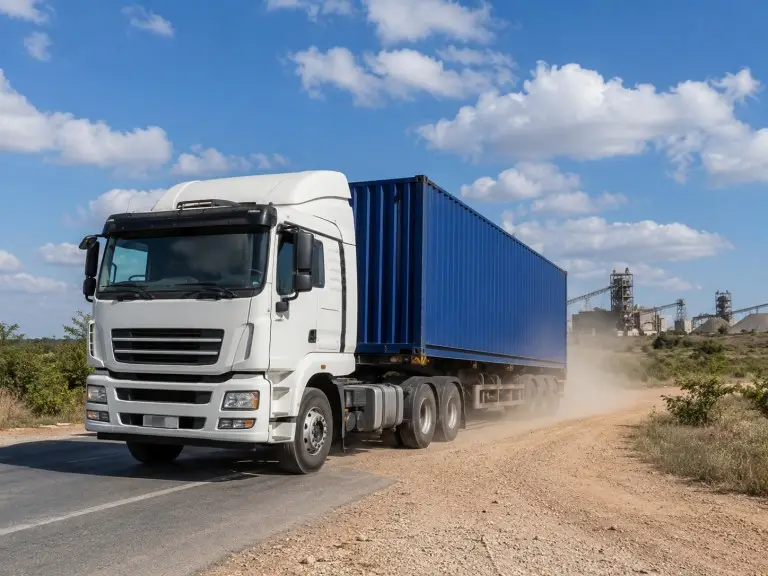
Acquisition cost for a Shacman 6×4 runs higher than the equivalent 4×2 in the same series. The gap comes from the additional MAN-technology rear axle, driveshaft components, and heavier frame. But buying a 4×2 to save upfront when the operation requires 6×4 capability often leads to accelerated drivetrain wear, tire failures, and downtime that far exceeds the initial savings. In one recurring pattern with Shacman F3000 orders, buyers selecting 4×2 for cost savings on routes with even 10–15 km of unpaved access road at the delivery point end up requesting axle upgrades or replacement units within 18 months.
The reverse trap is equally costly. When buyers adopt a 6×4 for pure highway container logistics, they accept higher fuel burn, more tire positions, and more frequent differential servicing for the truck’s entire service life — without receiving any traction benefit.
We prevent both traps by building a cost projection based on the buyer’s route, payload, annual mileage, local fuel price, and tire availability at the destination before confirming the layout.
Choosing the Right Shacman Tractor Configuration
The choice between Shacman 4×2 and 6×4 comes down to load weight, worst-case road conditions, and destination axle-load regulations. Everything else — series, engine, cab — is configured after the drive layout is locked in.
Send us your cargo weight, route conditions including access roads at pickup and delivery points, trailer type, target country, emission standard, and steering requirement. We will match the suitable Shacman 4×2 or 6×4 tractor configuration with engine, gearbox, axle, tire, and fuel tank options configured to your operation. For a step-by-step walkthrough of the procurement process, see our guide on how to buy a Shacman tractor truck from China.
FAQ
Can I use a Shacman 4×2 tractor for heavy loads?
Shacman 4×2 GCW ratings vary by platform. Some configurations carry listed ratings well above what many buyers assume for a single-drive-axle layout. Whether a 4×2 suits your load depends on the specific model, your trailer type, and the destination country’s axle-load regulations. We confirm rated GCW against your operating parameters during quotation.
How do I verify which configuration I need?
Confirm the maximum loaded combination weight for your standard cargo. Identify the worst road segment on your regular route. Check per-axle load regulations plus emission and steering requirements at the destination. These data points determine the drive layout before any discussion about series, engine, or cab options.
Does switching from 6×4 to 4×2 void any warranty?
Drive configuration is a factory specification, not a field modification. Warranty terms apply to the configuration as ordered. The relevant question is whether the truck is operated within its rated GCW and approved application.
Are Shacman 4×2 tractors available in right-hand drive?
Shacman offers both LHD and RHD across multiple series and configurations, including 4×2. Availability of specific RHD setups varies by series and engine option. We confirm during quotation.