Buying a Shacman tractor truck from China means making decisions across four areas: supplier type, model specs, compliance, and shipping. Each decision affects your total cost, delivery time, and long-term reliability. This guide covers the key steps for buyers purchasing new Shacman tractor trucks for commercial fleet use.
Table of Contents
What “Buying from China” Actually Means for Shacman Tractor Trucks
There are three ways to buy a Shacman tractor truck from China. Each carries a different risk level, price structure, and after-sales outcome.
The first option is an authorized Shacman export dealer or regional distributor. These suppliers hold a valid agreement with Shaanxi Automobile Holding Group. The second is an independent export agent with a proven Shacman export record. The third is a trading company or B2B platform with no direct factory access.
The truck price is rarely where the biggest cost difference appears between these channels. Lead time, spec accuracy, and parts availability after delivery matter more — especially for buyers in Africa, the Middle East, and Southeast Asia, where Shacman’s service network varies by country.
Choosing the Right Shacman Model for Your Route and Payload
Three variables determine the right model: GVW requirement, drive axle configuration, and the emission standard at your destination port. A mismatch on any one of these will push the unit out of budget or make it non-compliant on arrival.
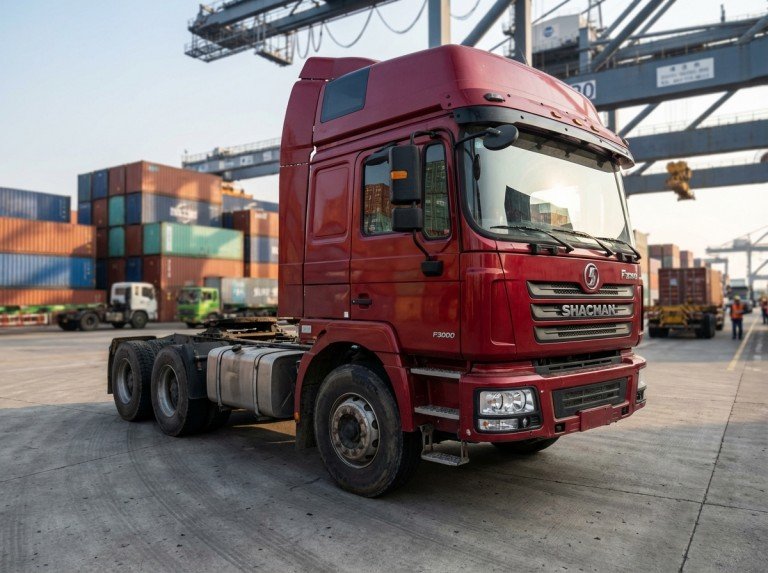
The F3000 and X3000 sit on different platforms with distinct engine ranges and aerodynamic profiles — the right choice depends on your route type and fuel priority. The F3000 offers Weichai or Cummins engines spanning roughly 340 to 420 hp. It is widely used across Africa and the Middle East where Euro 2 to Euro 4 standards apply. The X3000 runs from 345 to 500 hp and suits high-mileage corridors where fuel economy is a priority variable. The X5000 is for buyers who need 500 hp and above, with driver assistance systems included as standard.
Drive configuration depends on payload and road type. A 4×2 unit works for paved highways with GVW up to around 40 tons. A 6×4 is standard for mixed terrain or heavier loads. Axle load limits vary by country, so confirm the legal limit with a local road authority before locking in the config.
The Misconception That Low FOB Price Means Low Total Cost
The cheapest FOB quote often produces the highest total landed cost. The reason: the quoted price leaves out emission standard gaps, wrong axle ratings, or missing documents that hold up port release and add storage fees.
The failure follows a clear pattern. A buyer orders a Euro 2 or Euro 3 truck. The destination country has moved to Euro 4 or Euro 5. The truck arrives, fails emissions inspection, and the buyer pays for reshipment or local engine modification. This has happened in Southeast Asia, East Africa, and parts of Latin America, where emission rules have changed in recent years. We write the required emission standard as a line item in the purchase agreement before the pro forma invoice is issued.
A full landed cost estimate should include: ex-factory price, inland transport to the Chinese port, export documentation fees, ocean freight, marine insurance, import duty at the destination, and local registration. Each figure changes based on port, country, order size, and Incoterms.
How to Verify a Shacman Supplier’s Export Credentials
A credible Shacman export supplier can provide three documents quickly: a valid Chinese export license, a current authorized dealer certificate from Shaanxi Automobile Holding Group, and a record of past exports to your region. If any of these is missing, the price gap between suppliers does not cover the risk.
Ask three questions when assessing a supplier. Can they show their Shacman dealer or distributorship agreement? What is their export volume of Shacman trucks, and to which countries? Do they know the import documents required in your destination country? A supplier with real export experience answers these with specifics, not vague claims.
Customization, Order Confirmation, and Pre-Shipment Inspection
Shacman tractor trucks can be configured across cab type, engine and transmission pairing, axle rating, fuel tank size, fifth wheel height, and electrical spec. All of these need to be confirmed before production starts, not after delivery. We give buyers a written technical confirmation before the purchase agreement is signed.
Common requests from international buyers include right-hand drive for markets like Kenya, South Africa, and Australia; CNG or LNG engines for regions with gas infrastructure; and lighting or marking changes required by local authorities. RHD units take longer to produce than standard LHD builds. Check availability and lead time with the supplier before placing the order.
Pre-shipment inspection by an independent party or the buyer’s own team is standard on high-value orders. The inspection should check VIN accuracy against the factory order, engine and chassis serial numbers, tire spec, brake function, and electrics. Buyers who skip this step often find spec errors only after the truck clears customs — where fixing them costs more time and money.
Shipping Terms, Port Selection, and Transit Risk
Two shipping methods cover most Shacman truck exports: Roll-on Roll-off (RoRo) and flat rack container. RoRo costs less and works well for single units or small fleets. Flat rack container gives better protection and is the only option where the destination port does not support RoRo vessels.
FOB (Free On Board) is the most common Incoterm for Shacman truck exports. Under FOB, the buyer takes responsibility once the truck is loaded onto the vessel. The buyer arranges ocean freight, marine insurance, and destination customs clearance. CIF (Cost, Insurance, and Freight) shifts freight and basic insurance to the supplier up to the destination port. We confirm Incoterms in writing before the pro forma invoice is issued, since this sets who pays what and when risk transfers.
Customs Clearance, Destination Registration, and After-Sales Planning
Standard customs documents for a Shacman tractor truck include: commercial invoice, packing list, bill of lading, certificate of origin, and vehicle certificate of conformity. Some markets also require an import permit, a pre-shipment inspection certificate, or emissions documentation from a recognized authority. Check country-specific requirements with a local customs broker before the shipment leaves China.
After-sales support depends on Shacman’s network in your country. Service stations and parts stock exist across parts of Africa, the Middle East, and Southeast Asia, but coverage is not even across all markets. Before buying, confirm that engine, transmission, and axle parts are available locally and find the nearest authorized service point. Downtime in a working fleet costs more than price comparisons show. We cover this with buyers during scope review.
Conclusion
Getting the spec right before signing costs less than fixing it after delivery. The key variables — model series, emission standard, supplier credentials, customization scope, and Incoterms — are all easier to resolve before the purchase agreement than after.
At HOWO Special Truck Ltd, we work with buyers across Africa, the Middle East, and Southeast Asia to match Shacman tractor truck specs to real operating conditions before production starts. When buyers share full route, payload, emission, and compliance details upfront, the path from inquiry to delivery is shorter — because spec gaps are closed before the build, not found at the destination port.
Share your requirements with us: route type, GVW target, emission standard at your destination port, and any customization needs. We will provide a spec-confirmed quote, a lead time estimate, and a document checklist for your destination country’s customs process.
FAQ
What determines the total cost of a new Shacman tractor truck from China?
The factory price is only the starting point. Add inland transport to the Chinese port, export docs, ocean freight, marine insurance, import duty, and local registration. Every item varies by country, order size, and Incoterms. Get all figures confirmed before accepting the pro forma invoice.
Can Shacman trucks meet Euro 5 or Euro 6 emission standards?
Yes — but only for certain models, and it must be confirmed before production. Availability depends on the engine variant. Emission requirements vary by country and vehicle type, and several markets have tightened rules in recent years. Check the required standard with a local authority or customs broker, then write it into the purchase agreement.
Is right-hand drive available for Shacman tractor trucks?
Yes, for select models. RHD units are used in Kenya, South Africa, Australia, and similar markets. Production lead times for RHD are longer than for standard LHD. Confirm availability and current scheduling with your supplier before ordering.
How do I confirm a Shacman supplier has genuine export authorization?
Ask for three documents: export license, authorized dealer certificate, and a regional buyer reference list. Suppliers with real factory access provide these without delay. Check the dealer certificate against Shaanxi Automobile Holding Group’s official overseas channels. If a supplier stalls on any of these, treat them as unverified — regardless of price.