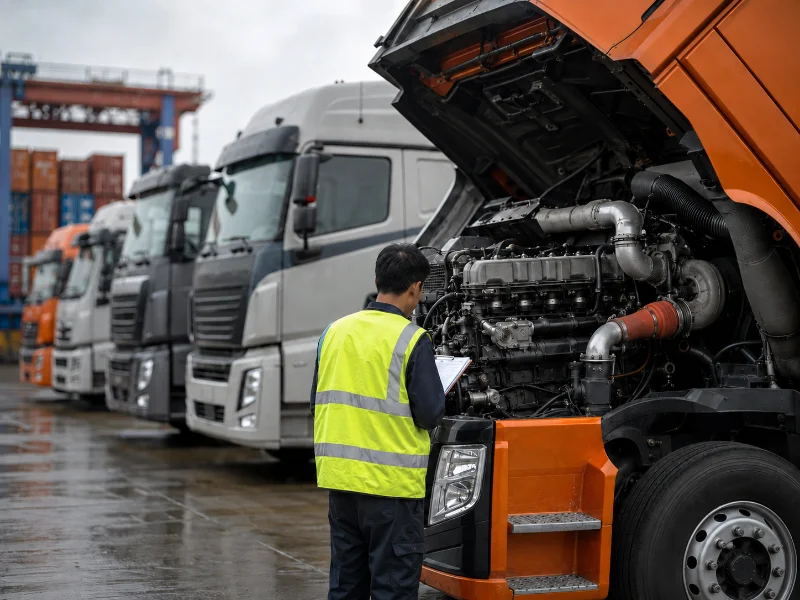
The engines Sitrak trucks use come from two lineages: Sinotruk’s own MC diesel and MT gas series, built on MAN-licensed platforms, and Weichai units at the top of the range. Which one is fitted depends on the model line, the destination market and the announcement batch the build came from. A model name on its own does not fix the engine. Across the configurations documented here, C7H tractors carry MC11 or MC13 diesels, the 660 hp C9H carries a Weichai 15-litre unit, and gas builds appear from both lineages. The designation on the engine plate is what settles it.
The Engines Sitrak Trucks Use, Model by Documented Model
The engines Sitrak trucks use are documented per build, not per model line, and which unit a given truck carries depends on its destination market and the announcement batch it came from.
| Sitrak configuration | Engine documented for it | Displacement | Rated output | Peak torque | Where the figure comes from |
|---|---|---|---|---|---|
| T5G rigid | MC07 class | 6.87 L | 330 hp as marketed | 1,250 N·m | Australian road-test report; the catalogue’s MC07.33-30 matches on displacement and torque |
| C7H tractor | MC11 | 10.518 L | 440 hp as marketed | not documented per build | Importer buyer guide; variant suffix not stated |
| C7H tractor | MC13 | 12.419 L | 540 hp as marketed | 2,500 N·m | Road-test report; catalogue lists MC13.54-50 at 400 kW and 2,500 N·m |
| C9H prime mover | Weichai WP15H660E62A | 15.3 L | 485 kW, 660 hp | about 3,220 N·m at 1,200–1,400 rpm | Importer specification sheet, Australian build |
| Gas builds | MT13; also a Weichai 15-litre gas unit (WP15N) | 12.419 L; 15-litre class | 360–430 PS (MT13 catalogue band); up to 530 hp (WP15N) | 1,800–1,900 N·m (MT13) | Series catalogue; Chinese ministry announcement batches |
| C9H EV | no engine; electric drive axle | — | — | — | Manufacturer show material, 2025 |
The map covers documented configurations only. Options vary by market, by announcement batch and by build year, and a rating offered in one market may not be orderable in another. Published “hp” figures here are metric horsepower (PS): 400 kW is 544 PS.
What the MAN Licence Covers, and What It Does Not
The MC series traces to a 2009 technology transfer, so a licensed origin does not put a European parts or warranty channel behind the truck, and which channel serves a fleet depends on the Sinotruk distributor covering it. MAN took a 25% plus one share stake in Sinotruk’s Hong Kong-listed arm that year and transferred engine and component technology. Sinotruk’s own engine catalogue describes the MC series as the D08, D20 and D26 platforms produced under that agreement. Traton, the licensor’s parent, has publicly characterised the holding as a financial investment with no operational influence and no supply relationship between its brands and Sinotruk.
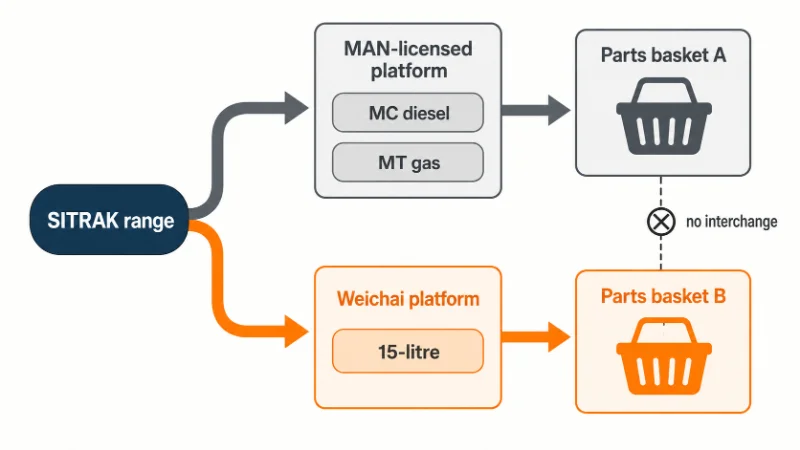
The licence also has a ceiling. The highest MC13 rating in the series catalogue is 444 kW, or 604 PS. The C9H is rated at 485 kW and 660 hp, which puts the flagship outside the licensed platform altogether. Public sources do not establish what drove that sourcing decision; they establish only that the catalogued platform does not reach the rating.
Do not assume MAN’s European dealer network stands behind an MC engine because the design was licensed. Part numbers, diagnostic access, warranty responsibility and software normally sit inside the Sinotruk channel unless a local distributor states otherwise. A fleet that specifies on lineage and skips the channel question meets the problem late. An MC-series injector or ECU fails, the shop’s HOWO-pattern stock does not interchange, and one truck waits on a single-source item while the rest keep earning. A fleet running C7H and C9H units together is running two engine lineages under one badge, with two parts baskets behind them.
What Separates the MC, MT and Weichai Options
Sitrak’s engine options differ less in horsepower than in what each one needs from the fuel supply behind it, and on an export route that dependency decides more of the specification than the rating does. The MC diesels cover the broadest band and, at the higher emission stages, carry catalyst-based aftertreatment. The gas line trades that dependency for a different one: a corridor with refuelling on it.
| Series | Displacement in catalogue | Catalogue output band | Catalogue torque band |
|---|---|---|---|
| MC07 / MC07H | 6.87 L / 7.36 L | 151–258 kW (205–351 PS) | 830–1,400 N·m |
| MC11 / MC11H | 10.518 L / 11.051 L | 231–363 kW (314–494 PS) | 1,550–2,400 N·m |
| MC13 / MC13H | 12.419 L / 13.02 L | 341–444 kW (464–604 PS) | 2,300–2,700 N·m |
| MT13 (gas) | 12.419 L | 265–316 kW (360–430 PS) | 1,800–1,900 N·m |
Catalogue bands cover Sinotruk’s whole engine portfolio, not Sitrak alone. Presence in the catalogue is no evidence that a rating is orderable on a Sitrak build in a given market. The catalogue also carries no dated edition, so treat the bands as indicative and confirm against the datasheet for the order.
Gas is not a like-for-like substitute for a diesel of the same size. The MT13 sits on the same nominal 12.419-litre displacement class as the MC13, but the catalogue tops it out at 316 kW against 444 kW, and 1,900 N·m against 2,700 N·m. A gas specification therefore means accepting a lower ceiling, reducing combination mass, changing gearing, or moving to the 15-litre gas unit that ministry batch listings record for Sitrak at up to 530 hp. Equal displacement is also no evidence that internal or service parts interchange.
Reading a Sitrak Engine Designation
A Sitrak engine designation carries more of the specification than the model name does, and reading it depends on knowing that the middle figure is metric horsepower. In MC13.54-61, MC13 is the 13-litre class and 54 is the rated output in tens of PS. The arithmetic checks out: the catalogue lists MC13.54-50 at 400 kW, and 400 kW is 544 PS.
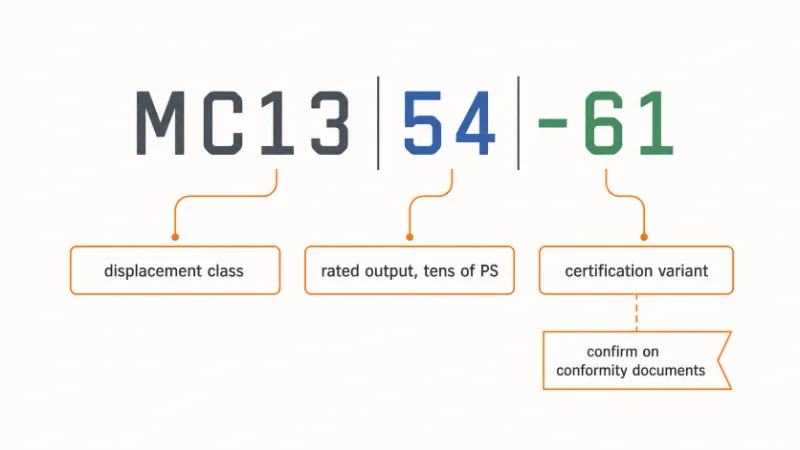
Treat the trailing digits as a certification or calibration variant. The catalogue groups the -30 models under China’s National III stage, -50 under National V and -61 under National VI. Those are domestic heavy-duty stages, and they are separate type approvals from the Euro stages an importing country may require. The stage an import authority will accept comes from the conformity documents for the truck, not from the suffix. Weichai’s format works the same way in a different layout: WP15H660E62A reads as the 15-litre class, 660 metric horsepower, and E62A as an emissions and calibration variant. The importer’s sheet for that build lists it as Euro 6, and the designation on its own is not the certificate.
The reading holds against an independent source. An Australian road-test report puts the T5G at 6.87 litres, 330 hp and 1,250 N·m; the catalogue’s MC07.33-30 is 6.87 litres, 240 kW, which is 326 PS, and 1,250 N·m. Torque matches to the newton-metre and the “33” matches the marketed horsepower. So a quotation that gives horsepower but no designation can often still be placed: the horsepower and torque pair usually finds the unit in the catalogue. A gap between the quoted power and the number inside the designation means the two documents describe different builds.
The suffix carries weight of its own. MC11 and MC11H are different engines, so an order line reading “MC11” has not specified the engine yet. Which papers prove that one specific truck matches its quotation before shipment is a per-order verification job, and the SITRAK C7H specification review covers that workflow.
Matching the Engine to Fuel Supply and Duty Cycle
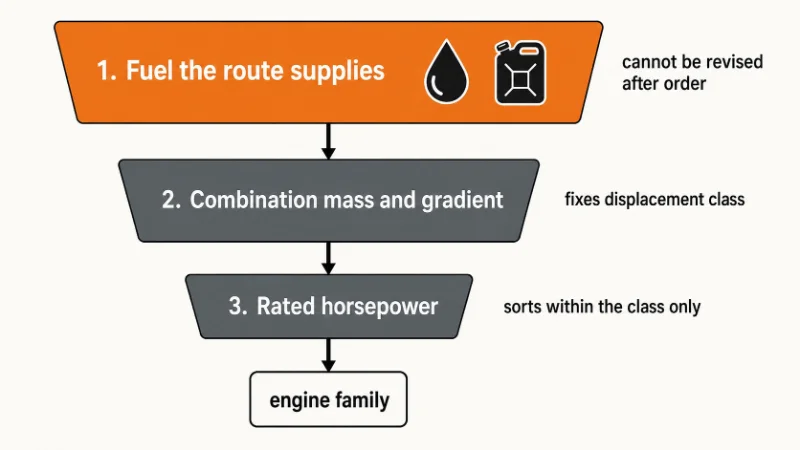
Two variables settle a Sitrak engine specification before horsepower enters it: the fuel the route can supply, and the mass the truck runs at. Each one removes whole options. Fuel comes first, because it is the only input here that cannot be revised after the order.
Sulphur degrades catalyst-based aftertreatment, and sulphur arrives in the fuel, not in the truck. An SCR system that runs out of urea will derate under the inducement rules applying to it. So the sulphur specification of the diesel sold along the route, and the DEF supply depot by depot, both belong in the enquiry before a stage is chosen.
Combination mass ranks second, since it fixes the displacement class and the torque band, and that decides which options are still in the running. Rated horsepower ranks last, because it only sorts options inside a class the first two variables have already chosen. Where fuel quality varies between depots, the enquiry is the place for the route’s fuel data.
If neither compliant low-sulphur diesel nor a DEF supply can be relied on, a high-stage engine buys an aftertreatment liability, and the more serviceable purchase is a lower-stage export build or a mechanically simpler HOWO truck, subject to local registration rules.
Everywhere else the branch is short:
- Gas refuelling on a fixed corridor: the MT-series builds, or the 15-litre gas unit where a higher rating is needed.
- Low-sulphur diesel, DEF along the route, combination mass at the heavy end: the 15-litre diesel.
- Low-sulphur diesel, DEF along the route, standard linehaul mass: the 13-litre diesel class.
- Weight-sensitive or regional work where a lighter engine pays for itself: the 11-litre class.
Where to Start When Specifying a Sitrak Engine
Nothing about the MC, MT and Weichai split is settled at brand level. The engines Sitrak trucks use are fixed on the order line, and two inputs fix them. The fuel a route can supply removes whole options; the mass the truck runs at sets the displacement class. Horsepower ranks after both.
The specification that causes trouble later is usually the one where the emission stage came off a brochure and the fuel that stage needs was never checked against the depots on the route. Which rating a specific truck carries also depends on its build batch and destination market, so confirm it per order; a range table will not do it. We check the full engine designation on a quotation against the published series data before it goes out. We also flag any gap between the horsepower a buyer was quoted and the number carried inside the designation.
Bring these to a quotation request and the engine question largely answers itself:
- Destination country and the emission stage its registration rules require.
- Sulphur specification of the diesel actually sold along the route, depot by depot.
- Whether DEF is stocked along that route, and by whom.
- Gross combination mass and the worst sustained gradient the truck will pull.
- Duty pattern: linehaul hours against stop-start vocational work.
- Fuel decision, diesel or gas, and whether gas refuelling exists on the corridor.
- The full engine designation wanted, suffix included, rather than a horsepower figure.
- Parts lead time your depot can live with, and which components you want stocked from day one.
If the first three answers rule out a high-stage engine, the same list works for a HOWO Truck build, where mechanical simplicity is what you are buying.
Related on this site: what a SITRAK truck is at brand and tier level, and the engine power of HOWO tractor trucks if the fuel answers point that way.
FAQ
What is the difference between an MC11 and an MC11H?
Displacement and torque band separate them. The published catalogue lists the MC11 at 10.518 litres and the MC11H at 11.051 litres, with different torque figures at comparable nominal power. The H variant is a family-wide convention rather than a one-off: MC07H and MC13H sit above their base series the same way, so the gap the suffix closes exists at every displacement class.
Are Sitrak and HOWO ever fitted with the same engine?
At the top of both ranges, yes. Chinese regulatory batch listings covering the 660 hp 15-litre unit show it approved for Sitrak and for HOWO MAX tractors among others, so that engine is not exclusive to either badge. Lower in the ranges the two brands diverge, so check the overlap build by build.
How often does the engine option list for a Sitrak model change?
Engine options move at the regulatory batch level rather than on a model-year cycle. New engine-and-model combinations enter through the Chinese ministry’s public announcement batches, which means a specification sheet from an earlier batch is no evidence for a current order. Ask which batch the quoted build sits in.
Does the electric Sitrak still have an engine?
No engine sits in the battery-electric variants. The C9H EV shown at the 2025 Brisbane Truck Show uses an electric drive axle in place of the engine and gearbox. Engine designations, emission stages and fuel-quality questions do not apply to it, and the comparison moves to charging and range instead.