A shacman truck gear lever is the cab-side input to a shift-control system whose architecture varies by gearbox. On multi-range transmissions the high–low range may be preselected at the knob, or by a pneumatic valve in the remote mechanism outside the cab. Confirm which arrangement a truck uses before ordering a knob, a lever body or a complete assembly. Four things settle the choice: the full transmission model code, the control architecture, the cab and steering layout, and the number on the part being replaced. Symptoms narrow it further, because the mechanical gate path and the pneumatic range path fail independently.
What the Shacman Truck Gear Lever Actually Controls
A Shacman shift control is three assemblies sold separately — knob, lever body, and the linkage back to the gearbox — and which of them has failed depends on where the range valve sits.
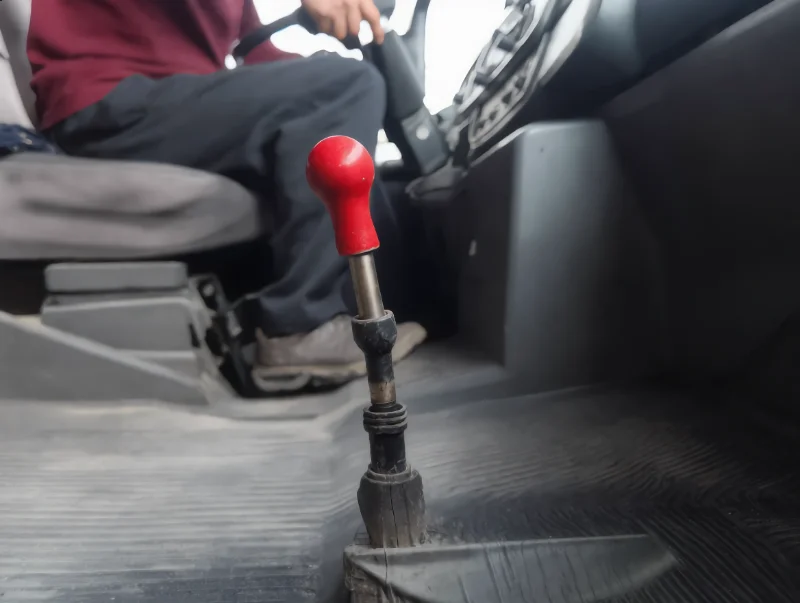
The lever body pivots in a seat on the cab floor or on a tower, and passes hand movement through the linkage to the shift rails in the main box. That path is purely mechanical. Everything that goes wrong with it shows up as position or effort: play at the pivot, vague gate positions, resistance in one plane of the gate.
The range change does not travel that path. On transmissions with an auxiliary section behind the main box, air shifts the range, and the change completes only as the main box passes through neutral. The valve commanding it may sit at the lever, reachable as a switch under the driver’s thumb. It may equally sit in the remote mechanism, with only wiring or an air line running up to the cab.
Two systems share one handle. They fail independently, and they are bought as different parts.
Gear count screens rather than answers. Ten, twelve and sixteen forward gears normally indicate an auxiliary range section, and therefore a pneumatic circuit somewhere in the control. The count says nothing about where the valve for that circuit is mounted.
Identifying the Shift-Control Architecture Before Anything Else
The location of the range valve determines which parts of a Shacman shift control can be bought on their own, and the vehicle settles that location, not the gear count or the series badge.
| Architecture | Where the range is commanded | What the knob is | What a knob replacement can fix | How to identify it on the truck |
|---|---|---|---|---|
| Knob-mounted preselector | Valve inside the knob | A working pneumatic component | Range faults traced to that valve, plus grip and gate marking | Air line runs up inside or alongside the lever shaft |
| Remote-mechanism valve | Valve in the shift mechanism outside the cab | A handle carrying the gate pattern | Grip and gate marking only | Only wiring or a control line reaches the cab; the valve sits at the gearbox end |
| AMT electronic selector | Control unit, through actuators | An input device rather than a mechanical control | Nothing mechanical; the unit is diagnosed, not judged by feel | An electrical connector at the base instead of a linkage or air line |
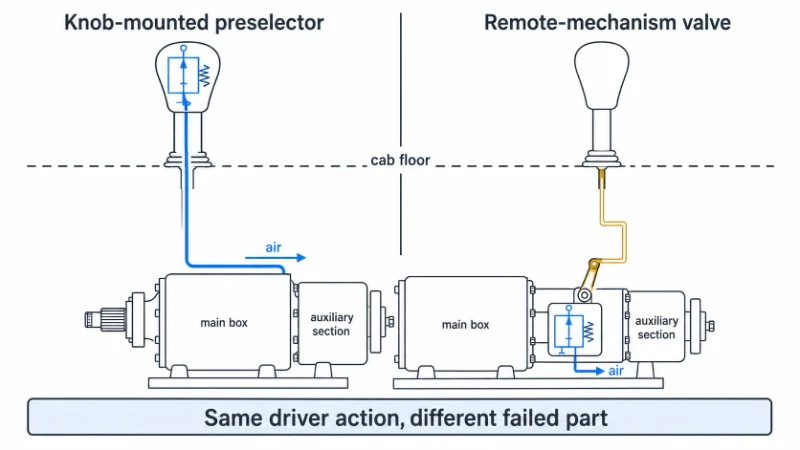
Driver-side evidence will not separate the two mechanical arrangements, and this is where most listings go wrong. Published shifting procedures for these gearbox families follow one order: select the range first, then clutch and bring the lever through neutral, and let the auxiliary section complete the change. That sequence is identical whichever architecture is fitted. So the way the truck shifts, the feel at the handle and the symptom the driver reports are all consistent with both.
Only the air line distinguishes them. Follow it from the lever base and see whether it terminates at the shaft or leaves the cab toward a housing on the gearbox.
Order a knob on assumption instead of tracing that line, and the usual result is a part that fits the thread and does nothing for the fault. The valve that failed was never in the knob.
Gearbox First, Truck Model Second: What Decides Fitment
Fitment for a Shacman shift control follows the transmission and the cab it sits in, not the series badge, and the nameplate model code carries most of what a supplier works from.
Shaanxi Fast Auto Drive, which supplies the transmissions on most of these chassis, publishes a key to its own model codes. The initial numeral gives the number of forward gears and the middle digits track a torque class. The letters record construction: mechanical manual operation, the centre distance in the auxiliary section, helical gearing, twin countershaft layout, and whether synchronizers are fitted. Read suffixed and special variants against the document version covering them, not against a similar code.
None of those characters describe the shift tower, the cab floor height, the remote mechanism or the side the driver sits on. The code is necessary and not sufficient. Two gearboxes in different torque classes can share one shift control, and one gearbox model in two cab layouts can need two different ones. A quotation built on the gearbox code alone is a starting point, not a confirmation.
Two variables come before the rest. The first is the full transmission model with suffix, which decides whether an auxiliary section exists and therefore which family of parts applies. The second is the control architecture, because an error there surfaces only after the part is in the cab. Throw length, knob shape and offset are preferences, revisable later at small cost, which is why they sit further down the list.
Confirm these before comparing any part:
| Confirm | Why it decides the outcome | Where to read it |
|---|---|---|
| Full transmission model code, suffix included | Sets whether an auxiliary section exists, and therefore which parts family applies | Gearbox nameplate, not paperwork |
| Chassis number or VIN | Opens the build record behind that specific truck | Vehicle plate or vehicle documents |
| Where the range valve sits | Sets whether a knob replacement can fix a range fault at all | Trace the air line from the lever base |
| Gate pattern and reverse position | Mechanical interfaces can match while the gate logic differs | Count the gate positions in the cab |
| Cab type and steering side | Sets lever offset, bracket position and routing | The truck itself |
| Air line count, port position and thread | Mismatched ports stop a pneumatic control from sealing | The old part |
| Complete number on the part being replaced | Tells a supplier which catalogue to search | Stamped or cast on the old part |
Trucks with an AMT selector leave this comparison altogether: the selector is verified with diagnostic equipment, may need configuration after fitting, and will not interchange with a mechanical lever or its knob.
Reading the Part-Number Systems on a Shacman Shift Control
Shift-control components for these trucks circulate under three numbering conventions, and recognising which one a number belongs to tells a buyer what that number can settle on its own.
| Prefix pattern | Catalogued by | What it can confirm | What it cannot confirm alone | How to check |
|---|---|---|---|---|
| DZ… | Chassis-side numbering used on Shacman and Delong builds | That an assembly belongs to that chassis family | Gearbox variant, cab layout or control architecture within the family | Match against the chassis number, not the series name |
| Gearbox model prefix (e.g. 12JS160T-…) | Transmission maker’s catalogue, keyed to the gearbox model | That the part sits in that gearbox’s shift-control group | Which cab and remote mechanism it was installed with | Read the complete model code from the transmission nameplate |
| WG… | Sinotruk-side numbering, frequently listed as cross-fitting | That a seller treats it as interchangeable | Interchangeability with a Shacman control, absent a formal cross-reference | Compare gate pattern, air port position and shaft dimensions against the old part |
Numbers appearing in more than one system have usually been cross-referenced by a trader, not by a vehicle manufacturer. Treat a cross-reference as a lead to verify. Confirm it against the part in hand or an OEM catalogue before ordering quantity.
Telling a Lever Fault from a Range or Linkage Fault
Most shift complaints on these trucks resolve to one of four subsystems, and the symptom pattern narrows the search before anything is dismantled, provided the gates and the range change are tested separately.
| Symptom | Likely subsystem | Checks before ordering |
|---|---|---|
| Play in every direction, all gate positions still findable | Lever base: pivot, seat, bushings | Boot for splits, movement at the base with the shaft held, mounting bolts |
| Vague or fouled gate positions, range changes normal | Linkage or remote mechanism | Joint wear and adjustment, rod or cable routing, end play |
| One complete range unavailable, gates normal | Pneumatic range circuit or auxiliary section | Supply pressure, hoses and connectors for leaks, valve output, neutral signal, range cylinder travel |
| Grinding confined to the range change | Incomplete range shift, or auxiliary synchronizer wear | Air delivery and cylinder stroke first, then fork movement and oil condition |
The symptom identifies the subsystem, not the failed component. A missing range has at least half a dozen candidates behind it, and the cab-side lever is the last of them to justify replacement.
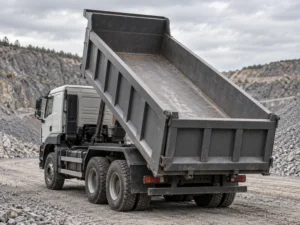
On a Shacman dump truck working dusty tipping and quarry cycles, the boot and pivot at the base of the lever are usually the first parts of the shift control to need re-inspection. Grit that passes a split boot reaches the pivot long before it reaches anything further down the linkage.
Technique shows up in the last row. The auxiliary section alone absorbs the speed step of a whole range, so crossing the range boundary by skipping gears, or calling for low range at road speed, loads that one synchronizer instead of the main box gears. A truck damaged this way keeps a healthy gate pattern while its range change degrades — the reverse of what a worn lever produces. Once that synchronizer goes, the decision leaves shift-control selection and becomes a gearbox teardown with its own parts list.
Serviceable limits for play, travel and supply pressure come from the manual for that transmission. General figures quoted for heavy trucks as a class are not a substitute.
Where to Start on a Shacman Gear Lever Replacement
Two facts decide almost every shacman truck gear lever order: what the transmission nameplate says in full, and where the range valve sits. Add the cab layout, and the prefix on the old part tells a supplier which catalogue to search. The symptom pattern tells them whether a knob, a lever body, a linkage or nothing in the cab at all should be quoted.
For a lever that is merely loose, the cheaper repair is usually the right one. Bushings, a new boot and a linkage adjustment restore most of the lost precision, and a complete assembly earns its cost only once the shaft or its seat is worn past what the manual allows. Replace a lever without checking the range circuit first and the fault tends to return in another form, with the second diagnosis costing more than the first inspection would have.
Whether a given control is correct still depends on the gearbox variant and cab layout of the individual chassis, confirmed against the nameplate and the build record. We check both before comparing part numbers for a shacman truck, because a badge tells less than a nameplate does.
When the architecture cannot be settled from the driver’s seat, two photographs answer it: one at the base of the lever showing where the air line runs, and one of the shift mechanism where it meets the gearbox. That pair decides which family of parts is being bought. Taking it before the order costs nothing; taking it after the wrong part arrives costs a shipment.
FAQ
Do left- and right-hand-drive trucks use the same shift control?
Do not assume they do. Lever offset, bracket, mounting position and the routing of rods, cables or air lines can all differ with cab layout. The gate pattern then ends up wrong for the driver even when the shaft fits the seat. Verify the remote mechanism, bracket, routing and complete original number, not the shaft dimension alone.
Can a worn gear lever damage the gearbox?
Wear can contribute, though the chain is conditional: detents and interlocks also hold a gear once engaged. Excessive wear or a misadjusted linkage cuts the selector travel actually reaching the shift rails, and a gearbox worked repeatedly without full engagement puts dog teeth, sleeves and synchronizer faces at risk.
Which fails first, the knob or the lever body?
Architecture decides. Where the knob houses the range preselector, it carries both the driver’s hand load and the pneumatic duty, and tends to go first. Where the valve sits in the remote mechanism, the knob is a handle, and wear moves down to the pivot and linkage.
How often should the boot and pivot be inspected?
At any service where the cab floor is already open, and sooner on trucks in dust. No fixed interval applies, because wear here tracks operating environment more closely than distance travelled. Boot and pivot checks therefore belong in Shacman truck maintenance planning rather than on a mileage schedule.
Is a used lever assembly worth buying?
Rarely. The wear that matters sits in the pivot and seat, and a photograph shows neither.