Curtain side trailers pair the three-side access of a flatbed with the hard roof and enclosed body of a van. Shippers reach for them when freight needs both fast forklift loading and cover from the weather. The load security question is where most descriptions go wrong: curtains keep rain, dust, and prying eyes off a load, but on their own they are not a cargo restraint system. A tensioned strap or a reinforced XL-rated body does the restraining.
The design has moved a long way from early tarp-and-frame builds toward bodies that carry part of the restraint load structurally. This article covers how a curtain side trailer is built, the main types you will meet, its US and European dimensions, and the part the name really promises: how cargo is actually secured inside one. Load security here means meeting real restraint standards, not trusting the fabric. This is not a guide to trailer leasing rates or to securing specialized oversized loads, both of which turn on separate rules.
How Curtain Side Trailers Work
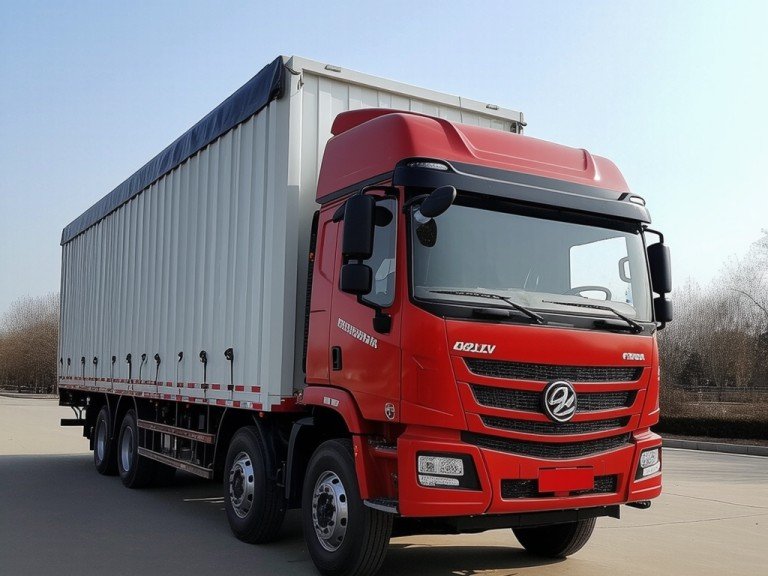
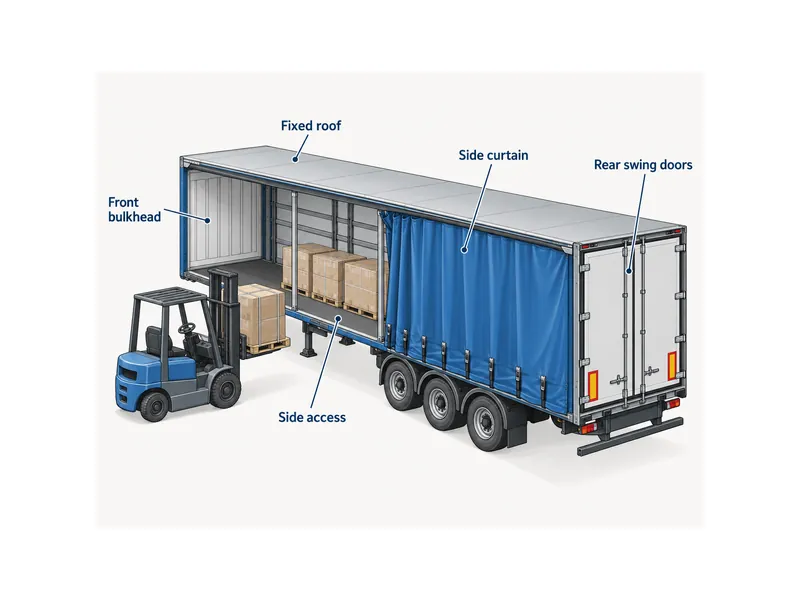
Four fixed elements define a curtain side trailer: a solid front bulkhead, a hard metal or aluminum roof, rear swing doors, and tensioned fabric curtains along both sides. The curtains slide back on a top rail so a forklift can reach the deck from either side or from the rear dock, which removes the first-on, last-off bottleneck of a box van. Top loading is not possible, because the roof and frame stay fixed.
The body does two jobs at once. Its roof and seams shield cargo from rain, wind, and dust, while the frame carries structural loads that a plain flatbed leaves entirely to straps and tarps. That combination is why a curtainsider sits between a flatbed and a dry van instead of replacing either. For weather-sensitive freight that still needs side access, the enclosed-but-openable body is the whole reason to choose one, and the check is simple: can a forklift reach every pallet from the side without hand-tarping?
Types of Curtain Side Trailers
Curtain side trailers come in three main configurations. Roof and curtain design separate them more reliably than the overlapping trade names operators use day to day.
Standard Curtainsiders (Tautliners)
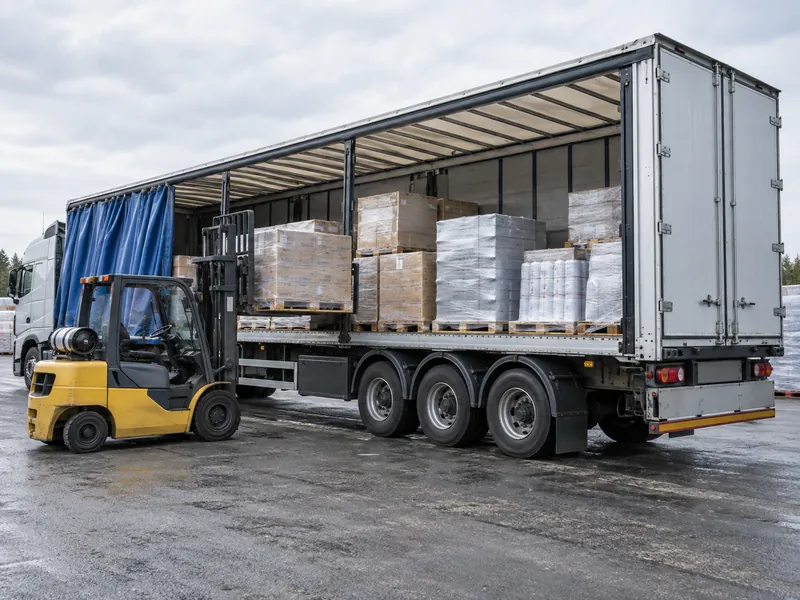
Standard curtainsiders, often called tautliners, pair a solid front wall, a hard fixed roof, and conventional rear doors with sliding side curtains. The curtains are heavy coated fabric, commonly an 18-ounce material in US spec sheets, tensioned against the frame to form a taut, weatherproof wall. This is the workhorse configuration for palletized and general freight that needs side loading.
Curtain Vans
Curtain vans look almost like a dry van from the outside but swap the rigid side panels for curtains. Horizontal roof supports and a metal roof keep the structure rigid while the sides open, which suits operators who want close-to-dry-van cover with faster side access. The trade is a heavier tare weight than a bare flatbed, paid for in payload.
Conestoga-Style Systems
Conestoga-style systems get confused with curtainsiders but differ at the roof. A true Conestoga uses a retractable tarp that slides back over both the sides and the roof, so the deck can be loaded from the top or by crane. A curtain side trailer keeps a fixed roof and opens only at the sides and rear. That distinction drives load security: a fixed roof gives tighter weather sealing, while a retractable system gives top and crane access at the cost of that seal.
Curtain Side Trailer Dimensions and Payload
Check every curtain side trailer dimension against its market before planning a load, because US and European figures do not interchange. Mixing them is the most common spec error in this category.
| Spec | US service | European standard |
|---|---|---|
| Length | 48 ft and 53 ft | ~13.6 m internal |
| Cargo width | ~8 ft 4 in | ~2.45–2.48 m |
| Cargo height | ~8 ft | ~2.6–2.7 m internal |
| Payload / capacity | ~40,000–43,000 lb cargo | up to ~24 tonnes; ~91 m³ |
US carrier equipment guides quote curtainsiders in 48-foot and 53-foot lengths, with cargo weight commonly in the 40,000 to 43,000 pound range. European standard curtainsiders are quoted in metric: roughly 13.6 meters of internal length, about 91 cubic meters of volume, and payloads up to around 24 tonnes. The metric internal length and cubic capacity belong to the European tautliner, not the US 53-footer. A figure such as 32,800 kilograms is a European-market payload and sits above typical US legal cargo weight. Verify the trailer’s rated payload against your jurisdiction’s axle weight limits before committing, because the heavier curtainsider body eats into legal payload compared with a bare flatbed.
How Load Is Actually Secured on a Curtain Side Trailer
What secures a load in a curtain side trailer is the cargo restraint, and in some markets the reinforced body itself; the curtains do not. Treating tensioned fabric as a restraint is the mistake that leads to shifted and spilled loads.
In the United States, cargo in any trailer must be secured to meet FMCSA cargo securement rules. Per FMCSA 49 CFR 393, the aggregate working load limit of the tie-downs must be at least 50 percent of the cargo weight. The load must also be contained or immobilized so it cannot shift enough to affect the vehicle’s stability. A curtainsider gives no exemption: straps, load bars, and blocking still do the securing work, and a roadside inspection checks the restraint, not the curtain.
Europe adds a second path through the body. Under the EN 12642-XL standard, a reinforced curtainsider body is certified to hold 50 percent of the load to the side, and the UK’s DVSA accepts that XL-rated vehicles need no extra lashing when the load is a positive fit. Positive fit, as the standard defines it, means no gap over 80 millimeters between the load and each curtain, the load pushed up to the front bulkhead, and the rear restrained. The rating stamped on the plate, not the curtain fabric, decides what a given body may legally contain. A body without XL certification is not treated as sharing the restraint.
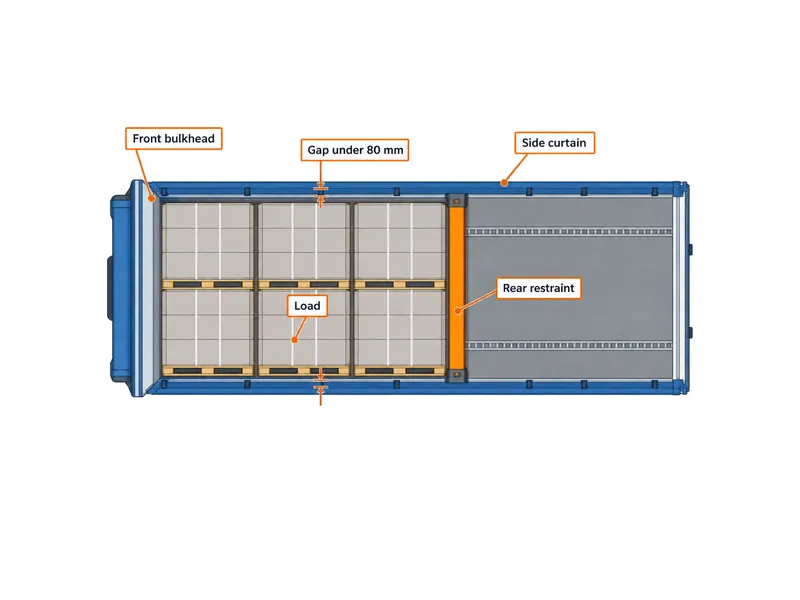
The genuine innovation in load security is structural: XL-rated bodywork turns the trailer body into part of the restraint system, so a correctly loaded positive fit can replace some external lashing. Where a body is not XL-rated, securement still depends on tie-downs, load bars, and blocking sized to the FMCSA working-load-limit rule. A common weight-distribution guideline places roughly 60 percent of the load ahead of the trailer’s axle and 40 percent behind, but the securement standard, not the ratio, is what an inspection checks.
One field caution applies to multi-drop work. As the load shrinks at each stop, a positive fit that was legal when full can open gaps that now need extra lashing. Re-secure after every drop instead of assuming the body still contains the remaining freight.
Curtain Side Trailers vs. Flatbeds and Dry Vans
Weather exposure, loading access, weight, and securement labor decide between a curtain side trailer, a flatbed, and a dry van. Each trailer wins on a different variable, so the freight makes the call.
Against a flatbed, the curtainsider trades a weight penalty for weather protection and faster loading. A flatbed leaves cargo exposed and shifts securement to the crew through manual tarping and tie-downs, which adds labor, time, and a genuine fall hazard. Those same labor and equipment factors are part of what drives flatbed trailer costs, so enclosed trailers are often weighed against them on total handling cost, not line-haul rate alone. A curtainsider keeps three-side access while covering the load, though it still needs proper tie-downs unless the body is XL-rated.
Against a dry van, the curtainsider gives up some sealing for side access. A dry van offers a fully sealed enclosure that loads from the rear dock, which fits standard freight and is usually the more available option. Confirm rate and equipment on your lane before assuming a cost difference either way. A curtainsider earns its place when a forklift needs to reach the load from the side. Freight that needs a completely sealed or temperature-controlled environment still belongs in a van, while freight prone to falling off pallets can ride securely in a curtainsider when it is properly tied down.
Choosing a Curtain Side Trailer for Your Freight
Match the curtain side trailer to your freight by working through weather sensitivity, side-access need, weight budget, and regional availability, in that order. Settle the first constraint that disqualifies an option, then compare what is left.
Weather-, moisture-, or light-sensitive goods that still need side loading are the clearest fit, because the enclosed body covers them while the curtains open. Weight-critical full truckloads are the weakest fit, since the heavier body cuts into legal payload against a flatbed. Availability is a practical constraint as well. Curtainsiders are less common than vans and flatbeds on some US lanes, so confirm the equipment is bookable and price it against alternatives before you build a shipping plan around it.
Conclusion
A curtain side trailer earns its place when freight needs weather protection and side forklift access at once. It loses to a dry van when the load must be fully sealed, and to a flatbed when every pound of payload counts. The load security the name implies does not come from the curtains: in the US the cargo still has to meet FMCSA tie-down rules, and in Europe only an EN 12642-XL body loaded to a proper positive fit is rated to hold the load. Read every dimension and payload figure against its market, treat the curtains as weather and access instead of restraint, and confirm the securement path your route actually requires before booking.
As a Chinese heavy truck seller, HOWO Special Truck Ltd supplies HOWO and other Chinese-brand models such as faw, and can build semi-trailers, including curtain side configurations, to your specification.
FAQ
Do you still need to strap down cargo in a curtain side trailer?
Yes, in most cases. In the US, FMCSA rules require tie-downs whose combined working load limit is at least half the cargo weight, whatever the curtains are doing. Only an EN 12642-XL-rated body in Europe, loaded to a positive fit, is certified to hold the load without extra lashing.
What is the difference between a curtain side trailer and a Conestoga?
The roof is the difference. A curtain side trailer keeps a fixed hard roof and opens only at the sides and rear, which gives tighter weather sealing. A Conestoga uses a retractable tarp over the sides and roof, allowing top and crane loading at the cost of some seal.
What can you haul in a curtain side trailer?
Palletized and general freight that benefits from side loading and weather cover fits best, including building materials, packaged goods, and moisture- or light-sensitive loads. Fully sealed or temperature-controlled freight is better suited to a dry van or reefer.
Is a curtain side trailer more secure than a dry van?
Not inherently. A dry van offers a fully sealed, harder-sided enclosure, while a curtainsider trades some of that for side access. Loads that tend to fall off pallets can ride securely when properly tied down inside a curtainsider.
What does positive fit mean for load security?
Positive fit is the EN 12642-XL condition that lets an XL-rated body hold the load without added lashings. It means no gap over 80 millimeters between the load and each curtain, the load pushed against the front bulkhead, and the rear restrained.
Further Reading
- FMCSA cargo securement rules (49 CFR 393.100) — US federal regulation. Sets the tie-down working-load-limit and shift-prevention requirements that apply to cargo inside a curtainsider.
- DVSA: Load security for XL-rated vehicles — UK government guidance. Explains positive fit and when an XL-rated curtainsider body needs no extra lashing.
- The EN 12642-XL curtainsider design standard — IRTE / Transport Engineer. Details what XL certification covers and the 80 mm positive-fit rule.