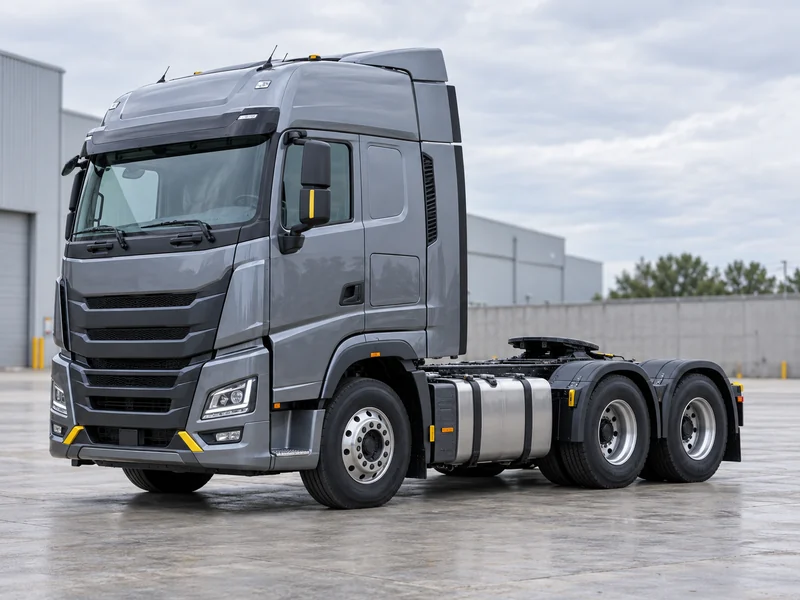
A HOWO tractor unit on its own, measured without a trailer, is roughly 6.8 to 7.0 m long, about 2.5 m wide, and about 3.1 to 3.7 m tall depending on the cab. Those figures are for the tractor head itself. They shift mainly with two choices: the drive configuration (a 4×2 has one driven rear axle, a 6×4 has two) and the cab (a flat or standard roof sits lower than a high-roof sleeper). This guide separates the 4×2 and 6×4 figures, explains the two-number wheelbase notation you will see on spec sheets, and shows where the tractor’s dimensions become a road-legal question once a trailer is coupled. Every figure below is a typical range; the exact value belongs to the specific model and build, so confirm it against the unit’s spec sheet before you commit to a trailer or a route.
What HOWO Tractor Truck Dimensions Actually Measure
“Tractor truck dimensions” describe the tractor unit alone, not the tractor-plus-trailer combination most buyers picture. The tractor unit is the powered HOWO truck head that couples to a semi-trailer through the fifth wheel. Its published length, width, and height stop at the back of the chassis, well short of anything the trailer adds. Reading a spec sheet with that boundary in mind prevents the most common mistake: comparing a tractor’s 6.8 m length against a 16 m combination length and assuming the numbers are wrong.
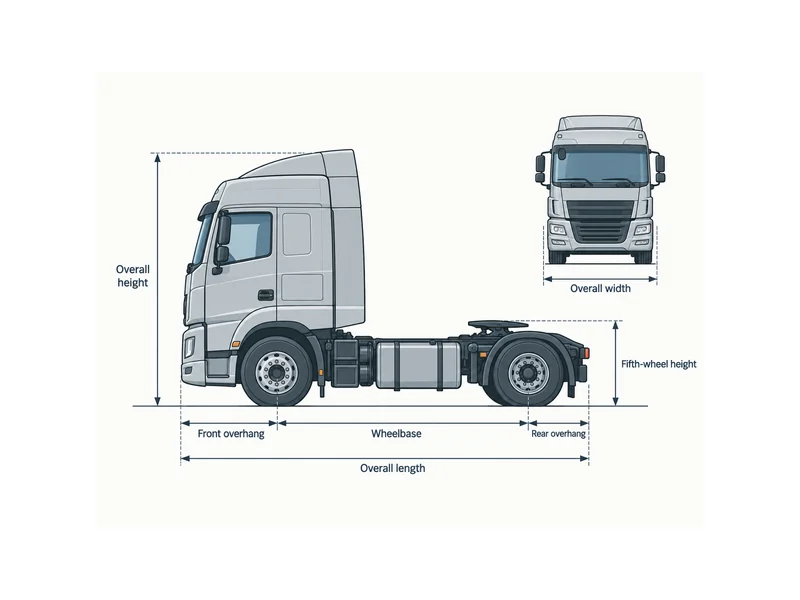
Six measurements carry most of the decision weight on a tractor head. Overall length, width, and height set the parking footprint and the clearance envelope. Wheelbase and the front and rear overhangs govern how the fifth wheel sits over the drive axles and how tightly the unit turns. Fifth-wheel height, together with curb weight, gross vehicle weight (GVW), and gross combination weight (GCW), decides what trailer and payload the tractor can legally pull. Each moves with configuration, so a single “HOWO dimensions” number is less useful than the range plus the reason it varies.
HOWO 6×4 Tractor Truck Dimensions
Measured without a trailer, a HOWO 6×4 tractor head stretches from roughly 6.8 m to 7.0 m in length and sits close to 2.5 m wide. Cab roof aside, its height lands anywhere from about 3.1 m to 3.7 m. The defining feature is the pair of driven rear axles; that second axle is why a 6×4’s weight reads heavier than a 4×2’s. One sourced 6×4 build lists a curb weight near 9,210 kg. Plan around an 8 to 9.2-tonne magnitude, and confirm it against the specific cab, fuel, and axle spec, since the figure is not fixed.
Wheelbase on a 6×4 is written as two numbers, such as 3,200+1,350 mm or 3,255+1,350 mm, and reading them correctly matters. The first number is the main wheelbase from the front axle to the center of the rear tandem. The second is the spread between the two rear drive axles. Adding them does not give a usable “wheelbase,” which is why the notation is kept split. A longer main wheelbase sets the fifth wheel further rearward, while a shorter one keeps the unit more compact, so the wheelbase you pick follows the route and trailer, not a headline spec.
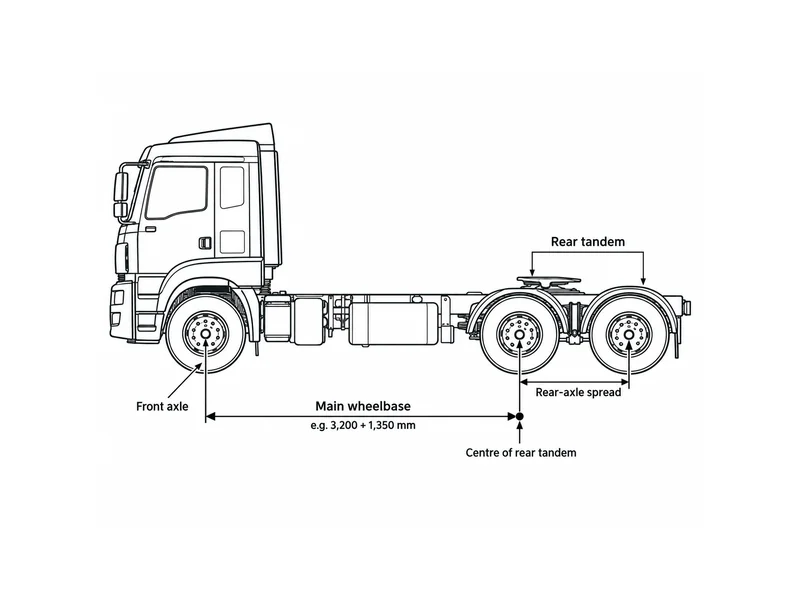
| Dimension | HOWO 4×2 tractor head | HOWO 6×4 tractor head |
|---|---|---|
| Overall length | Not separately published in these sources; expect it close to the 6×4 head, and confirm on the build’s spec sheet | ~6.8–7.0 m (multiple exporter spec pages agree) |
| Overall width | ~2.5 m | ~2.5 m |
| Overall height (cab-dependent) | ~3.1–3.7 m, set by cab roof | ~3.1–3.7 m, set by cab roof |
| Wheelbase notation | single figure; one 4×2 build lists ~3,500 mm | split, e.g. 3,200–3,400 + 1,350–1,400 mm |
| Driven rear axles | one | two |
| Curb weight | not separately sourced for 4×2; industry tractor-unit weight ~7.5–9 t (indicative only) | one sourced build ≈ 9,210 kg; plan an ~8–9.2 t magnitude |
Length, width, and height barely separate the two configurations. The real difference sits in the rear-axle count, the split-versus-single wheelbase, and how much the head weighs. Confirm each cell against the specific build, because model series and emission generation can push any figure a step in either direction.
HOWO 4×2 Tractor Truck Dimensions
With one driven rear axle instead of two, a HOWO 4×2 tractor head carries less axle mass than a 6×4. It uses a single-figure wheelbase, commonly around 3,500 mm on the one 4×2 build in these sources. Length, width, and height stay close to the 6×4 head. The sources here do not publish a separate 4×2 overall length, so treat the 6×4 range as the nearest reference and confirm the exact figure on the build’s spec sheet. Curb weight is not separately sourced for the 4×2 either; industry tractor-unit weight sits around 7.5 to 9 tonnes as an indicative band, not a specific HOWO 4×2 spec.
Height on a 4×2 follows the same rule as any tractor head: the cab decides it. A flat-roof or standard cab keeps the unit near the lower end of the range. A high-roof sleeper adds height for long-distance driver comfort at the cost of a taller clearance envelope.
How Cab and Configuration Change the Numbers
Read the roof before you read the height number, because the cab is the single largest swing factor in a HOWO tractor’s stated height. A standard or flat-roof cab can sit near 3.1 to 3.4 m; a high-roof sleeper can reach roughly 3.6 to 3.7 m. That half-meter comes entirely from the roofline and never appears in a “tractor truck dimensions” headline unless the cab type is named. Any height figure that omits the cab is incomplete for clearance planning.
Configuration and model generation move the rest. Drive layout changes how the wheelbase is written and how much the unit weighs. Model series and emission generation shift the chassis, fuel-tank, and axle specs enough to nudge length and weight by a step. Options like tank size or wheel-and-tyre choice add smaller variations on top. Because these layers stack, verify the four numbers that drive your decision — overall height, wheelbase, curb weight, and fifth-wheel height — against the build’s own nameplate, not a generic range. That check is what keeps a trailer match or a bridge-clearance test from failing on a figure that was never meant to be universal.
Fifth-Wheel Height, Combined Height and Length Limits
Fifth-wheel height is where a tractor’s dimensions turn into a compliance question, and on a HOWO tractor head it typically sits around 1.3 m above the ground. The fifth wheel is the coupling plate over the rear axles where the trailer’s kingpin locks in. Its height sets the trailer’s ride height, so a small change here ripples into the combined height of the whole rig.
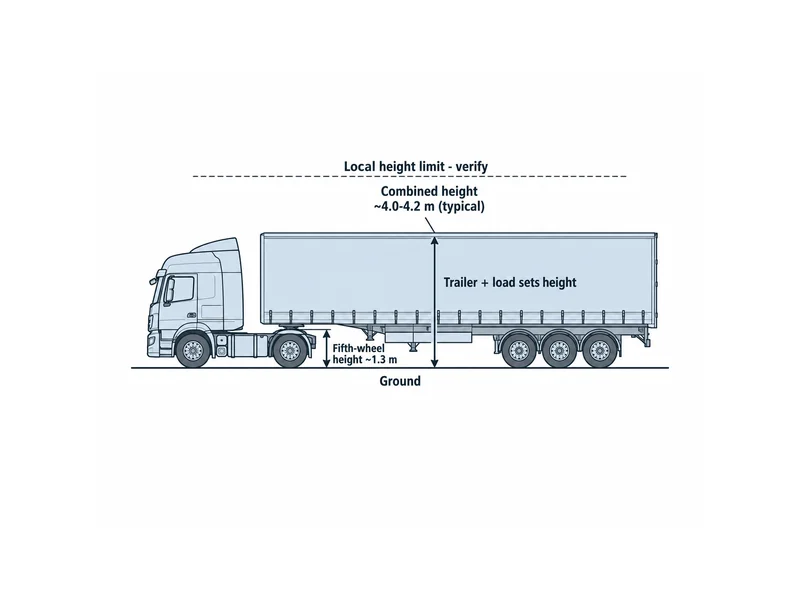
Combined height and length are set by the trailer plus the local law, not by the tractor alone. Add a standard semi-trailer to a fifth wheel near 1.3 m and the loaded combination commonly lands near 4.0 to 4.2 m tall. The legal ceiling, though, depends on the market or route, so confirm the local limit before assuming a single figure clears everywhere. Combination length works the same way: the tractor contributes only its own 6.8 m or so, while the legal maximum for the whole rig is a jurisdictional rule to check against your route. Weight closes the loop, since the GVW and gross combination weight the tractor is rated for interact with axle limits and local law to cap what you can legally pull.
Conclusion
Pick the HOWO tractor’s dimensions by constraint order, not by chasing a single headline size. Fix the fixed limits first: the route’s height and length ceilings and the trailer you must pull, because those decide the clearance and coupling envelope the tractor has to fit. Choose the drive configuration next, since the 4×2-versus-6×4 decision sets the wheelbase notation and the curb weight. Only then settle the cab, which is the half-meter that makes or breaks a height limit. Throughout, remember that a HOWO tractor head is measured without its trailer, that the fifth-wheel height near 1.3 m is where its dimensions become a road-legal question, and that the reliable figure is the one on the specific build’s nameplate. The four numbers to confirm before you commit are overall height, wheelbase, curb weight, and fifth-wheel height, each checked against the exact spec you are considering and the limits of your route.
FAQ
How long and how tall is a HOWO 6×4 tractor head without the trailer?
On its own, a HOWO 6×4 tractor head is typically 6.8–7.0 m long and, cab depending, somewhere between 3.1 and 3.7 m tall; width holds near 2.5 m. Whether it lands at the low or high end of that height band depends on a standard roof versus a high-roof sleeper. These are the tractor-only figures; the trailer adds nothing to them until it is coupled, so confirm the exact height for your cab against the build’s spec sheet before a clearance check.
What is the wheelbase difference between a HOWO 4×2 and a 6×4 tractor?
The main difference is notation and axle count. A 4×2 uses a single wheelbase, commonly around 3,500 mm, while a 6×4 splits it into a main wheelbase plus a rear-axle spread, written as figures like 3,200–3,400 + 1,350–1,400 mm. The second 6×4 number is the gap between its two driven rear axles, not part of the main span, so the two configurations cannot be compared on one number alone.
Does a HOWO tractor with a high-roof sleeper cab stay under a 4.1 m height limit with a trailer?
Clearance under a 4.1 m limit depends on the trailer, not the tractor height alone. A high-roof sleeper tractor near 3.6 to 3.7 m plus a standard semi-trailer commonly puts the loaded combination near 4.0 to 4.2 m. Where a 4.1 m limit applies, that margin is thin and set by the trailer and load, not the cab. Treat 4.1 m as one market’s example, not a universal ceiling, and confirm the specific trailer’s height and the legal limit for your own route before assuming clearance.
What fifth-wheel height should I expect on a HOWO tractor truck?
Fifth-wheel height on a HOWO tractor head typically sits around 1.3 m above the ground, though the exact value moves with suspension and configuration. That height sets the trailer’s ride height and feeds directly into the combined height of the rig. Treat it as a planning input for both clearance and trailer matching, not a fixed spec, and verify it on the build you are quoting.
Further Reading
- Truck Size and Weight (FHWA Office of Operations) — U.S. Federal Highway Administration overview of the federal and state truck-size and weight framework that buyers should verify before matching a tractor unit to a route.
- Compilation of Existing State Truck Size and Weight Limit Laws (FHWA) — FHWA reference on state commercial-vehicle size and weight rules, useful when checking the route constraints discussed in this guide.