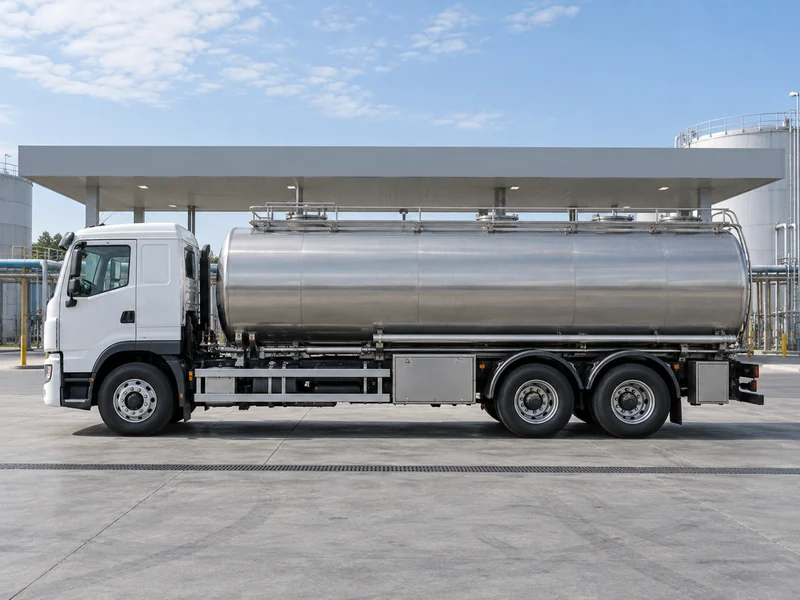
HOWO fuel tanker truck dimensions follow one consistent rule: overall width stays close to 2.5 meters across the range, while length and height grow with the axle count and tank size. A two-axle 4×2 rig, a three-axle 6×4, and a four-axle 8×4 are built on progressively longer chassis. The same 2.5 m body then rides on a longer, taller package as capacity climbs from roughly 10,000 liters to 35,000 liters or more (about 2,600 to 9,200 US gallons). This article maps the published overall dimensions and tank capacities to each axle configuration so buyers can size a truck against road limits before comparing capacity. All figures below are typical manufacturer specifications and vary by build.
HOWO Fuel Tanker Truck Dimensions at a Glance
Of the three numbers that define a fuel tanker’s footprint, only two move much. Overall length and height climb with tank volume and axle count. Width, by contrast, stays effectively fixed near 2,490–2,500 mm, since road-width limits cap it well before fuel volume does. That is why a 6×4 unit and an 8×4 unit can differ by roughly two meters in length and half a meter in height yet share almost the same width.
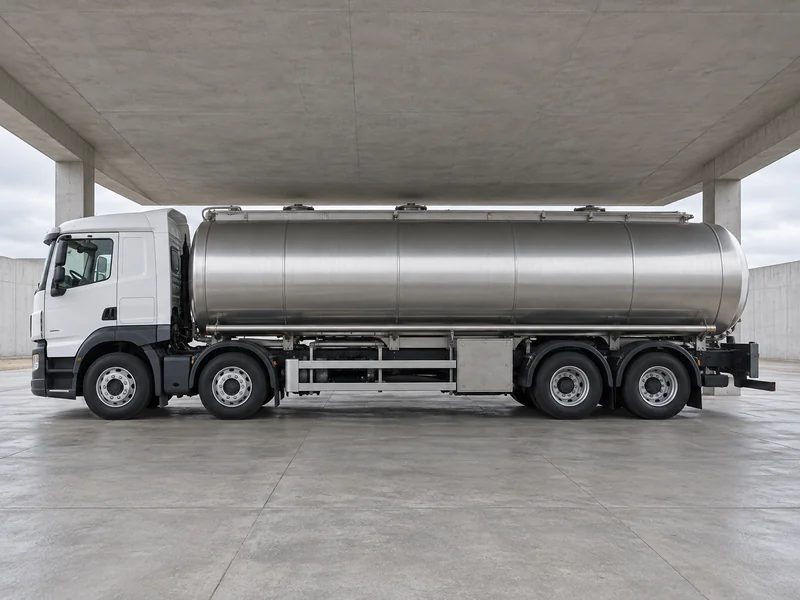
Overall dimensions describe the whole vehicle, not the tank alone, and the gap between the two matters when planning depots and turning circles. On a published 6×4 build the tank body measures about 6,500 × 2,490 × 1,650 mm inside an overall envelope near 9,840 mm long, so cab, chassis overhang, and rear frame account for the remaining length. Readers comparing the wider HOWO tank truck lineup should treat tank dimensions and vehicle dimensions as two separate specs on the datasheet.
Length and height are the constraints most likely to catch a buyer out, not width. A carbon-steel 8×4 tanker in published specs runs about 12,000 mm long and roughly 3,780 mm tall — the point where low canopies, depot doors, and bridge clearances become the deciding factor. Confirm the quoted height against every fixed structure on the route, and verify how much the loaded figure differs on the specific datasheet.
Dimensions by Axle Configuration: 4×2, 6×4 and 8×4
Axle count is the single best predictor of a HOWO fuel tanker’s size, so start there when reading a spec sheet. The table below pairs each configuration with its typical published overall dimensions and nominal tank capacity; capacities are shown in liters with an approximate US gallon conversion at 1 L ≈ 0.264 gal.
| Configuration | Axles | Typical overall L × W × H | Nominal tank capacity | Compartments |
|---|---|---|---|---|
| 4×2 | 2 | Shorter two-axle body; width ~2.5 m (exact length/height vary by build) | ~10,000–15,000 L (≈2,600–4,000 US gal) | 1–3 |
| 6×4 | 3 | ~9,800–9,950 × 2,500 × 3,150–3,350 mm | ~18,000–25,000 L (≈4,800–6,600 US gal) | 2–4 |
| 8×4 | 4 | ~12,000 × 2,490 × 3,780 mm | ~30,000–35,000 L (≈7,900–9,200 US gal) | up to 8 |
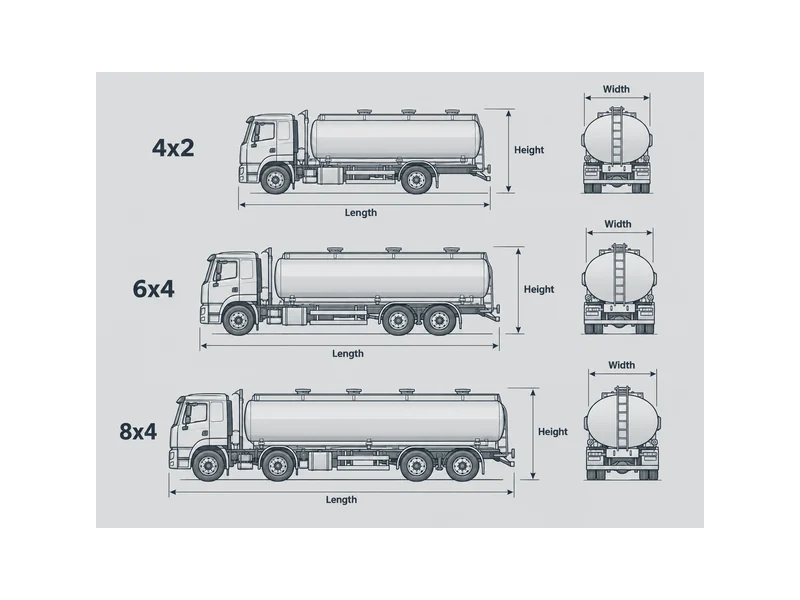
The 4×2 is the compact option for tight urban work, and its shorter two-axle wheelbase is the reason. Published builds carry roughly 10,000–15,000 liters, and while makers list capacity and engine ratings, exact overall length and height are rarely fixed and depend on the tank and cab chosen. Choose the HOWO 4X2 heavy duty tanker truck format when maneuverability at filling stations outweighs volume per trip.
The 6×4 is the volume-per-length sweet spot for regional fuel distribution. Published 6×4 tankers land around 9,800–9,950 mm long, 2,500 mm wide, and 3,150–3,350 mm tall, carrying roughly 18,000–25,000 liters depending on tank profile. A HOWO 6X4 tanker truck fits operators who need meaningful payload without stepping up to a four-axle footprint.
The 8×4 exists to move the most fuel per trip, and its extra axle and length are the trade. A published 8×4 build measures about 12,000 mm long and 3,780 mm tall for a 30,000–35,000 liter carbon-steel tank, with some listings reaching higher volumes. The HOWO 8X4 Tanker Truck suits long-distance and cross-border hauling where fewer trips offset the larger, taller vehicle.
Tank Capacity, Compartments, and Effective Volume
Buyers who plan around the headline capacity tend to over-order, because nominal volume and usable volume are not the same number. One manufacturer guide reports a lower effective volume than the nameplate for the 20,000–30,000 liter class, with vapor space and internal hardware taking up part of the difference; treat that as a single-source pointer, not a fixed deduction. Size deliveries against effective volume, and ask the maker to state it instead of inferring it from tank geometry.
Compartment count rises with tank size, which lets one truck carry multiple grades safely. Published HOWO tankers run from 2 compartments on smaller 6×4 bodies to as many as 8 on large multi-grade units, and multi-compartment builds typically give each compartment its own valve so diesel and gasoline can travel separately. Adding compartments means adding internal bulkheads and hardware, which is one reason two tanks of equal nominal volume can carry different curb weights.
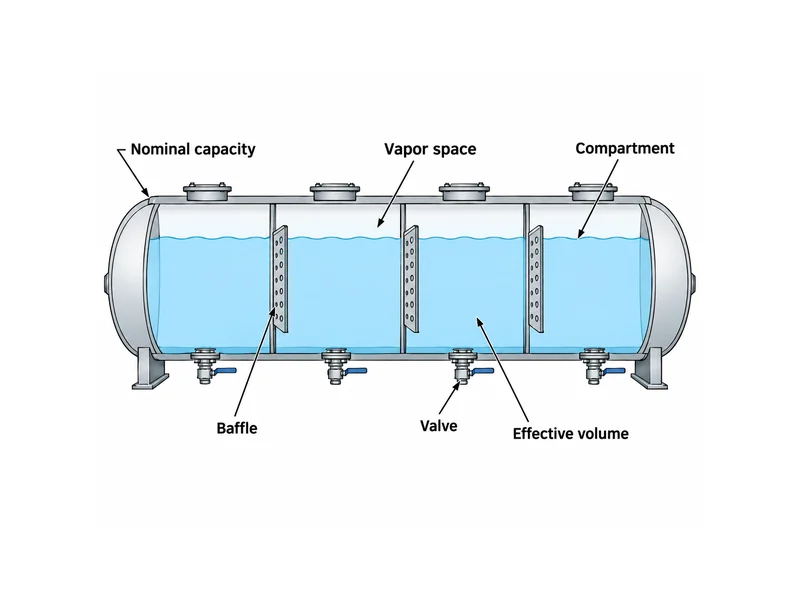
Capacity converts cleanly to US gallons, and getting the conversion right avoids ordering the wrong size. Multiply liters by about 0.264 to reach US gallons: a 20,000 liter tank is roughly 5,280 gallons, 25,000 liters is about 6,600 gallons, and a 35,000 liter 8×4 is near 9,250 gallons.
The cargo tank is not the chassis fuel tank, and mixing up the two is a common ordering mistake. The tanker body that holds 10,000–35,000 liters of product is entirely separate from the truck’s own diesel tank that feeds the engine, which holds a few hundred liters at most. When a spec sheet lists a small tank figure alongside a large one, the small number is the chassis running tank and the large number is the cargo you can deliver.
How Tank Material and Baffles Affect Size and Curb Weight
Tank material sets the weight budget, which shapes how much product a given chassis can carry within its rated gross weight. Published HOWO tankers use carbon steel — about 5 mm wall thickness on at least one published 8×4 build — or, on lighter designs, aluminum alloy, which trims curb weight and resists corrosion at a higher price. Payload is what remains after you subtract curb weight from the gross-weight rating. Every kilogram of tank is therefore a kilogram less of cargo, which makes material choice largely a payload decision.
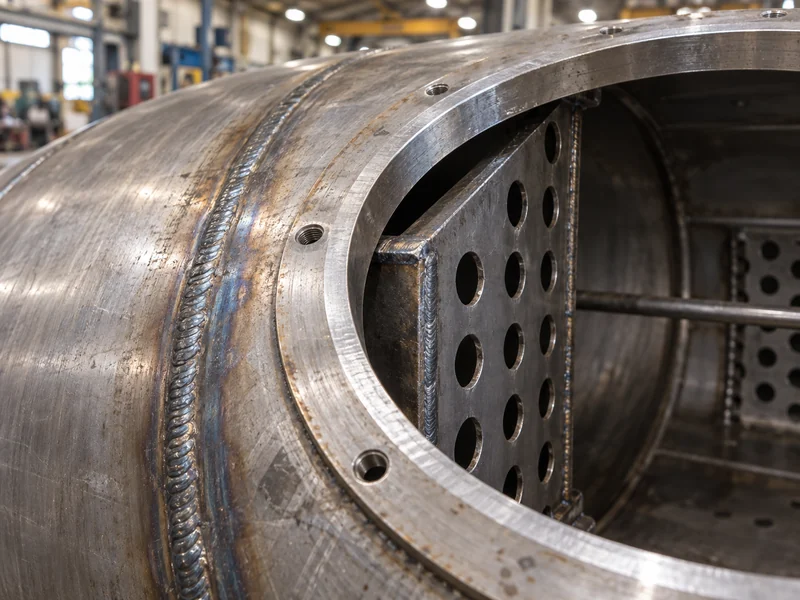
Internal baffles change the strength and behavior of the tank without changing its outside dimensions much. Anti-wave (anti-slosh) plates are welded inside the compartments to cut the surge of moving liquid and stiffen the shell. The variable to verify is compartment layout against your typical part-loads, because a partly filled compartment lets liquid move more freely. Baffle spacing and compartment sizing affect stability more than the raw length figure suggests.
Curb and gross weights, where a maker publishes them, tell you the real payload headroom. On published 6×4 tankers curb weight runs roughly 11.2–12.2 tonnes with gross vehicle weight around 26–29.5 tonnes, leaving the difference for fuel and hardware. Treat these as per-build figures and confirm them on the actual datasheet, because tank material, compartment count, and cab spec all move the curb weight.
Reading Dimensions Against Legal Weight and Your Route
Dimensions only matter in relation to the route and the law. Work through the constraints in order instead of starting from capacity: fix the hard limits first — the lowest clearance and narrowest access on your regular routes, then the axle and gross-weight limits your jurisdiction enforces. A tank that fits your yard but exceeds a bridge weight limit or a canopy height on the delivery route is the wrong tank regardless of how attractive its volume looks.
Axle configuration comes next, since it sets both footprint and rated load capacity together. Step up from 4×2 to 6×4 to 8×4 only when the added payload justifies the longer, taller vehicle and the wider turning circle. The extra axle raises rated load capacity, though the legal figure depends on your local axle-weight rules. Operators weighing this trade can work through the variables when choosing a HOWO tank truck model around route and payload, keeping headline capacity secondary.
Capacity and compartments are the last variables to lock, once size and weight are settled. Match effective volume to your delivery drop sizes, and set compartment count to the number of grades you actually carry, since spare compartments add bulkhead weight without adding useful payload. This ordering keeps a purchase anchored to what the route and the law allow instead of to the largest number on the brochure.
Conclusion
Sizing a HOWO fuel tanker works best as an elimination sequence, not a capacity contest. Start by excluding any configuration that breaks a route clearance or a gross-weight limit, then let axle count follow from the payload you need within local weight rules, and only then settle nominal capacity, effective volume, and compartment count. Width will stay near 2.5 meters whichever way you go, so length, height, and weight are the constraints that actually decide the choice. Read effective volume before the nameplate, confirm curb and gross weights on the specific datasheet, and the dimensions on the spec sheet will line up with what your routes and depots can actually accept.
FAQ
What are the overall dimensions of a HOWO 6×4 fuel tanker truck?
A published HOWO 6×4 fuel tanker is typically around 9,800–9,950 mm long, 2,500 mm wide, and 3,150–3,350 mm tall, carrying roughly 18,000–25,000 liters. Exact figures vary by tank profile and cab, so confirm length and height on the specific datasheet, especially against low clearances.
How many liters and gallons can a HOWO 8×4 fuel tanker carry?
An 8×4 HOWO fuel tanker typically carries about 30,000–35,000 liters in published builds, which is roughly 7,900–9,250 US gallons at 1 liter ≈ 0.264 gallon. Some listings go higher, and one manufacturer guide notes that the usable effective volume runs below the nominal figure, so confirm it with the maker, not the nameplate.
How many compartments does a HOWO fuel tanker have, and why?
HOWO fuel tankers commonly have between 2 and 8 compartments, with count rising alongside tank size. Multi-compartment builds typically fit each compartment with its own valve, letting one truck carry different grades such as diesel and gasoline separately, which is why larger tanks are subdivided instead of left as a single vessel.
Is the tanker capacity the same as the truck’s own diesel fuel tank?
No — the cargo tank and the chassis diesel tank are entirely separate. The tanker body holding 10,000–35,000 liters is the product you deliver, while the truck’s own running tank that feeds the engine holds only a few hundred liters, so never read the small chassis-tank figure as delivery capacity.
Which HOWO fuel tanker size fits regional versus long-haul delivery?
A 6×4 in the 18,000–25,000 liter range is commonly positioned for regional distribution, while an 8×4 at 30,000–35,000 liters is aimed at long-haul work where fewer trips offset the larger vehicle. Match the choice to route clearances and legal weight first, then to your delivery drop sizes.
Further Reading
- Questions and Answers About Vehicle Size and Weight — U.S. Federal Highway Administration. Sets out the federal 102-inch (2.6 m) width limit, the 80,000-pound gross-weight standard and the Bridge Formula, which is why a tanker body stays near 2.5 m wide and why route weight limits should gate the axle choice.
- 49 CFR 178.345-1: general design requirements for DOT 406 cargo tanks — U.S. DOT specification (Cornell LII). Defines baffles and bulkheads (compartments) and ASME-based construction for highway flammable-liquid cargo tanks, backing the compartment-count and anti-slosh baffle points; it governs the tank spec, not exact vehicle dimensions.
- 49 CFR 393.67: liquid fuel tanks — FMCSA regulation (Cornell LII). Covers the truck’s own chassis fuel tank that feeds the engine, reinforcing that the small running-tank figure is separate from the tanker’s cargo capacity.