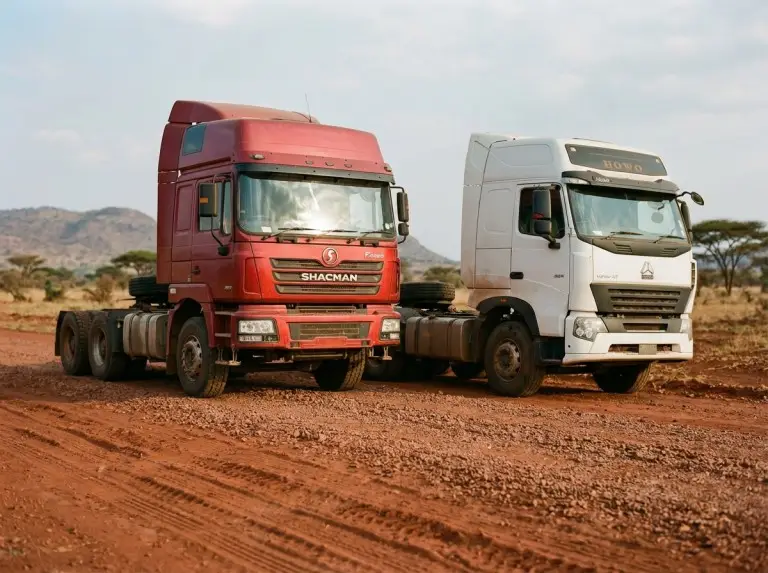
Choosing between the Shacman F3000 and the HOWO A7 comes down to three things: route type, maintenance environment, and upfront cost vs long-term running cost. Both are proven export tractor trucks for Africa, the Middle East, and Southeast Asia. The right choice depends on where you operate and what failing first costs you most.
The comparison below covers common export configurations of the F3000 6×4 and HOWO A7 6×4 tractor variants. Exact specs vary by chassis code, engine code, model year, and destination market. Confirm the specific configuration with your supplier before making a purchase decision.
Table of Contents
What Each Truck Is Built For
The F3000 and HOWO A7 target the same markets but come from different engineering backgrounds. SHACMAN publicly describes the F3000 as built with technology derived from MAN, launched in 2009. SINOTRUK’s materials describe the HOWO series as in-house developed. The A7 is Sinotruk’s higher-end tractor within that lineup.
The F3000 is built for reliability under load in harsh conditions. Its frame, axles, and suspension handle rough roads and heavy payloads. The HOWO A7 is a higher-comfort highway tractor. It suits fleet operators on long-haul paved routes who want a refined cab alongside strong power.
The Assumption That Gets Buyers into Trouble
Most buyers compare horsepower and price — and miss the variable that drives the most cost over three to five years: parts availability at their specific location. We see this often in inquiries from operators in West Africa and Central Asia. They chose the HOWO A7 for its power. Then they found authorized service scarce in their region. Routine maintenance became a sourcing problem.
The F3000 has a broader parts network in some markets — especially across Africa — because of Shacman’s longer export history there. The HOWO A7 has stronger dealer presence where Sinotruk invested earlier, such as East Africa and the Middle East. Before choosing on spec, confirm which truck has local service and spare parts in your country. Check directly with the local authorized dealer. Published network lists go out of date fast.
Engine and Powertrain
The F3000 is available with Weichai or Cummins engines. Common export configs run 340 to 430 hp. The Cummins option matters in markets where operators already run Cummins equipment. Local mechanics know the engine, parts move through Cummins’ own network, and service intervals are predictable. The F3000 pairs these engines with FAST transmissions, which are well understood across most export markets.
The HOWO A7 runs Sinotruk’s own WD615 or D12 engine. Common export configs cover 336 to 420 hp. The engines are proven in long-haul use. The A7 uses ZF hydraulic power steering — a quality part, but harder to source in markets where ZF stock is thin. Engine and cab parts both depend on Sinotruk’s supply chain being strong in your market.
In Cummins-infrastructure markets, the F3000 has a clear serviceability edge. In markets where Sinotruk has a strong dealer network, the A7’s in-house ecosystem works just as well.
Cab Comfort and Driver Experience
The HOWO A7 leads on cab comfort for highway use. Its sleeper berth, sound insulation, and dashboard reduce driver fatigue on long paved runs. The cab also has hydraulic tilting and an ergonomic seat setup built for long shifts.
The F3000 cab is built for durability over refinement. Its four-point air suspension, dust sealing, and reinforced structure hold up better on mining sites and unpaved roads. The A7’s higher-finish interior shows wear faster in those conditions. High-roof air-conditioned cab options are available on the F3000 for operators who need driver comfort without giving up field durability.
For paved long-haul routes, the A7 cab wins. For rough terrain, mining sites, or dusty environments, the F3000 sealing and structure last longer.
Fuel Efficiency
Fuel economy depends on engine code, rear axle ratio, load weight, average speed, and road grade — not brand. No fuel figure means anything without those conditions.
That said, patterns emerge. The A7’s aerodynamic cab helps on flat, steady-speed highway runs. The F3000’s drivetrain tuning holds fuel efficiency more steadily on mixed routes with grades and shifting loads. If fuel economy is a key factor, ask for the engine code and rear axle ratio on the specific config you are being quoted. Then compare against your route before deciding.
Emission Standards by Configuration
Emission standard availability depends on the specific engine code and model year — not the truck name alone.
| Truck | Common export emission range | Notes |
|---|---|---|
| Shacman F3000 | Euro II – Euro V | Weichai and Cummins variants; higher standards need specific engine codes |
| HOWO A7 | Euro II – Euro IV (most listings) | Euro V exists for select markets; confirm by chassis code |
Do not assume the default export config meets your country’s import rules. Write the required emission standard as a line item in the purchase agreement before production starts.
Price Range
Both trucks sit in a similar price band for equivalent 6×4 export configs. Final cost depends on engine choice, emission standard, order volume, origin port, destination, and Incoterms. The F3000 may cost less in markets where Cummins parts and independent supply lower total ownership cost. The HOWO A7 may carry a premium where Sinotruk’s brand supports resale value.
Price comparisons only work when the chassis code and engine code match. Get a spec-confirmed quote from your supplier with both written in before drawing any cost conclusion.
Side-by-Side Decision Summary
| Dimension | Shacman F3000 | HOWO A7 |
|---|---|---|
| Engine options | Weichai or Cummins (340–430 hp) | Sinotruk WD615/D12 (336–420 hp) |
| Transmission | FAST (widely serviceable) | HW series (Sinotruk supply chain) |
| Cab comfort | Durable, strong dust sealing | Better highway comfort, wider sleeper |
| Fuel efficiency | More stable on mixed/graded routes | Stronger on flat long-haul |
| Emission range | Euro II–V (config-dependent) | Euro II–IV common; Euro V select |
| Parts network | Broader in Sub-Saharan Africa, Russia | Stronger in East Africa, Middle East |
| Customization | High — Cummins engine available | Moderate — within Sinotruk ecosystem |
| Best fit | Rough terrain, Cummins markets | Paved long-haul, Sinotruk dealer markets |
For a full breakdown of Shacman tractor specs by model, see our specification guide.
Conclusion
At HOWO Special Truck Ltd, we work with buyers across Africa, the Middle East, and Southeast Asia choosing between these two trucks. When buyers share their route type, maintenance setup, parts access, and required emission standard upfront, the right fit is clear faster. When buyers choose on horsepower alone without checking local service coverage, the result is avoidable downtime — fixed only after sourcing parts from outside the country at real cost and delay.
Share your details with us: route profile, GVW requirement, destination country, emission standard, and chassis code preference if known. We will confirm which F3000 config fits your operation, the current lead time, and the customs document checklist for your destination.
FAQ
Is the Shacman F3000 or HOWO A7 better for rough terrain?
The F3000 is the stronger choice for unpaved and harsh-terrain work. Its chassis, axle reinforcement, and cab dust sealing are built for mining sites and off-road use. The A7 is optimized for highway operations and wears faster in rough-terrain conditions.
Which truck has better fuel economy?
Neither — it depends on config and route, not brand. The A7’s aerodynamic cab helps on flat, steady-speed highway runs. The F3000 holds efficiency better on mixed routes with grades and variable loads. Compare the engine code, rear axle ratio, and load profile of the exact config before using fuel economy as a deciding factor.
Can the Shacman F3000 be fitted with a Cummins engine?
Yes. The F3000 supports Cummins. The HOWO A7 does not. This matters in markets with existing Cummins infrastructure. It keeps parts in a familiar supply chain, cuts sourcing complexity, and lowers long-term maintenance cost.
Which truck has stronger after-sales support in Africa?
It depends on your country, not Africa as a whole. The F3000 has a wider independent parts network across West and Sub-Saharan Africa. The HOWO A7 has stronger authorized dealer coverage in parts of East Africa. Confirm local parts stock and nearest service center with your supplier — network coverage changes and no list stays current.
What emission standards are available for both trucks?
F3000: Euro II–V across configs. HOWO A7: Euro II–IV in most listings, Euro V for select markets. Availability depends on the engine code and model year. Write the required emission standard into the purchase agreement. Do not assume the default export spec meets your destination country’s current import rules.
What is the price difference between the F3000 and HOWO A7?
Both sit in a similar band for equivalent 6×4 export configs. Final cost depends on engine choice, emission standard, order size, port, and Incoterms. Price comparisons only work when chassis code and engine code match. Get a spec-confirmed quote with both written in before drawing any cost conclusion.