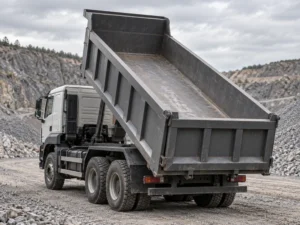
Checking the tire condition of a HOWO tractor truck takes four repeatable steps before dispatch: measure tread depth by axle position, verify cold inflation pressure against the load, inspect the tread and sidewalls for damage, and read the wear pattern. Steer tires and drive or trailer tires are held to different tread limits, so one blanket “legal minimum” does not cover a heavy tractor. This guide gives an owner-operator or fleet technician a routine that runs in a few minutes and shows whether a tire is safe to run, needs watching, or must come off.
Because tires carry the load and transmit braking and steering, their condition belongs with the truck’s safety features, not below them. Regular tire inspections catch the slow leaks, uneven wear, and sidewall damage that become blowouts or roadside violations when they run unchecked.
HOWO Tractors and Why Tire Condition Is Load-Critical
HOWO tractors are heavy-duty units built to move containers, machinery, and other large cargo over long distances. That duty cycle puts sustained load and heat through every tire. It is also why tire condition matters more here than on a light vehicle: the same wear or underinflation a car tolerates can overload a tractor casing.
The towing capacity and fuel efficiency that make HOWO tractors productive both depend on correctly inflated, evenly worn tires. Underinflation and misalignment quietly raise rolling resistance and burn fuel long before they cause a visible failure. Tire checks protect operating cost as much as safety.
Why Tire Condition Checks Matter on HOWO Tractors
Skipping tire checks trades a few minutes now against a blowout, a longer stopping distance, or a truck placed out of service at a roadside inspection. Worn or damaged tires lose grip and stability first, and the failure that follows is rarely convenient.

Steer tires deserve the closest attention. They control direction and carry a large share of braking effort. A worn, underinflated, or damaged steer tire degrades handling and braking together, which is why the brake system on HOWO tractor trucks and the tires are best inspected in the same walk-around.
Catching problems early is cheaper than the alternative. Uneven wear, low tread, and small punctures cost little to correct when found during a routine check. Left in service, the same faults lead to premature replacement, downtime, or an accident.
Checking Tread Depth (Steer vs Drive and Trailer)
Tread depth limits differ by axle on a commercial tractor, so measure each position against its own standard. Under FMCSA rule 49 CFR 393.75, steer (front) tires must keep at least 4/32 inch of tread, and drive and trailer tires at least 2/32 inch. Take the measurement in a major tread groove, away from tie bars, humps, or fillets.
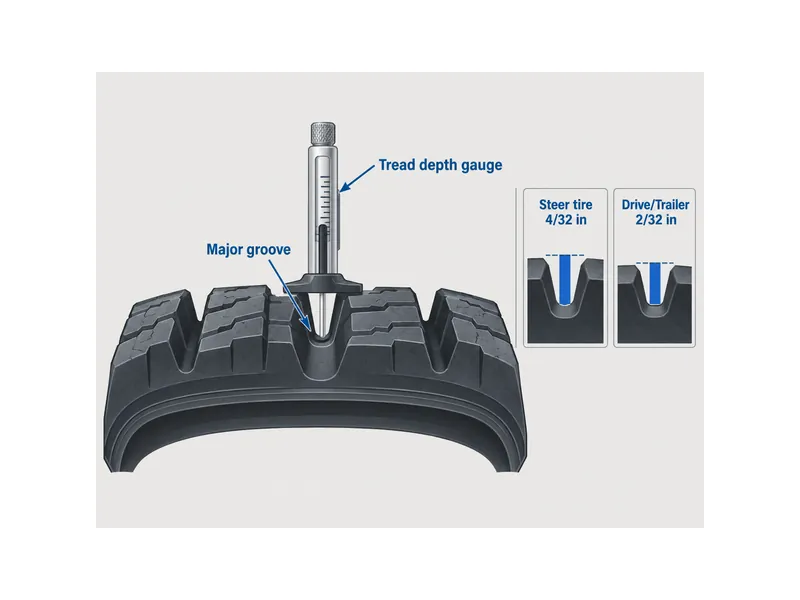
Use a tread depth gauge for an exact reading, and treat a coin as a quick field check only. Push the gauge probe into the lowest point of a major groove and read the value in 32nds of an inch. With a penny, set Lincoln’s head down in the groove; if you can see the top of his head, tread is at or below 2/32 inch. A quarter works the same way for the steer limit: seeing the top of Washington’s head means tread is at or near 4/32 inch.
Plan replacement before you reach the legal floor. New truck tires generally start around 10/32 to 11/32 inch, and traction on wet or worn roads drops well before the 2/32 inch limit. Many operators pull tires early for safety instead of running them to the minimum. Measure across the inner, center, and outer ribs of each tire, because a gap between those readings points to an inflation or alignment problem, not wear alone.
Checking Tire Pressure the Right Way
Check tire pressure when the tires are cold, and set it to the vehicle’s specified value for the load, not to the maximum stamped on the sidewall. FMCSA rules set two limits. A tire may not run below the cold inflation pressure specified for its load, and it must never carry more than the load marked on its sidewall. NHTSA guidance is to check pressure at least monthly and before long trips, with the tires cold. Driving heats the air and raises the reading.

Correct pressure is not one number across the truck. Cold targets differ by axle position and by how the truck is loaded. Read the recommended values from the vehicle or tire placard and the load and inflation table. Do not apply a single figure to steer, drive, and trailer tires. Steer positions generally call for a higher target than drive or trailer positions, but the exact value depends on axle load and the specific tire.
On dual assemblies, check both tires and keep them close in pressure. A meaningful gap between paired duals makes one tire carry more load and wear faster. The inner dual is also where slow leaks hide, so use a dual gauge or inspection tool to reach it. If pressure is low, add air to the specified level. If a cold tire reads high, bleed it down; never release pressure from a hot tire.
Inspecting for Damage and Uneven Wear
Look over the full tread and both sidewalls of every tire, because some conditions take a tire out of service regardless of tread depth. Under 49 CFR 393.75, a tire may not run with ply or belt material exposed through the tread or sidewall, with any tread or sidewall separation, when it is flat or has an audible leak, or with a cut deep enough to expose the ply or belt.
A sidewall bulge or blister is a warning sign of internal damage, not a value you read off a gauge. Do not keep judging it by eye: have a qualified tire technician assess whether the casing is compromised, since a bulge can precede a separation the regulation does treat as a defect.
Read the wear pattern, because it points to a cause you can fix. Wear in the center points to overinflation, and wear on both shoulders points to underinflation. Wear heavier on one side usually points to alignment or a worn suspension part. Feathered edges across the ribs point to a toe setting that needs attention.
When you find damage, have a qualified tire technician decide whether the tire can be safely repaired or must be replaced. Punctures in the tread area are sometimes repairable; sidewall damage and separations are not, and guessing wrong on a loaded tractor is not worth the risk.
Rotation and Balancing on HOWO Tractors
Rotation and balancing even out wear and remove the vibration that shortens tire life, so treat them as scheduled maintenance, not a reaction after a tire goes bad. Drive and steer positions wear at different rates because of their different jobs, and moving tires between positions spreads that wear across the set.

Follow the rotation interval in your HOWO maintenance schedule, and let the wear pattern override the calendar. If one position wears noticeably faster, rotate sooner and check alignment before the next planned service. Balancing corrects uneven weight on the wheel and is best done with shop equipment whenever a tire is remounted or a vibration appears at speed.
Rotation on a loaded tractor is not a generic driveway job. Lift ratings, the manufacturer’s jacking points, the correct rotation pattern, and lug-nut torque all vary by model and wheel. Follow the applicable HOWO maintenance material, the tire maker’s rotation pattern, and a qualified commercial tire shop’s procedure. Correct lug-nut torque matters as much as the rotation itself, because over- or under-torqued nuts create their own failures.
When to Replace a HOWO Tractor Tire
Replace a tire when it reaches a wear limit or shows a condition that makes it unsafe to run. A steer tire at 4/32 inch, a drive or trailer tire at 2/32 inch, exposed cord, a separation, a flat or audible leak, or a cut deep enough to reach the ply all mean the tire comes off. A sidewall bulge or an unrepairable cut belongs in the same list once a technician confirms it. A tire that keeps losing pressure is a repair-or-replace decision, not a top-up: reinflate to the specified value for the load, then find and fix the cause.
Build these checks into a rhythm. Run a quick tread, pressure, and visual walk-around before each trip, and a more thorough inspection on a set schedule; that catches most faults while they are still cheap to fix. The HOWO tractor tire maintenance FAQs cover the routine questions that come up between services. For repairs, alignment work, and replacement calls beyond a visual check, a qualified commercial tire technician is the right resource.
Conclusion
The tire condition of a HOWO tractor truck is judged by axle, not by one number. Steer tires answer to the 4/32 inch limit, drive and trailer tires to 2/32 inch, and pressure is set cold to the load. Exposed cord, a separation, a flat, or a deep cut means an immediate stop, and a sidewall bulge goes to a technician before the tire runs again. The point most often missed is the steer axle, which carries a higher tread limit because it steers and brakes. Keep a pre-trip tread, pressure, and damage check as your baseline, let the wear pattern flag alignment or inflation problems, and bring anything past a visual judgment to a technician before the tire fails on the road.
FAQ
What is the minimum tread depth for HOWO tractor truck tires?
Steer tires must keep at least 4/32 inch of tread, and drive or trailer tires at least 2/32 inch, measured in a major groove, under FMCSA rule 49 CFR 393.75. Because traction falls off before the legal floor, many operators replace tires early instead of running them down to the minimum.
How do I check truck tire tread with a coin?
A coin gives a quick pass-fail, not an exact reading. Place a penny with Lincoln’s head down in the lowest groove; if you can see the top of his head, the tread is at or below 2/32 inch. Use a quarter the same way to check the 4/32 inch steer limit, and use a tread depth gauge when you need the precise value.
What tire conditions can put a truck out of service?
Under 49 CFR 393.75, a tire must come off when it has ply or belt material exposed, a tread or sidewall separation, a flat or audible leak, or a cut deep enough to reach the ply. Tread below the axle limit does the same. A sidewall bulge should be judged by a technician, and a tire that runs well under its specified pressure should be repaired, not simply topped up.
How often should I inspect my HOWO tractor tires?
Run a quick tread, pressure, and visual check before each trip and a more thorough inspection on a set maintenance schedule. Check pressure with the tires cold, since heat from driving raises the reading and can hide a low tire.
Further Reading
- FMCSA regulation 49 CFR 393.75 – Tires — U.S. federal rule (T1). Defines the 4/32 inch steer and 2/32 inch drive/trailer tread minimums, the measurement method, and the tire conditions prohibited in service.
- NHTSA – Tire Pressure Maintenance: A Statistical Investigation (DOT HS 811 086) — U.S. government research (T1). Supports why cold-pressure checks and correct inflation matter for safety and fuel economy.